Tag Archives: ituc

Journée internationale de commémoration des travailleuses et des travailleurs morts ou blessés au travail 2024 : agir contre les risques liés au climat sur le lieu de travail

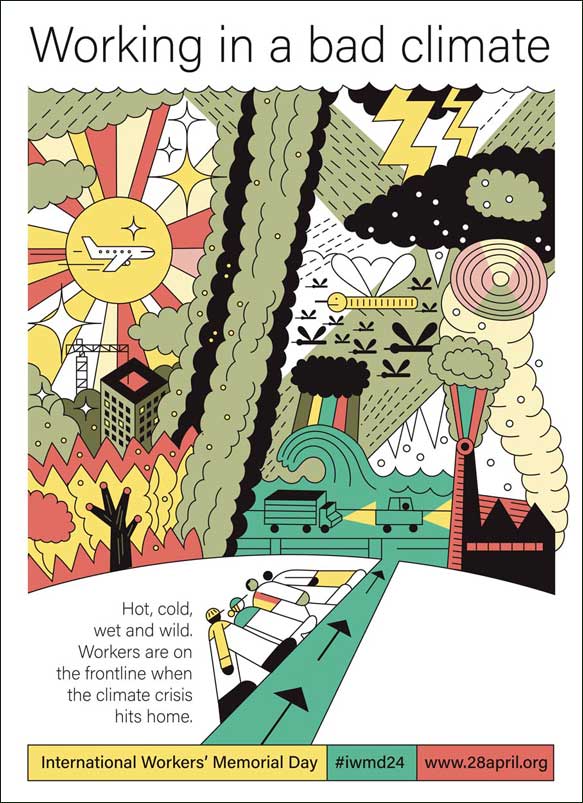
Le 28 avril 2024, à l’occasion de la Journée internationale de commémoration des travailleuses et des travailleurs morts ou blessés au travail, les syndicats réclament des actions urgentes pour lutter contre les «risques climatiques pour les travailleurs», c’est-à-dire les dangers croissants que la crise climatique fait peser sur la main-d’œuvre partout dans le monde.

Il est nécessaire et urgent d’intégrer la préparation aux situations d’urgence aux politiques de sécurité sur le lieu de travail, en consultant démocratiquement les organisations syndicales.

Dans sa déclaration du 2 décembre 2023, l’Organisation mondiale de la santé (OMS) souligne une augmentation très inquiétante des catastrophes liées au climat, pointant du doigt les graves conséquences pour la santé des travailleurs et la sécurité de l’emploi.

Les travailleurs des secteurs de l’agriculture, de la construction, de la distribution du courrier et d’autres encore ont été particulièrement touchés, et on constate dans ces secteurs une hausse marquée du nombre de maladies et de décès liés à la chaleur. La chaleur n’est pas la seule menace; les tempêtes, les ouragans, les inondations, les blizzards, les éclairs, les tornades, les feux de forêt et les vents violents sont autant de dangers croissants pour les lieux de travail.

Pour Luc Triangle, secrétaire général de la CSI, «la crise climatique n’est plus une menace lointaine, c’est un danger actuel pour les travailleurs et les travailleuses du monde entier. Il est impératif que nous exigions des politiques fermes et des pratiques solides pour protéger notre main-d’œuvre des effets dangereux du changement climatique. Notre appel à l’action est clair: nous devons intégrer l’évaluation des risques climatiques et la préparation aux situations d’urgence à nos normes de sécurité et de santé au travail».

Partout dans le monde, des syndicats ont déjà obtenu des protections contre les risques liés au climat sur le lieu de travail:

  •  À Phoenix, aux États-Unis d’Amérique, grâce à une campagne menée par les syndicats Unite Here et SEIU, une nouvelle loi a été adoptée obligeant les entrepreneurs à fournir des protections contre la chaleur aux personnes qui travaillent en plein air.
  •  En Espagne, les pompiers ont fait reconnaître les fumées cancérigènes des incendies de forêt comme un risque pour la santé au travail et ont ainsi obtenu le droit d’en être protégés.
  •  En République démocratique du Congo, plusieurs syndicats se sont unis pour formuler une série de revendications pour les travailleurs de l’industrie stratégique de l’exploitation minière, qui travaillent dans des conditions dangereuses à l’intérieur et à l’extérieur.
  •  En Australie, le syndicat CFMEU s’attèle activement à obtenir des modifications de la législation et de la réglementation pour protéger les travailleurs exposés au stress thermique.
  •  Au Brésil, l’organisation SITICOP tente d’étendre des protections aux travailleurs touchés par des catastrophes environnementales.

Et Luc Triangle de conclure: «Le travail de ces syndicats, et de bien d’autres, est une source d’inspiration. Les gouvernements, les employeurs et les organismes de réglementation doivent agir immédiatement pour faire face à la menace actuelle et croissante que représente le changement climatique pour la sécurité et la santé des travailleurs.

De telles actions incluent de consulter les syndicats, de mettre en place une formation complète sur la sécurité et d’appliquer des normes de sécurité rigoureuses pour atténuer les risques associés aux conditions climatiques extrêmes. La démocratie doit être au cœur de cette démarche, car faire preuve de démocratie sur le lieu de travail suppose que le personnel est écouté et peut jouer un rôle pour sa propre sécurité. Comme l’affirme la CSI dans sa campagne Pour la démocratie, de vraies démocraties prennent soin de leurs travailleurs et travailleuses, et cela inclut de veiller à les protéger contre le climat».

La CSI a publié une note d’information détaillée sur les effets de la crise climatique sur la sécurité et la santé, disponible ici. En outre, vous trouverez ici du matériel pour les médias sociaux.

https://www.ituc-csi.org/iwmd24_fr

RESOURCES

ITUC 28 April videos
English https://28april.org/?p=6653
Spanish https://28april.org/?p=6651
French https://28april.org/?p=6649
German https://28april.org/?p=6646

ITUC 28 April graphics

English https://28april.org/?p=6627
Spanish https://28april.org/?p=6587
French https://28april.org/?p=6608

Other resources
https://28april.org/?p=6525

Día Internacional en Memoria de los Trabajadores Fallecidos y Heridos 2024: Acción frente a los riesgos laborales relacionados con el clima

Este 28 de abril, Día Internacional en Memoria de los Trabajadores Fallecidos y Heridos, los sindicatos exigen medidas urgentes para hacer frente a los “riesgos climáticos para los trabajadores”, es decir, los peligros cada vez mayores que la crisis climática supone para los trabajadores y las trabajadoras de todo el planeta.

Es sumamente urgente integrar en las políticas de seguridad laboral medidas de preparación ante situaciones de emergencia, y hay que hacerlo manteniendo consultas democráticas con los sindicatos.

La Declaración de diciembre de 2023 de la Organización Mundial de la Salud pone de relieve el alarmante aumento de catástrofes relacionadas con el clima, subrayando las graves implicaciones para la salud y la seguridad laboral de los trabajadores y las trabajadoras.

Los trabajadores de la agricultura, la construcción, los servicios postales y otros sectores, se han visto especialmente afectados, registrándose un notable aumento de las enfermedades y muertes relacionadas con el calor. La amenaza no se deriva únicamente del calor: tormentas, huracanes, inundaciones, ventiscas, rayos, tornados, incendios forestales y fuertes vientos constituyen un peligro cada vez mayor en el ámbito laboral.

El secretario general de la CSI, Luc Triangle, ha declarado: “La crisis climática ya no es una amenaza lejana, es un peligro presente para los trabajadores y las trabajadoras de todo el mundo. Es imperativo que exijamos unas políticas y prácticas sólidas para proteger a nuestros trabajadores y trabajadoras de las peligrosas repercusiones del cambio climático. Nuestro llamamiento a la acción es claro: debemos integrar en nuestras normas de salud y seguridad en el trabajo las evaluaciones de los riesgos climáticos y medidas de preparación ante situaciones de emergencia”.

Sindicatos de todo el mundo están consiguiendo ya medidas de protección frente a los riesgos laborales relacionados con el clima:

  •  En Phoenix (EE.UU.), gracias a una campaña de los sindicatos Unite Here y SEIU, se ha aprobado una nueva ley que obliga a los contratistas a proporcionar medidas de protección contra el calor para los trabajadores que trabajan al aire libre.
  •  En España los bomberos han conseguido que se reconozca que el humo cancerígeno de los incendios forestales constituye un riesgo para la salud laboral y que tienen derecho a protegerse de él.
  •  En la República Democrática del Congo, varios sindicatos se han unido para establecer una serie de reivindicaciones para los trabajadores de la industria de extracción de minerales que se encuentran expuestos a unas condiciones de trabajo peligrosas tanto en el interior como en el exterior.
  •  En Australia, el sindicato CFMEU está consiguiendo cambios en la legislación y la normativa para proteger a los trabajadores expuestos al estrés térmico.
  •  En Brasil, SITICOP está trabajando para ampliar las medidas de protección a los trabajadores afectados por catástrofes medioambientales.

Luc Triangle concluye: “El trabajo de estos sindicatos, y de muchos otros, es realmente ejemplar. Necesitamos acciones inmediatas por parte de gobiernos, empleadores y organismos reguladores para hacer frente a la creciente amenaza actual que el cambio climático supone para la salud y la seguridad de los trabajadores y las trabajadoras.

“Esto incluye mantener consultas con los sindicatos, impartir una formación exhaustiva en materia de seguridad y aplicar normas de seguridad estrictas para mitigar los riesgos asociados a las condiciones meteorológicas extremas. El núcleo de todo ello es la democracia, porque la democracia en el lugar de trabajo significa que se tiene en cuenta la opinión de los trabajadores y que estos pueden desempeñar un papel en lo que respecta a su propia seguridad. Como dice la campaña de la CSI Por la Democracia, las verdaderas democracias benefician a los trabajadores y las trabajadoras, y eso incluye proporcionarles medidas de protección contra el cambio climático”.

La CSI ha elaborado un informe detallado sobre las repercusiones de la crisis climática en el ámbito de la salud y la seguridad, que puede consultarse aquí. Y aquí encontrarán material para las redes sociales.

https://www.ituc-csi.org/iwmd24_es

RESOURCES

ITUC 28 April videos
English https://28april.org/?p=6653
Spanish https://28april.org/?p=6651
French https://28april.org/?p=6649
German https://28april.org/?p=6646

ITUC 28 April graphics

English https://28april.org/?p=6627
Spanish https://28april.org/?p=6587
French https://28april.org/?p=6608

Other resources
https://28april.org/?p=6525

Internationaler Gedenktag für die Opfer von Arbeitsunfällen 2024: Bekämpfung von klimabedingten Gefahren am Arbeitsplatz

Anlässlich des diesjährigen Internationalen Gedenktages für die Opfer von Arbeitsunfällen am 28. April fordern die Gewerkschaften dringende Maßnahmen, um die ‘Klimarisiken für Beschäftigte‘ anzugehen: die immer größer werdenden Gefahren aufgrund der Klimakrise für Beschäftigte weltweit.

Es ist dringend notwendig, dass die Vorbereitung auf Notfälle in demokratischer Absprache mit den Gewerkschaften in den Arbeitsschutz integriert wird.

Die Weltgesundheitsorganisation hat in ihrer Erklärung vom Dezember 2023 vor einer alarmierenden Zunahme klimabedingter Katastrophen gewarnt und auf die gravierenden Folgen für die Gesundheit und die Arbeitsplatzsicherheit von Arbeitnehmerinnen und Arbeitnehmern hingewiesen.

Besonders betroffen sind Beschäftigte in der Landwirtschaft, der Baubranche, der Postzustellung und anderen Sektoren, in denen ein deutlicher Anstieg hitzebedingter Erkrankungen und Todesfälle zu beobachten ist. Dabei geht die Gefahr nicht nur von großer Hitze aus. Unwetter, Hurrikans, Überschwemmungen, Schneestürme, Blitze, Tornados, Waldbrände und starke Winde gefährden zunehmend Menschen am Arbeitsplatz.

„Die Klimakrise ist längst keine ferne Bedrohung mehr, sondern eine reale Gefahr für Arbeitnehmerinnen und Arbeitnehmer auf der ganzen Welt. Wir müssen dringend wirksame Maßnahmen und Praktiken einfordern, um unsere Beschäftigten vor den gefährlichen Auswirkungen des Klimawandels zu schützen. Unser Aufruf zum Handeln ist klar: Wir müssen Klimarisikobewertungen und Katastrophenschutz in unsere Arbeitsschutzstandards integrieren“, erklärt IGB-Generalsekretär Luc Triangle.

Bereits jetzt setzen Gewerkschaften auf der ganzen Welt erfolgreich Maßnahmen zum Schutz vor klimabedingten Gefahren am Arbeitsplatz durch:

  •  In Phoenix, USA, konnte mit einer Kampagne der Gewerkschaften Unite Here und SEIU ein neues Gesetz durchgesetzt werden, das Bauunternehmer dazu verpflichtet, Hitzeschutzmaßnahmen für Beschäftigte im Freien vorzusehen.
  •  Feuerwehrleute in Spanien haben durchgesetzt, dass der krebserregende Rauch von Waldbränden als ein berufliches Gesundheitsrisiko anerkannt wird und sie das Recht auf Schutz davor haben.
  •  In der Demokratischen Republik Kongo haben sich mehrere Gewerkschaften zusammengeschlossen, um eine Reihe von Forderungen zum Schutz der Beschäftigten beim Abbau wichtiger Mineralien aufzustellen, die im Freien und in geschlossenen Räumen gefährlichen Arbeitsbedingungen ausgesetzt sind.
  •  In Australien setzt sich die Bau-, Forst-, Bergbau- und Energiearbeitergewerkschaft CFMEU aktiv für eine Gesetzesänderung und neue Vorschriften zum Schutz von Beschäftigten ein, die Belastungen durch Hitze ausgesetzt sind.
  •  In Brasilien macht sich SITICOP für die bessere Absicherung von Beschäftigten stark, die von Umweltkatastrophen betroffen sind.

Luc Triangle: „Die Arbeit dieser und vieler anderer Gewerkschaften ist ermutigend. Regierungen, Arbeitgeber und Aufsichtsbehörden müssen sofort handeln, um den aktuellen und wachsenden Gefahren des Klimawandels für die Gesundheit und Sicherheit von Beschäftigten zu begegnen.

Dazu gehören Gespräche mit den Gewerkschaften, die Durchführung umfassender Sicherheitsschulungen und die Einhaltung strenger Sicherheitsstandards, damit die mit extremen Wetterbedingungen verbundenen Risiken eingedämmt werden. Im Mittelpunkt steht dabei die Demokratie, denn Demokratie am Arbeitsplatz bedeutet, dass die Arbeitnehmerinnen und Arbeitnehmer angehört werden und eine Rolle spielen können, wenn es um ihre eigene Sicherheit geht. Die Botschaft der IGB-Kampagne “Für Demokratie” lautet, dass wirkliche Demokratien für arbeitende Menschen liefern, und dazu gehört auch der Klimaschutz für die Beschäftigten.”

Der IGB hat ein ausführliches Merkblatt zu den Auswirkungen der Klimakrise auf die Gesundheit und Sicherheit verfasst, das hier verfügbar ist. Social-Media-Material zu dem Thema findet sich hier.

https://www.ituc-csi.org/iwmd24_de

RESOURCES

ITUC 28 April videos
English https://28april.org/?p=6653
Spanish https://28april.org/?p=6651
French https://28april.org/?p=6649
German https://28april.org/?p=6646

ITUC 28 April graphics

English https://28april.org/?p=6627
Spanish https://28april.org/?p=6587
French https://28april.org/?p=6608

Other resources
https://28april.org/?p=6525

Africa: BWI affiliates declare war on workplace hazards, unite for a safer future #iwmd24

BWI trade union affiliates across Mozambique, Namibia, and Zambia are forging a formidable front in the fight for safer workplaces, sounding the alarm against growing hazards and championing worker protection.

In a recent project evaluation and planning meeting attended by representatives from three unions, BWI, and SASK, crucial insights were gleaned on the progress and challenges of the 2023 initiative. Emphasising the urgent need for action, discussions centred on navigating potential obstacles looming over the SASK/BWI project in 2024. With an unwavering commitment to bolstering membership and safeguarding workers, affiliates like MANWU are seizing opportunities, such as the forthcoming USD 9.4 billion Green Hydrogen plant project. The project is expected to create approximately 15,000 direct jobs during the first four years of construction and 3,000 permanent jobs thereafter, with 90 percent of the workforce being drawn from the locals. Recognising the pivotal role of organized labour, MANWU plans to leverage this project to expand its ranks and enhance worker protection.

After the two-day evaluation and planning meeting, participants had a site visit to a road construction project managed by the Zhong Mei Engineering Group, a Chinese multinational company. The participants identified hazards and labour rights violations, reinforcing the pressing need for improved occupational health and safety standards. They also echoed BWI’s rallying cry: “Enough is enough—Let’s Talk Hazards,” to mark this year’s International Workers’ Memorial Day 2024.

Patrick Sakala of NUBEGW concluded by affirming their united stand to ensure that workplaces are not only productive but safe havens for all workers. “Although we have achieved many OHS gains, we must continue doing so especially when new developments continue to expose ‘new’ OHS hazards. As activists, it is our collective duty to stop the impassive violation of human and labour rights in our lifetime and advance the workers’ OHS agenda. Through the BWI and SASK project, all three project unions can fulfil their respective mandates,” he said.

BWI webpages

Global: Fighting for climate justice for food, farm and hotel workers in the face of climate change – IUF

The climate crisis puts the lives and livelihoods of millions of food, farm and hospitality workers at severe risk, the global food and farming union federation IUF says. As the planet warms, farming practices, food and beverage processing, trade and tourism must change and adapt. The IUF and its affiliates demand to be part of the solution, to negotiate with employers, governments and international institutions.  Rights, decent jobs and sustainable communities are at the core of the IUF response.

IUF says the working people of the world are most affected by climate instability, including those working in agriculture, food and beverage processing and tourism.

It is calling on UN institutions and International Finance Institutions (IFIs), national, state and local governments, “to work with trade unions to implement a Just Transition to a green and sustainable economy which prioritizes climate stability, biodiversity, social protection, respect for human rights and equality as a means to ensuring decent work, climate justice and the protection of democratic rights.”

IUF “pledges to put just transition and climate justice at the core of IUF work on the climate crisis,” it says.

https://www.iuf.org/what-we-do/policy-perspectives/climate-crisis/

Wales: National Workers’ Memorial Day event, Cardiff

Wales' National Workers' Memorial Day event, Cardiff | TUC

Wales TUC has announced it will hold a morning event on Monday 22 April 10:00 to 12:00 to mark International Workers’ Memorial Day that includes a breakfast roll and hot drink followed by a short ceremony to lay wreaths at the National Workers’ Memorial Stone. The ceremony will be attended by  by dignitaries including trade union leaders.  This year, International Workers’ Memorial Day will focus on exploring the impacts of climate change on occupational safety and health.

Sign up via this form • Attendees are requested to dress in smart dark clothes. For further details  contact; cwilliams@tuc.org.uk

Hungary: 28 April actions from MASZSZ

Hungarian Trade Union Confederation MASZSZ has published  details of an International Workers’ Memorial Day action taking place on 29 April. Further details below:

MASZSZ actions – April 28

1st Workers’ Health and Safety Symposium – afternoon April 29.

On the occasion of the Workers Memorial Day the Hungarian Trade Union Confederation invites all OSH community members, interested colleagues to be part of the OSH Symposium to discuss


  • the presence and future of OSH
  • state of play of social dialogue
  • what is presently at stake regarding OSH?

Discussants are: chair of employers’ group of the tripartite National OSH Committee / vice president of the Chemical Workers Union / OSH experts of several confederations.

We aim at open, forward-looking exchange of opinions how to revive a meaningful and full social dialogue for improving the OSH situation and assess the manifold challenges ahead of trade unions, workers’ representation, safety reps. We can not let the continuation of weakening the OSH regulations and the increasing of workers’ exposure to unhealthy, unsafe working conditions.

Commemorative act at the Memorial of those died and injured in work accident – evening April 29.

Wreath laying, candle lighting, addresses by OSH tripartite representatives

Global: BWI call to action IWMD 2024: Enough is enough! Let’s talk about hazards

The 28th of April marks International Workers’ Memorial Day 2024. Despite the success of establishing Occupational Safety and Health (OSH) as a fundamental right, the harsh reality persists: we witness a rise in fatalities each year due to work-related accidents and diseases. This year, BWI will put the spotlight on the risks leading to the loss of workers’ lives in our sectors daily, under the theme: ENOUGH IS ENOUGH—LET’S TALK HAZARDS.

Trade unions worldwide will collaborate with employers to conduct joint activities, and/or organise rallies to underscore the critical hazards in our sectors and strategize on preventing future workplace fatalities. These activities will take place from the 22nd to the 28th of April.

According to the November 2023 report by the International Labour Organization (ILO), the latest estimate for work-related accidents and diseases nears 3 million, with 2.6 million deaths attributed to work-related diseases and 330,000 to fatal accidents. This represents a more than 5 percent increase compared to 2015. The trend is clear, alarming and unacceptable! Each of these fatalities could and should have been preventable.

In memory of those we’ve lost, we call for a collective effort to ensure that all workers are aware of their rights, and that all employers understand their obligations in identifying, assessing, and controlling hazards in the workplace.

We pursue this through coordinated collective actions and other initiatives leading up to the International Workers’ Memorial Day on the 28th of April.

What can affiliates, partners, and allies do?

BWI regional offices will encourage and assist all affiliates in engaging in one or more of the following activities:

 Facilitate toolbox safety and health training sessions on hazards at worksites.

  • Conduct joint activities with employers at workplaces, demonstrating a shared commitment to addressing workplace risks.
  • Distribute BWI posters and hazard briefings.
  • Conduct safety and health worksite visits and inspections.
  • Organise mass rallies and demonstrations in front of companies to protest unsafe working conditions and poor safety records.
  • Arrange candlelight vigils or other commemorations for those who lost their lives or were injured at work.

Please share your plans with your regional coordinator, and we will include them on the dedicated website www.28april.org, where confirmed materials, activities, and events are shared.

During the Week of Action, document your activities by:  

  • Take photos and videos.
  • Issue press releases.
  • Share our activities through social media using the hashtag #IWMD2024.

Download our campaign materials.

Share all your content with the BWI communication team.

ITUC 28 April video: Climate change is bringing hazardous conditions for workers

ITUC 28 April video: El cambio climático genera condiciones peligrosas para los trabajadores