Category Archives: 2026 Europe

UK: Take part in International Workers’ Memorial Day – TUC briefing, campaign pack and events listing

Every year more people are killed at work than in wars. Most don’t die of mystery ailments, or in tragic “accidents”. They die because an employer decided their safety just wasn’t that important a priority.

International Workers Memorial Day (IWMD) 28 April commemorates those workers.

Attend a local #IWMD event

Trade unions and organisations are putting on #IWMD events across the country. Find one near you or if you’re organising one add it to our list.

Hold a one minute silence

Join union activists across the country by taking part in a one minute silence at 12.00 to remember all those who have died because of their work.

Share your tributes

Honour those we have lost and pay respects by submitting a tribute on the International Workers Memorial Wall

Spread awareness for #IWMD

Use the hashtag #IWMD on social media channels to help spread the word about the day and why you’re getting involved. We have produced a range of graphics for you to use and share. This campaign pack includes a selection of images to use on social media, and posters for you to print at home or print professionally.

Global: Psychosocial hazards at work – Hazards magazine poster for International Workers’ Memorial Day

Psycho killer
Work should not be miserable. It should not leave you desperate…

Get support. Get active.
Get organised!

Download the poster from Hazards Magazine here

Hazards webpages

UK: Overworked NHS staff report stress, sickness, and a reliance on antidepressants, says UNISON

UNISON National
In the run up to psychosocial hazards-themed International Workers’ Memorial Day health service union UNISON has said health workers need better support to cope with the pressures they face.

A third of NHS employees have taken time off for mental health issues in the past year with many staff talking about reaching “breaking point”, according to new findings released by UNISON on 15 April 2026.

A survey of health workers, including nurses, occupational therapists and paramedics, has also found more than four in five (85%) have experienced stress at work over the past 12 months.

Staff say stress has had a significant impact on their mental and physical health, with symptoms including anxiety, PTSD, panic attacks, migraines, and sleep disturbance.

Some have experienced high blood pressure, stress-related vomiting, dizziness and breathlessness, according to the findings of the union survey. One NHS worker even reported suffering a heart attack due to understaffing and high workloads.

Many described reaching breaking point, feeling exhausted and overwhelmed by sustained levels of stress. This has affected their relationships and family lives, with some reporting suicidal thoughts, UNISON says.

NHS workers also described taking antidepressants and beta-blocker drugs, as well as undergoing cognitive behavioural therapy and counselling.

UNISON says the findings – based on responses from more than 19,000 staff and released during the union’s annual health conference in Edinburgh – paint a grim picture when the NHS workforce is under pressure to reduce waiting lists.

Almost a quarter (23%) didn’t tell their employer the real reason for their absence from work. Of those, most said they did not feel their manager would support them, while concerns about stigma and not wanting colleagues to know were also common.

Counselling, medication or other forms of support had been sought in the past year by more than one in four (28%) of those under stress. Almost two thirds (65%) of those who had taken time off for stress reported feeling that they were under pressure to come to work, despite feeling mentally unwell. This adds strain to an already overstretched workforce, UNISON says.

The Covid inquiry into the impact of the pandemic on the UK’s healthcare systems highlighted the “almost superhuman efforts” of NHS staff despite the significant and long-lasting impact on their mental health and wellbeing.

Ongoing pressures and staff shortages since the pandemic are only adding to the problem, says UNISON.

UNISON head of health Helga Pile said: “Such high levels of stress in the NHS should be ringing alarm bells. Staff who care for others are being pushed to the point that they’re becoming unwell themselves.

“There should be no stigma around mental health, especially in healthcare. Staff need proper support to cope with the pressures they face.

“Government and employers must do more to help staff with their mental health, including providing fast-track access to treatment and moving away from punitive and counter-productive absence policies.

“They must also act to ensure the NHS is safely staffed to meet the growing needs of communities.”

Notes to editors:
– The survey was conducted from 27 January to 27 February 2026 and received 19,356 responses from staff working in healthcare across England, Scotland and Northern Ireland including nurses, paramedics, pharmacists, admin workers and cleaners.
– Staff experiences recorded by the survey include:
“Stress has brought on an eating disorder, and my mental health has suffered tremendously.” Health care assistant, Yorkshire
“I’ve started to take a high dose of antidepressants. I struggle to sleep. It affects my mood at home with my family. I’ve developed a twitch in my eye which the doctor and optometrist say is down to stress and fatigue.” Admin worker, Yorkshire
“I’m on anxiety medication. I’ve just finished some counselling but may restart in the future.” Mental health nurse, Yorkshire
“I’m on medication, regularly see a psychiatrist and psychologist, and have had to take sick leave.” Nurse, North West
“I’ve been so stressed I had a heart attack before Christmas due to no staff and massive workloads.” Admin worker, North West
“My stress manifested in physical symptoms such as stomach aches, vomiting, shaking and overwhelming anxiety when I walk into work. I also started pulling my hair out and it’s triggered by things such as heavy workloads.” Estates and facilities worker, North West
“I’ve developed depression and anxiety due to work, to the point I had negative thoughts and my GP has prescribed antidepressants. I’m constantly stressed and dread going to work. Constant micromanagement and demands are increasing burnout and anxiety.” Paramedic, London
“I often feel overwhelmed by my workload and struggle to switch off from my job, which has caused constant worry and anxiety. This stress made concentrating difficult and reduced my confidence in carrying out tasks. I also experience fatigue, low mood and have difficulty sleeping, and that’s affected my overall wellbeing and performance at work.” Midwife, London
“I have high levels of anxiety and constantly fear making mistakes due to the workload and staffing issues. I’ve experienced hair thinning, poor appetite, dehydration and urinary infections, because I’m unable to pause for a drink. My immune system is poor because I feel burnout, but I fear taking any time off leads to financial issues.” Nurse, West Midlands
“I underwent counselling to help me deal with my work-life balance. I had an occupational health referral that recommended redeployment to come off the road to help reduce stress, but this wasn’t accommodated on my return.” Emergency ambulance associate, South West
“Work pressure was overwhelming. As the weeks went by, I was getting worse: crying as I drove to work, struggling to cope with daily pressure. I was emotional, not eating or sleeping, lacked confidence, withdrew from social and family events. I struggled to even do grocery shopping. It’s something I hope I never go through again.” Admin worker, East of England
“Stress at work has affected my marriage, my ability to socialise and I feel constantly on the verge of tears.” Clinical support worker, Scotland
“My workload is unrealistic. I’m covering two people’s jobs whilst a colleague is on maternity. There’s very little support from senior management. I’ve been signed off by my GP due to work-related stress and high blood pressure for six weeks. I’m now on medication and looking for other jobs.” Admin worker, Northern Ireland
– UNISON’s annual health conference began on Monday (13 April) and continues until today (Wednesday 15 April) at the Edinburgh International Conference Centre, Edinburgh EH3 8EE. UNISON general secretary Andrea Egan gave the keynote speech on Monday afternoon. Health workers from across the UK have been in attendance to debate a variety of motions including NHS pay, a greener NHS, bank staff, support for migrant workers, mental health, sexual safety, problems with NHS salary scales, and safe staffing.
– UNISON is the UK’s largest union and the largest union in the NHS and in the ambulance sector, with more than 1.3 million members providing public services – in education, local government, the NHS, police service and energy. They are employed in the public, voluntary and private sectors.

Gibraltar: Workers’ Memorial Day ceremony next Wednesday at Alameda Gardens – Unite

The Workers’ Memorial Day ceremony will be held on Wednesday 29th April at the Alameda Gardens.

It will be a collaborative event between Unite the union and the Government, organised by Cultural Services.

The ceremony will begin at ten, and will be led by the Chief Minister, Fabian Picardo.

GBC newsGibraltar Cultural Services

Belgium/Europe: ETUI-ETUC invitation: Climate change and workers’ health, 28/04, 9:00

!!!   Please register HERE, before 24/04   !!!

ETUI-ETUC joint conference in commemoration of the International Workers’ Memorial Day

Climate change and workers’ health

28 April 2026, 9:00 – 17:00
Thon Hotel Brussels City Centre (Avenue du Boulevard 17, 1210 Brussels), room Oslo II

Climate change is not only challenging the labour market but it is also reshaping working conditions and occupational risks and workers’ health across Europe and beyond. Rising temperatures, extreme weather events and environmental degradation are creating new and intensified occupational hazards while exposing existing inequalities between sectors, territories and groups of workers.

This one-day conference organised on 28th April will commemorate the International Workers’ Memorial Day. The event will bring together leading academics, trade union representatives, policymakers and practitioners to examine the growing impacts of climate change on occupational health and safety with a particular focus on heat stress at work and the prospect of better EU legal tools against occupational heat.

By fostering dialogue between research, social partners and EU institutions, the conference aims to contribute to the development of fair, effective and worker-centered responses to climate change putting occupational health and safety at the heart of Europe’s climate and social agenda.

Download the final programme HERE.

The event will take place IN PERSON in Brussels. Interpretation will be available in English, French, Italian and Spanish. Following the conference, the recording and the presentations of participating speakers (subject to their agreement) will be made available on this website. Please register HERE before 24/04.

UK: Hazards Campaign press release: International Workers’ Memorial Day 28 April 2026

Hazards Press Release: International Workers’ Memorial Day 28 April 2026

PRESS RELEASE: For immediate release
28 April 2026

Workers’ Memorial Day 2026: Remember the Dead. Fight for the Living — Addressing Psychosocial Hazards at Work

On International Workers’ Memorial Day, 28 April 2026, workers and trade unions around the world will come together to remember those who have died, been injured, or made ill because of work — and to demand action to prevent further harm.

In 2026, the global trade union movement, coordinated by the International Trade Union Confederation (ITUC), is marking Workers’ Memorial Day with a focus on the urgent and growing crisis of psychosocial hazards at work, highlighted through its global campaign at: https://28april.org

Psychosocial hazards — including work-related stress, excessive workloads, long and unpredictable hours, job insecurity, bullying, harassment, workplace violence, and the misuse of technology and surveillance — are among the leading causes of work-related ill health worldwide. These risks contribute to mental ill health, cardiovascular disease, burnout, and suicide, yet are preventable. Despite this, they are still too often ignored or treated as individual resilience issues rather than recognised as health and safety failures rooted in how work is organised. The ITUC warns that deregulation, weak enforcement, insecure work, climate-related pressures, and technological intensification are driving a global rise in psychosocial harm.

The long-standing message of Workers’ Memorial Day — “Remember the Dead. Fight for the Living.” — reminds us that behind every statistic is a worker whose life has been permanently changed or cut short by unsafe work, including unsafe systems of work that damage mental health.

Manchester Event

Greater Manchester Hazards Centre will mark International Workers’ Memorial Day with a public event at Lincoln Square in central Manchester on 28 April from 11.30am:
https://gmhazards.org.uk/index.php/event/international-workers-memorial-day-28-april-2026

We will be remembering those we have lost and standing with workers currently experiencing harm caused by work-related stress, pressure, and insecurity. Other events will be held around the country, see:
https://www.megaphone.org.uk/events

Will at Greater Manchester Hazards Centre said:

“Psychosocial hazards are real workplace hazards. Stress, bullying, harassment, overwork, and insecure work are killing workers just as physical dangers are. This Workers’ Memorial Day, we honour those we have lost and recommit ourselves to changing the way work is organised so that it protects, rather than damages, people’s health.”

International Workers’ Memorial Day is also a call for action. In line with the ITUC’s 2026 campaign, Greater Manchester Hazards Centre calls on employers, regulators, and governments to:

  • Explicitly recognise psychosocial hazards as workplace health and safety risks
  • Conduct effective risk assessments addressing work-related stress and mental health
  • Prevent bullying, harassment, violence, and discrimination at work
  • Regulate excessive working hours and unsafe workloads
  • Strengthen enforcement of health and safety legislation
  • Ensure protection for all workers, including those in insecure and outsourced work

Psychosocial harm at work is not inevitable. Strong laws, strong enforcement, and strong unions save lives. On 28 April, we remember those who have died and recommit to fighting for safe, healthy and dignified work for all.

Ends

Notes to Editors

International Workers’ Memorial Day takes place annually on 28 April.

In 2026, the ITUC global theme focuses on psychosocial hazards at work, including stress, working hours, job insecurity, bullying, and the mental health impacts of work organisation.

Campaign resources and statements are available at:
https://28april.org
https://gmhazards.org.uk

Media Contact

Name: Will Starritt
Role: Coordinator
Organisation: Greater Manchester Hazards Centre
Email: William@GMHazards.org.uk
Phone: 0161 884 4229

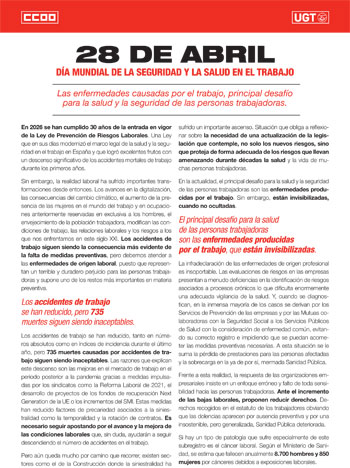
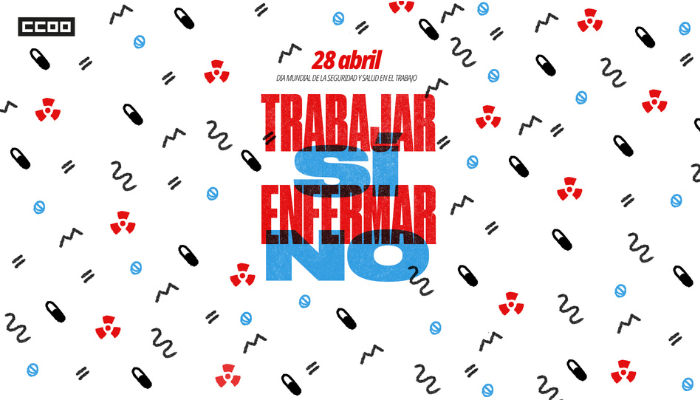
Spain: USO 28 april resources show climate change is a workplace risk

Te envío nuestra campaña de este año, centrada en que el cambio climático es ya un riesgo laboral. En este sentido, reivindicamos espacios de trabajo seguros ante los fenómenos meteorológicos adversos cada vez más frecuentes y el cambio climático.

En los últimos años estamos asistiendo a un cambio en los patrones climatológicos que, más allá de veranos más largos o inviernos más cálidos, afecta directamente sobre el entorno y las condiciones de trabajo. La DANA de Valencia, los incendios del 2025 o la borrasca Filomena nos han demostrado que las condiciones ambientales también afectan directamente a la seguridad y la salud en el trabajo.

Por ello, desde USO consideramos imprescindible poner en el foco datos, estadísticas, estudios y análisis que, ante el próximo Día Mundial de la Seguridad y la Salud en el Trabajo, evidencian esta nueva realidad laboral. Mientras las empresas mantienen una actitud reactiva y las instituciones avanzan con marcos normativos en fase de desarrollo, la siniestralidad vinculada al clima exige una intervención inmediata.

Los materiales de esta campaña son:

·  Manifiesto y cartel
·  Díptico en formato Preguntas Frecuentes dirigido a trabajadores y trabajadoras.

Un abrazo


Netherlands: FNV plans multiple activities to mark 28 April

Paarse brandende kaars

Workers’ Memorial Day

Every year on April 28: commemoration of the victims

On Workers’ Memorial Day, we remember employees who have died as a result of a workplace accident or occupational disease. This day is not unique to the Netherlands. Victims are commemorated worldwide. Workers’ Memorial Day falls on April 28 every year.

Workers’ Memorial Day Symposium

On Thursday, April 23, the FNV, together with the Arbeidsongevallen Foundation, is organizing a symposium as part of Workers’ Memorial Day. This year, we are reflecting on workplace accidents involving migrant workers. Because safe and healthy work is a right for all workers, including migrant workers.

Paarse brandende kaars

Workers’ Memorial Day commemorations on April 28

On Tuesday, April 28, the FNV will commemorate Workers’ Memorial Day at various locations throughout the country. This is the day on which all people worldwide who have fallen ill, been injured, or died as a result of a work accident or occupational disease are remembered. You can be there.

Amsterdam

  • Location: Trade Union House Amsterdam, Derkinderenstraat 2-8 in Amsterdam
  • Time: April 28 from 10:30-11:30
  • To register: ko.hartman@vereniging.fnv.nl

Utrecht

  • Location: Central Trade Union House, Het Facet, Hertogswetering 159 in Utrecht
  • Time: April 28 from 12:00 to 12:30

Rotterdam

  • Location: at the ‘Vaart Vrij’ monument in the Buizenpark, Rotterdam Katendrecht
  • Time: April 28 at 5:30 PM
  • The commemoration is preceded by a gathering at the nearby Verhalenhuis Belvédère from 3:00 PM to 5:00 PM.

Hengelo

  • Location: Trade Union House Hengelo, Oldenzaalsestraat 129 in Hengelo
  • Time: April 28 from 19:00 to 20:30

You are welcome to commemorate the victims with us at one of these locations.

Every year, more than 4,000 people die in the Netherlands as a result of a workplace accident or occupational disease. That is far too many. It is important to observe a moment of silence for this every year. Safe and healthy work is a right for every employee. That is why the FNV draws attention to the subject every year on April 28, Workers’ Memorial Day.

More than 4,000 deaths per year

It seems so self-evident to return home safely after a workday. Every year in the Netherlands, 50-70 workers die following an accident at work. Fathers, mothers, sons, and daughters who did not return home after a workday. And every year, more than 4,000 people in the Netherlands also lose their lives due to occupational diseases, largely due to exposure to hazardous substances. In addition, there are tens of thousands of reports of serious accidents and occupational diseases every year. This is far too many. Working safely and healthily is a fundamental right, also in the Netherlands.

Many companies are not doing enough. 

The FNV believes that things must and can be improved. Many companies are still doing far too little to make work safe, healthy, and sustainable. Most companies provide insufficient protection for employees working with carcinogenic substances. This often applies to migrant workers from Eastern Europe who perform heavy and dangerous work here for low wages. Furthermore, temporary agency workers and self-employed professionals often cannot access the company doctor. That is why we call on the government: show more ambition and prioritize safe and healthy working conditions.

Flag at half-mast

On April 28, at the FNV, we remember all those who have died as a result of a workplace accident or occupational disease. The flag is flown at half-mast and we lay a wreath. A moment of silence follows the wreath-laying. Is the flag at your workplace also at half-mast on April 28? Ask your employer.

https://www.fnv.nl/werk-inkomen/veilig-gezond-werken/bedrijfsongevallen/workers-memorial-day?lang=en-US

Europe: ETUI-ETUC invitation – Climate change and workers’ health | 28 April

ETUI-ETUC joint conference in commemoration of the International Workers’ Memorial Day
Climate change and workers’ health
28 April 2026, 9:00 – 17:00
Thon Hotel Brussels City Centre (Avenue du Boulevard 17, 1210 Brussels), room Bergen

Climate change is not only challenging the labour market but it is also reshaping working conditions and occupational risks and workers’ health across Europe and beyond. Rising temperatures, extreme weather events and environmental degradation are creating new and intensified occupational hazards while exposing existing inequalities between sectors, territories and groups of workers.

This one-day conference organised on 28th April will commemorate the International Workers’ Memorial Day. The event will bring together leading academics, trade union representatives, policymakers and practitioners to examine the growing impacts of climate change on occupational health and safety with a particular focus on heat stress at work and the prospect of better EU legal tools against occupational heat.

By fostering dialogue between research, social partners and EU institutions, the conference aims to contribute to the development of fair, effective and worker-centered responses to climate change putting occupational health and safety at the heart of Europe’s climate and social agenda.

Download the final programme

The event will take place IN PERSON in Brussels. Interpretation will be available in English, French, Italian and Spanish. Following the conference, the recording and the presentations of participating speakers (subject to their agreement) will be made available on this website. Please register here.

Poland: Światowy Dzień Bezpieczeństwa i Ochrony Zdrowia w Pracy 2026

From the Polish safety agency CIOP. Below in English translation and Polish | Z polskiej agencji bezpieczeństwa CIOP. Poniżej tłumaczenie na język angielski i polski.

Dear Sirs,

I would like to kindly inform you that the theme of the celebration of the World Day for Safety and Health at Work in 2026 is the creation of a healthy psychosocial work environment.

The slogan of this year’s celebrations:

How is it at work?

A healthy psychosocial environment is essential

Today, more and more attention is paid to the psychosocial work environment and its impact on workers’ health. It includes not only the atmosphere in the team, but also the way in which tasks are planned and organized, e.g. their number, pace and time of execution, clarity of expectations, the extent of independence, the support of superiors and transparent rules of operation.

These elements greatly affect the health, safety and efficiency of employees. If they are poorly designed or neglected, they can become a source of psychosocial risks, stress and its consequences for health.

The poster for the celebration of the Day 2026 can be seen at:

www.ciop.pl/28kwietnia

Soon we will post more materials and information about this year’s celebrations on this page. If you have any questions, please contact me.


Yours sincerely,
Dorota Pięta
Centre for Promotion and Implementation
Central Institute for Labour Protection – National Research Institute
Czerniakowska 16, 00-701 Warsaw
tel. 22 623 37 22


Szanowni Państwo,

 Uprzejmie informuję, że tematem obchodów Światowego Dnia Bezpieczeństwa i Ochrony Zdrowia w Pracy w 2026 r. jest tworzenie zdrowego psychospołecznego środowiska pracy.

 Hasło tegorocznych obchodów:

Jak tam w pracy?

Zdrowe środowisko psychospołeczne to podstawa

 Coraz więcej uwagi zwraca się dziś na psychospołeczne środowisko pracy i jego wpływ na zdrowie pracowników. Obejmuje ono nie tylko atmosferę w zespole, ale także sposób planowania i organizacji zadań, np. ich liczbę, tempo i czas wykonywania, jasność oczekiwań, zakres samodzielności, wsparcie przełożonych oraz przejrzyste zasady działania.

 Te elementy w dużym stopniu wpływają na zdrowie, bezpieczeństwo i efektywność pracowników. Jeśli są niewłaściwie zaprojektowane lub zaniedbane, mogą stać się źródłem zagrożeń psychospołecznych, stresu oraz jego konsekwencji dla zdrowia.

Plakat obchodów Dnia 2026 można zobaczyć na stronie:

www.ciop.pl/28kwietnia

 Wkrótce na tej stronie zamieścimy więcej materiałów i informacji na temat tegorocznych obchodów. W razie pytań, uprzejmie proszę o kontakt.


Z pozdrowieniami
Dorota Pięta
Ośrodek Promocji i Wdrażania
Centralny Instytut Ochrony Pracy – Państwowy Instytut Badawczy
ul. Czerniakowska 16, 00-701 Warszawa
tel. 22 623 37 22