Category Archives: 2026 Global

Global: ITUC global webinar on psychosocial risks at work – video and resources

The ITUC global webinar on psychosocial risks at work took place on 8 April 2026 ahead of International Workers’ Memorial Day. The event addressed the 28 April theme of psychosocial risks focusing on increasing levels of stress, anxiety, depression and burnout linked to insecure work, excessive hours, poor work-life balance and intensifying workplace pressures.

Watch the full seminar here and download the speakers’ presentation notes here.

Global: BWI report – Record-breaking global mobilisation pushes workers’ safety demands worldwide


Two weeks after International Workers’ Memorial Day (IWMD), workers across the globe continue to send a clear message: “Remember the dead, fight for the living.”

This year, BWI affiliates marked IWMD with a record-breaking 305 activities organised by 86 affiliates in more than 47 countries, demonstrating the growing strength of the global movement for safer and healthier workplaces.

Under BWI’s global campaign focus on heat stress and extreme weather risks, affiliates organised workplace trainings, rallies, memorial ceremonies, bargaining initiatives, policy discussions, and awareness campaigns that mobilised thousands of workers across every region.

While the global focus this year was on heat stress and extreme weather risks, affiliates also used IWMD to commemorate victims of occupational accidents and diseases, raise awareness on psychosocial risks and mental health, strengthen occupational safety structures, and push for broader workplace protections.

The actions below are only some examples of the extraordinary mobilisation carried out by BWI affiliates worldwide.

Global Action

At the international level, BWI also brought workers’ concerns directly to the Meeting of Experts on occupational safety and health in extreme weather events and changing weather patterns in Geneva, the tripartite experts at the International Labour Organisation (ILO) reached consensus on a first-ever set of measures to address the impacts of extreme weather on workers and enterprises.

At the BWI Global Young Workers Forum in Utøya, Norway, young union leaders marked IWMD with discussions on bringing heat stress and climate risks into collective bargaining and strengthening demands for agreements that protect workers. The Forum also held a minute of silence honouring workers lost due to unsafe work and victims of political violence.

A major coordinated initiative entered the IFA with the Acciona Group, in which IWMD activities took place across Spain, the Philippines, Brazil, Chile, Italy, Panama, Peru, the Netherlands, and Mexico. Activities included workplace safety discussions, awareness sessions on working in heat, psychosocial risks and wellbeing, prevention campaigns, and commemorative moments honouring workers who lost their lives.

Africa and the Middle East: Workplace Awareness and Worker Engagement

Across Africa and the Middle East, affiliates used IWMD to bring occupational safety discussions directly into workplaces and communities.

  • In Tunisia, FGBB brought together 99 workers to discuss physical and mental health at work, highlighting the growing importance of psychosocial risks and workers’ well-being alongside broader occupational safety concerns.
  • In Kenya, KUPRIPUPA, KETAWU, and KBCTFIEU organised workplace awareness meetings and site visits focused on occupational health and safety concerns in construction and manufacturing workplaces.
  • In Uganda, UBCCECAWU held IWMD activities at Zhongmei Engineering Company, discussing labour standards, worker safety, and occupational health protections in road construction.
  • In Ghana, CBMWU organised workplace safety awareness activities, while GCQMWU highlighted psychosocial risks and the psychological working environment faced by workers.
  • In Nigeria, NUCECFWW joined workers at CBC Global Construction in Abuja to discuss occupational accidents, workplace safety, and prevention measures.
  • In Zimbabwe, ZCATWU organised worker meetings in Masvingo and Harare, focusing on occupational health and safety awareness and workers’ rights.
  • In Mauritius, CMWEU held panel discussions with government institutions and OHS stakeholders before participating in a public demonstration with 900 participants in Rosehill, calling for stronger workplace protections.

Affiliates in TunisiaLebanon, and Jordan also organised workplace outreach, awareness activities, and worker discussions on occupational safety and health.

Europe: Memorial Activities and Public Campaigns

Across Europe, affiliates organised memorial activities, public awareness campaigns, and discussions on workplace safety and mental health.

  • In Ukraine, PROFBUD organised an OSH conference and training with international experts, on asbestos awareness, Crane and lift safety, and traffic control, as well as prepared union statements, awareness activities, and commemorations honouring workers killed or injured at work.
  • In Bulgaria, PODKREPA publicly called for stronger workplace protections and safer working conditions in the construction sector.
  • In Italy, FILCA CISL, FILLEA CGIL, and CGIL/FILLEA organised rallies, memorial activities, workplace campaigns, and tributes honouring workers who lost their lives due to occupational accidents and diseases.
  • In the UK, Unite organised commemorative events in Liverpool, Bridgwater, Belfast, and Tower Hill, raising concerns around occupational fatalities, psychosocial risks, stress, mental health, and workers’ wellbeing.

Affiliates in Sweden, GeorgiaPolandKyrgyzstanMoldovaDenmarkTurkey, and Spain also marked IWMD through rallies, statements, member meetings, posters, and social media campaigns.

Latin America and the Caribbean: Training, Prevention, and Organising

Across Latin America and the Caribbean, affiliates combined worker education, prevention campaigns, and commemorative activities.

  • In Brazil, unions organised Green April mobilisations, webinars, workplace awareness campaigns, and prevention initiatives addressing occupational safety and workers’ health, highlighting how climate change is transforming occupational health and safety into a central collective bargaining issue.
  • In Peru, FTCCP carried out one of the region’s largest IWMD programmes, including seminars, livestreams, videocasts, social media campaigns, and virtual trainings on occupational safety, hazard identification, fall prevention, and workplace risks.
  • In Argentina, UOCRA organised campaigns on occupational health, psychosocial risks, work at height, and prevention measures in construction workplaces. At the SIDERSA plant in San Nicolás, union OHS teams conducted workplace assessments involving around 350 workers.
  • In the Dominican Republic, unions combined practical occupational safety training with a candlelight ceremony commemorating victims of occupational accidents and diseases.
  • In Panama, SUNTRACS organised workplace assemblies and occupational health and safety discussions across construction projects linked to protections secured through collective agreements.
  • In Chile, workers participated in workplace prevention campaigns and awareness activities focused on occupational safety and well-being.

Asia-Pacific: Grassroots Mobilisation and Worker Education

Across the Asia-Pacific, affiliates mobilised thousands of workers through training, awareness campaigns, organising activities, and commemorations.

  • In Pakistan, PFBWW organised IWMD meetings and awareness activities at Tarbela Dam, Balakot Dam, and Mohmand Dam, bringing workers together to discuss occupational safety, workplace risks, and the importance of prevention and worker protection.
  • In India, unions organised workplace discussions, rallies, seminars, poster campaigns, and district-level mobilisations focused on occupational safety, workers’ rights, and workplace wellbeing. SGEU alone mobilised around 1,000 women members.
  • In Nepal, CAWUN, ANCWU, and CUPPEC organised worker meetings and awareness discussions on occupational safety and health.
  • In Indonesia, SERBUK and other affiliates carried out extensive activities, including OSH trainings, workplace visits, youth campaigns, climate justice discussions, and awareness sessions on workers’ safety and wellbeing.
  • In Malaysia, STIEU organisers met migrant workers in several workplaces to discuss occupational safety, organising, and workers’ conditions, while TEUPM held discussions linked to the Too Hot To Work campaign.
  • In the Philippines, NUBCW organised simultaneous OSH trainings, awareness discussions, campaign reels, and worker mobilisations during May Day activities.
  • In Cambodia, affiliates organised training, outreach campaigns, and awareness activities on occupational safety and workers’ health.
  • In Australia, CFMEU and ETU commemorated workers who never returned home from work while renewing calls for stronger workplace protections.

From Awareness to Agreements

Across all regions, IWMD 2026 demonstrated a growing determination among workers and unions to strengthen occupational safety protections through organising, education, bargaining, and collective action.

From memorial ceremonies and psychosocial risk campaigns to workplace trainings and climate-related advocacy, affiliates reinforced one common

message: work-related deaths, injuries, and illnesses are preventable.

Let’s Keep Up the Momentum

The struggle for safer and healthier workplaces does not end on 28 April.

BWI calls on all affiliates to continue organising, educating, bargaining, and fighting for enforceable protections for all workers.

Because every worker has the right to go to work—and come home safely.

ORGANISE.
BARGAIN.
WIN PROTECTION.
 

Global: Acciona joins global union BWI’s Workers’ Memorial Day events across multiple countries

Acciona Group marked Workers’ Memorial Day across Spain, the Philippines, Brazil, Chile, Italy, Panama, Peru, the Netherlands and Mexico through a coordinated global safety initiative linked to BWI campaigns. Activities included minutes of silence, workplace training, awareness sessions and safety campaigns focused on occupational health, psychosocial risks, mental health and heat stress. The company also developed materials supporting the “Too Hot To Work” campaign, reinforcing prevention measures and safety culture across projects and construction sites in multiple countries.

Global: Psychosocial risks at work now deadlier than traditional hazards – PSI


On World Day for Safety and Health at Work, unions warn that stress, long hours and toxic workplaces have become the biggest killers at work. Long hours alone cause 745,000 deaths yearly, with over 840,000 total deaths linked to psychosocial risks, 70,000 work-related suicides and 12 billion days lost to depression and anxiety.

Behind the daily reality of work, millions of working people are facing relentless pressure: long hours, job insecurity, impossible targets and toxic workplace cultures. These are not just bad jobs – they are dangerous jobs. Stress, anxiety and burnout are now causing more harm globally than traditional workplace hazards such as chemicals or dust.

A new ITUC report “Tackling Psychosocial risks at work: how stresses and strains can kill workers and how unions can save them” shows the scale of the crisis:

  • Long working hours alone are responsible for around 745,000 deaths each year.
  • There are at least 70,000 work-related suicides annually.
  • 12 billion working days are lost every year due to depression and anxiety.
  • Burnout affects around one in five workers globally.
  • Psychosocial risks are linked to over 10 per cent of cases of heart disease, depression and suicides.

The International Labour Organisation (ILO) has also published a ground breaking report titled “ The psychosocial working environment: Global developments and pathways for action” that sheds light on the global epidemy of PSR at work. It shows that:

  • more than 840,000 people die each year from health conditions linked to psychosocial risks, such as long working hours, job insecurity, and workplace harassment. These work-related psychosocial risks are mainly associated with cardiovascular diseases and mental disorders, including suicide.
  • 35 per cent of workers work more than 48 hours per week
  • 23 per cent of workers globally have experienced at least one form of violence or harassment in their working life, with psychological violence being the most prevalent at 18 per cent
  • nearly 45 million disability-adjusted life years (DALYs) are lost annually, reflecting years of healthy life lost due to illness, disability, or premature death, and are estimated to result in economic losses equivalent to 1.37 per cent of global GDP each year.

The root causes of a poor psychosocial working environment

Psychosocial risks depend on three interrelated levels of factors that shape the psychosocial working environment:

  • the nature of the job itself, including demands, responsibilities, alignment with workers’ skills, access to resources, and the design of tasks in terms of meaning, variety, and skill use.
  • how work is organized and managed, covering role clarity, expectations, autonomy, workload, work pace, and supervision and support.
  • the broader workplace policies, practices and procedures that govern work. These include employment and working time arrangements, the management of organizational change, digital monitoring, performance and reward processes, OSH policy and management systems, procedures to prevent violence and harassment at work, and mechanisms for genuine worker consultation and participation.

Psychosocial risks are the most pressing OSH issue in public service jobs

According to a PSI global survey on OSH risks among public service workers, with 54 affiliates responding from 32 countries across all continents and PSI sectors and professions, psychosocial risks—including work-related stress and mental health—are identified as the most pressing workplace issue (75% of respondents). These are followed by understaffing and workload pressure (67.3%), workplace violence and harassment (55.8%), and long working hours (40.4%). Notably, all four of the highest-rated OSH risks identified by public service unions fall within the broader category of primary or contributing factors to psychosocial risks.

PSI will review and discuss priorities and actions related to psychosocial risks in public services during the next PSI Global OSH Network meeting on 22 September 2026.

Question: Which of the following OSH issues are most urgent in the sector(s) your union represents?

Source: PSI OSH Global Network Survey 2025-2026

What can be done to address psychosocial risks at work?

The ILO emphasizes that psychosocial risks can be prevented through organizational approaches that address their root causes. It also highlights the importance of integrating psychosocial risk management into occupational safety and health systems, supported by social dialogue between governments, employers, and workers.

Across the world, unions are proving that change is possible. Evidence shows that a strong, democratic trade union presence in the workplace is the most effective protection against psychosocial risks, improving workers’ health and economic outcomes.

Trade unions worldwide are calling for:

  • Strong laws to prevent psychosocial risks at work.
  • Full involvement of trade unions in workplace health and safety.
  • Decent work, including secure jobs, fair pay, safe staffing levels and manageable workloads.
  • Recognition of mental health conditions as occupational diseases.

The European Agency for Occupational Safety and Health (EU-OSHA) has also marked World Day for Safety and Health at Work, unveiling a new website for the Healthy Workplaces Campaign 2026-2028 ‘Together for mental health at work’. The website, is an anticipation of the EU-OSHA campaign on psychosocial risks at work that will kick-off in October 2026 and offers a first look at the upcoming campaign’s focus: managing and preventing psychosocial risks and their impact on workers and organisations. The websites carries materials, including the campaign guideflyer and poster, to learn more about how to raise awareness and take action.

Resources

Many resources are available for unions, workers and OSH reps who wish to bring progressive change and tackle psychosocial risks at work:

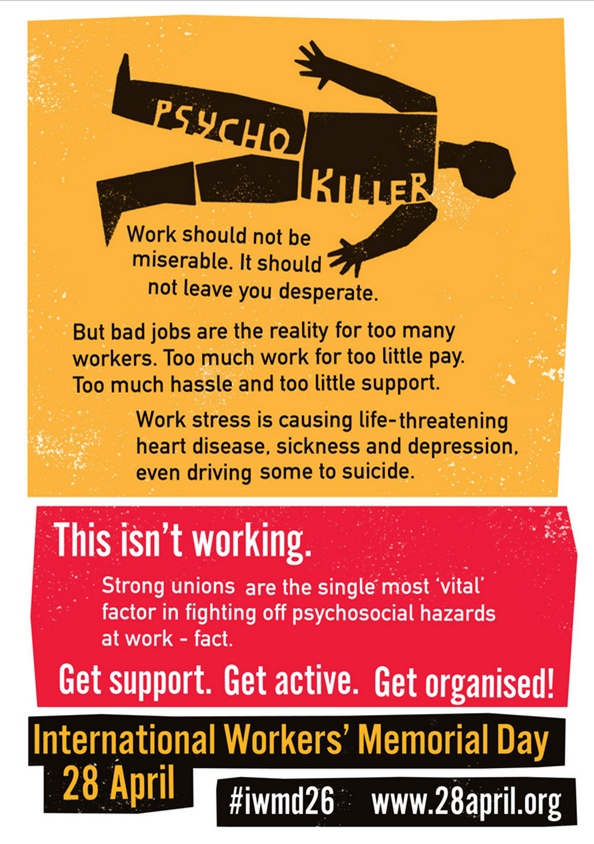
On 28 April, we the trade unions remember the dead – and fight for the living. Work should not cost lives. It must protect lives, dignity and mental health.

Note: this article draws on written materials from ITUC, ILO and EU-OSHA websites.

Global: ITUC calls for urgent action to tackle the global crisis of psychosocial risks at work

International Workers’ Memorial Day 2026: Tackling psychosocial risks at work

This International Workers’ Memorial Day, 28 April, the ITUC calls for urgent action to tackle the global crisis of psychosocial risks at work – now one of the leading causes of death, disease and distress for workers worldwide.

Behind the daily reality of work, millions of working people are facing relentless pressure: long hours, job insecurity, impossible targets and toxic workplace cultures.

These are not just bad jobs – they are dangerous jobs. Stress, anxiety and burnout are now causing more harm globally than traditional workplace hazards such as chemicals or dust.

ITUC’s new report shows the scale of the crisis:

  • Long working hours alone are responsible for around 745,000 deaths each year.
  • There are at least 70,000 work-related suicides annually.
  • 12 billion working days are lost every year due to depression and anxiety.
  • Burnout affects around one in five workers globally.
  • Psychosocial risks are linked to over 10 per cent of cases of heart disease, depression and suicides.

“Bad jobs can break anyone. When workers are pushed beyond their limits by job insecurity, excessive workloads and lack of control, the consequences can be fatal. This is not inevitable – it is a result of choices made in boardrooms and by governments.” ITUC General Secretary Luc Triangle

Across the world, unions are proving that change is possible. Evidence shows that a strong, democratic trade union presence in the workplace is the most effective protection against psychosocial risks, improving workers’ health and economic outcomes.

The ITUC is calling for:

  • Strong laws to prevent psychosocial risks at work.
  • Full involvement of trade unions in workplace health and safety.
  • Decent work, including secure jobs, fair pay and manageable workloads.
  • Recognition of mental health conditions as occupational diseases.

Luc Triangle concluded: “The solutions to these problems start with democracy in the workplace, with a voice for workers through their trade unions. Employers can ignore the psychosocial health of workers and break them, lose valuable skills and face the financial cost, or they can work with unions to ensure that workers are valued. If employers are struggling to recognise which is the correct choice, unions are ready and available to remind them. The fight for democracy in the workplace is the fight for the wellbeing of all working people.”

This 28 April, we remember the dead – and fight for the living. Work should not cost lives. It must protect lives, dignity and mental health.

Global: la CSI appelle à une action urgente visant à lutter contre la crise mondiale des risques psychosociaux au travail

Journée internationale de commémoration des travailleurs morts ou blessés au travail 2026: prendre en compte les risques psychosociaux au travail

Le 28 avril, à l’occasion de la Journée internationale de commémorations des travailleurs morts ou blessés au travail, la CSI appelle à une action urgente visant à lutter contre la crise mondiale des risques psychosociaux au travail, désormais l’une des principales causes de décès, de maladie et de souffrance pour les travailleurs et les travailleuses à travers le monde.

Derrière la réalité quotidienne du travail, des millions de personnes sont soumises à une pression incessante: longues heures de travail, insécurité de l’emploi, objectifs impossibles à atteindre et environnements de travail toxiques.

Il ne s’agit pas seulement d’emplois de mauvaise qualité, mais d’emplois dangereux. Le stress, l’anxiété et l’épuisement provoquent aujourd’hui plus de préjudice à l’échelle planétaire que les risques traditionnels sur les lieux de travail, tels que les produits chimiques ou la poussière.

Le nouveau rapport de la CSI (bientôt disponible en français) révèle l’ampleur de la crise:

  • La durée excessive des heures de travail est responsable à elle seule d’environ 745 000 décès chaque année.
  • Au moins 70 000 suicides liés au travail sont à déplorer annuellement.
  • Tous les ans, 12 milliards de jours de travail sont perdus en raison de la dépression et de l’anxiété.
  • L’épuisement au travail touche environ un travailleur sur cinq dans le monde.
  • Les risques psychosociaux sont associés, dans plus de 10 pour cent des cas, aux maladies cardiaques, à la dépression et aux suicides.

Luc Triangle, le secrétaire général de la CSI, a déclaré: «Les emplois de mauvaise qualité peuvent briser n’importe qui. Lorsque les travailleurs subissent des pressions au-delà des limites supportables, à cause de l’insécurité de l’emploi, de charges de travail excessives et d’un manque de contrôle, les conséquences peuvent être fatales. Cette situation n’est pas inévitable: elle résulte de décisions prises dans des salles de réunions et par les gouvernements.»

Sur l’ensemble du globe, les syndicats montrent qu’un changement est possible. Les faits indiquent qu’une présence syndicale forte et démocratique sur le lieu de travail constitue la plus efficace des protections contre les risques psychosociaux, en contribuant à améliorer la santé et les performances économiques des travailleurs et des travailleuses.

La CSI réclame:

  • Des lois rigoureuses destinées à prévenir les risques psychosociaux au travail.
  • La participation pleine et entière des syndicats aux questions de santé et de sécurité au travail.
  • Des emplois décents, c’est-à-dire des emplois sûrs, une rémunération équitable et des charges de travail supportables.
  • La reconnaissance des troubles de santé mentale comme maladies professionnelles.

Luc Triangle a conclu: «Les solutions à ces problèmes commencent par la démocratie au travail, pour permettre aux travailleurs de faire entendre leur voix par l’intermédiaire de leur syndicat. Les employeurs peuvent choisir d’ignorer la santé psychosociale de leurs employés et de les pousser à bout, de perdre leurs précieuses compétences et d’en payer le coût financier, ou choisir de collaborer avec les syndicats pour veiller à ce que les travailleurs soient valorisés. Si les employeurs peinent à savoir quel est le bon choix, les syndicats se tiennent prêts à le leur rappeler. La lutte pour la démocratie au travail est la lutte pour le bien-être de tous les travailleurs et travailleuses.»

Ce 28 avril, nous rendons hommage aux personnes décédées au travail, et nous nous battons pour les vivants. Le travail ne devrait pas coûter des vies. Il doit protéger la vie, la dignité et la santé mentale.

Global: la CSI hace un llamamiento a la acción urgente para abordar la crisis mundial de los riesgos psicosociales en el trabajo

Jornada Internacional de Conmemoración de los Trabajadores Fallecidos y Lesionados 2026: abordar los riesgos psicosociales en el trabajo


Con motivo de la Jornada Internacional de Conmemoración de los Trabajadores y Trabajadoras Fallecidos y Lesionados, el 28 de abril, la CSI hace un llamamiento a la acción urgente para abordar la crisis mundial de los riesgos psicosociales en el trabajo, la cual se ha convertido en una de las principales causas de muerte, enfermedad y sufrimiento entre los trabajadores y las trabajadoras de todo el mundo.


Detrás de la realidad cotidiana del trabajo, millones de personas trabajadoras se enfrentan a una presión continua: largas jornadas de trabajo, inseguridad laboral, objetivos imposibles de alcanzar y culturas empresariales tóxicas.


No solamente son malos empleos, son empleos peligrosos. El estrés, la ansiedad y el agotamiento ocupacional causan ahora más daños a escala mundial que los riesgos laborales tradicionales, como los inducidos por productos químicos o el polvo.


El nuevo informe de la CSI (disponible próximamente en español) muestra la magnitud de la crisis:

  • Solo las largas jornadas laborales son responsables de aproximadamente 745 000 muertes cada año.
  • Se registran al menos 70 000 suicidios anuales relacionados con el trabajo.
  • Se pierden 12 000 millones de días de trabajo cada año debido a la depresión y la ansiedad.
  • El agotamiento profesional afecta a aproximadamente uno de cada cinco trabajadores en todo el mundo.
  • Los riesgos psicosociales están relacionados con más del 10% de los casos de enfermedades cardíacas, depresión y suicidios.

Luc Triangle, secretario general de la CSI, afirmó en este sentido: “Los malos empleos pueden destrozar a cualquiera. Cuando la inseguridad laboral, las cargas de trabajo excesivas y la falta de control sobre el trabajo llevan a las personas trabajadoras más allá de sus límites, las consecuencias pueden ser fatales. No es algo inevitable: es el resultado de decisiones tomadas en las salas de juntas y por los gobiernos”.

En todo el mundo, los sindicatos demuestran que el cambio es posible. Los datos indican que una presencia sindical fuerte y democrática en el lugar de trabajo constituye la protección más eficaz contra los riesgos psicosociales, mejorando así la salud de las personas trabajadoras y los resultados económicos.

La CSI reclama:

  • Leyes estrictas para prevenir los riesgos psicosociales en el trabajo.
  • La plena implicación de los sindicatos en la salud y la seguridad en el trabajo.
  • Un trabajo decente, que incluya seguridad laboral, una remuneración justa, niveles de dotación de personal adecuados y cargas de trabajo asumibles.
  • El reconocimiento de los trastornos de salud mental como enfermedades profesionales.

Luc Triangle concluyó a este respecto: “Las soluciones a estos problemas comienzan por la democracia en el lugar de trabajo, con una voz para los trabajadores y trabajadoras a través de sus sindicatos. Los empleadores pueden pasar por alto la salud psicosocial de las personas trabajadoras y agotarlas, perder valiosas competencias y sufrir las consecuencias económicas, o bien pueden colaborar con los sindicatos para garantizar que se valore a las personas trabajadoras. Si los empleadores tienen dificultades para reconocer cuál es la opción correcta, los sindicatos están preparados y dispuestos para recordárselo. La lucha por la democracia en el lugar de trabajo es la lucha por el bienestar de todos los trabajadores y trabajadoras”.

Este 28 de abril, conmemoramos a los fallecidos y luchamos por los vivos. El trabajo no debería costar vidas. Debe proteger las vidas, la dignidad y la salud mental.

Global: Safe work, healthy workplaces: Tackling psychosocial risks at work – ILO

Safe work, healthy workplaces: Tackling psychosocial risks at work

On World Day for Safety and Health at Work 2026, ILO Director-General Gilbert F. Houngbo highlights the urgent need to improve psychosocial working environments.

Content also available in: españolfrançais   • italiano中文

As the world of work evolves, factors like job design, management practices, and workplace culture have a direct impact on workers’ health, dignity, and well-being. With over 840,000 deaths linked annually to psychosocial risks, the call is clear: governments, employers, and workers must act together to create safer, healthier, and more just workplaces for all.

Across the world, work shapes people’s lives in profound ways.
It can provide purpose, security and opportunity.

But the way work is designed, organized and managed also affects something fundamental:  workers’ safety, health and dignity.

Today, the world of work is changing rapidly. Digital technologies, new forms of employment, demographic change and climate pressures are transforming the way we work.

In this context, the psychosocial working environment has never been more important.

For workers in every sector, psychosocial factors at work can make the difference between a job that supports well-being and one that undermines it.

The consequences are significant.

Psychosocial risk factors at work are linked to more than 840,000 deaths each year worldwide, associated with cardiovascular diseases and mental disorders.

They place heavy costs on societies and economies.

Safe and healthy working environments are a fundamental principle and right at work.

But they do not happen by chance.

When work is designed with reasonable demands, adequate support, opportunities for participation and respect for dignity, it benefits everyone.

Workers are healthier and more motivated.

Enterprises become stronger and more sustainable.

Preventing psychosocial risks requires commitment and cooperation.

Governments must put in place effective policies, legal frameworks and occupational safety and health systems that support prevention.

Employers shape the daily reality of work through leadership and responsible management practices.

And workers and their representatives bring essential knowledge about how work is experienced.

On this World Day for Safety and Health at Work, the ILO calls on governments, employers and workers everywhere to strengthen their efforts to prevent psychosocial risks through social dialogue, to ensure that the design, organization and management of work creates the conditions for healthier workers, successful enterprises and societies that are closer to social justice.

This is at the heart of the ILO’s vision of decent work.

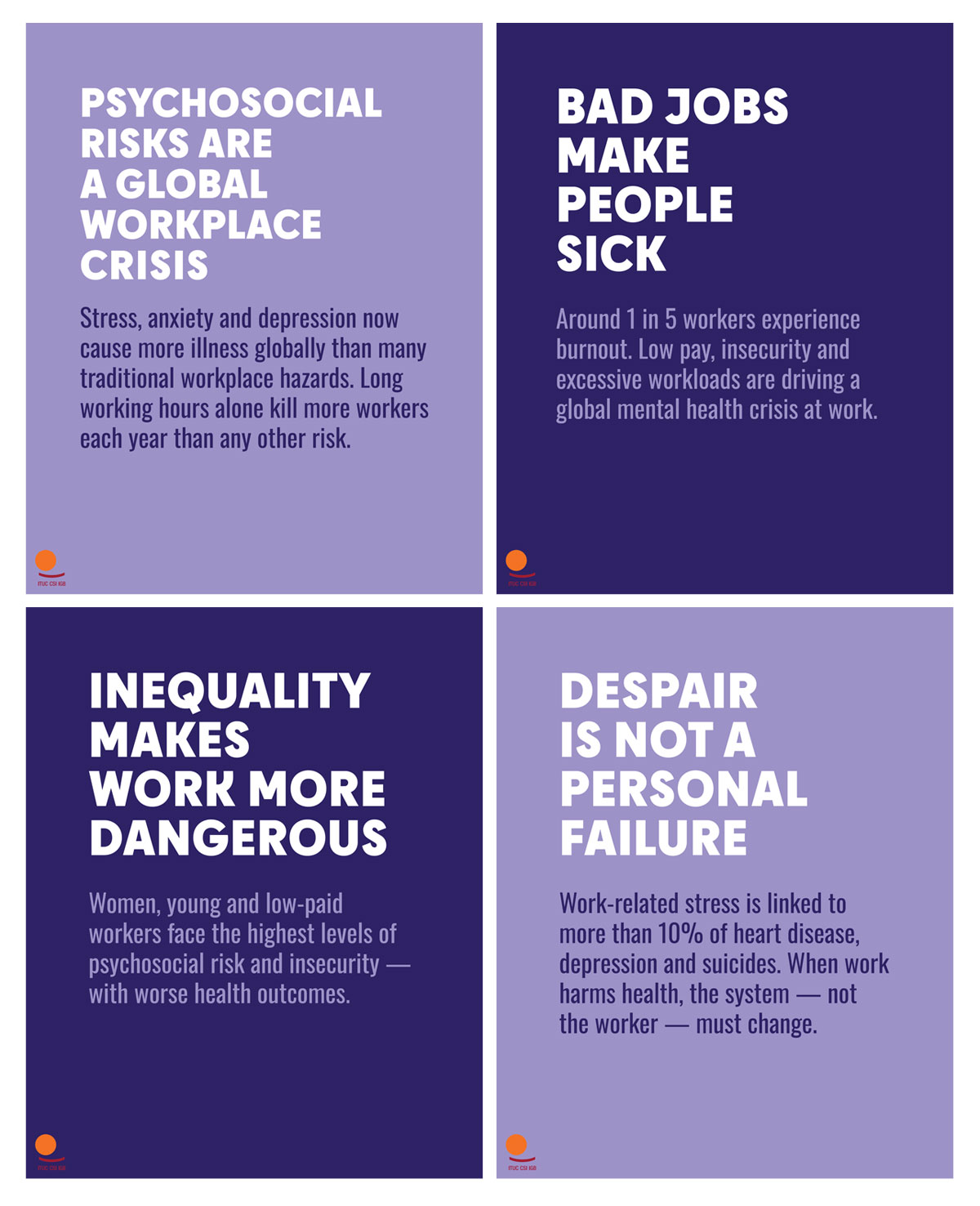
Global: ITUC 28 April shareables for social media campaigning

IGlobal union confederation ITUC has published a board range of social media ready 28 April shareables. A selection are below – you can download a complete set here


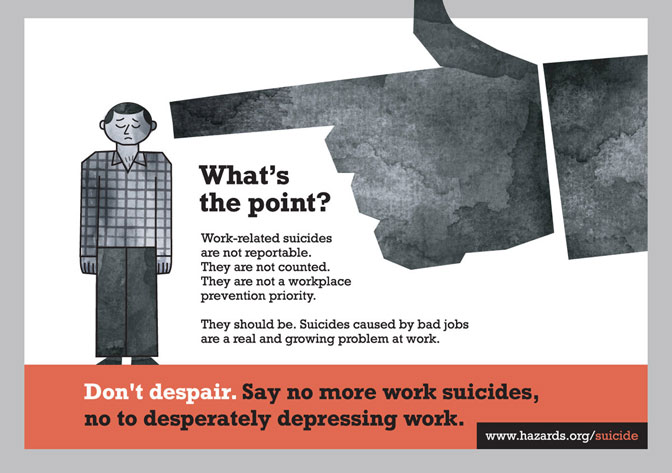
Global/UK: Suicide crisis – action call as more than one in 10 suicides is linked to work – Hazards magazine

Who benefits when regulators and the courts pursue bosses whose brutal employment practices drive workers to the brink of suicide or to actually kill themselves? Well, says Hazards, new studies suggest we all do, as it leads to ‘significant’ and widespread safety improvements.

Hazards magazine argues that when regulators and the courts go after the employers who are driving their workers to suicide, we will all benefit. Read SUICIDE CRISIS | Action call as more than one in 10 suicides is linked to work