Tag Archives: UNISON

UK: Overworked health staff report stressed out, says UNISON

A third of employees in the UK National Health Service (NHS) have taken time off for mental health issues in the past year with many staff talking about reaching “breaking point”, according to the union UNISON.

A survey of health workers, including nurses, occupational therapists and paramedics, has also found more than four in five (85%) have experienced stress at work over the past 12 months.

UNISON says the findings – based on responses from more than 19,000 staff and released during the union’s annual health conference in Edinburgh and released two weeks ahead of the psychosocial hazards-themed International Workers’ Memorial Day on 28 April – paint a grim picture when the NHS workforce is under pressure to reduce waiting lists.

Staff say stress has had a significant impact on their mental and physical health, with symptoms including anxiety, PTSD, panic attacks, migraines, and sleep disturbance.

Some have experienced high blood pressure, stress-related vomiting, dizziness and breathlessness, according to the findings of the union survey. One NHS worker even reported suffering a heart attack due to understaffing and high workloads.

Many described reaching breaking point, feeling exhausted and overwhelmed by sustained levels of stress. This has affected their relationships and family lives, with some reporting suicidal thoughts, UNISON says.

NHS workers also described taking antidepressants and beta-blocker drugs, as well as undergoing cognitive behavioural therapy and counselling.

Almost a quarter (23%) of those taking sick leave didn’t tell their employer the real reason for their absence from work. Of those, most said they did not feel their manager would support them, while concerns about stigma and not wanting colleagues to know were also common.

Counselling, medication or other forms of support had been sought in the past year by more than one in four (28%) of those under stress. Almost two thirds (65%) of those who had taken time off for stress reported feeling that they were under pressure to come to work, despite feeling mentally unwell. This adds strain to an already overstretched workforce, UNISON says.

UNISON head of health Helga Pile said: “Such high levels of stress in the NHS should be ringing alarm bells. Staff who care for others are being pushed to the point that they’re becoming unwell themselves.” She added: “Government and employers must do more to help staff with their mental health, including providing fast-track access to treatment and moving away from punitive and counter-productive absence policies.”

Unison news release

UK: Overworked NHS staff report stress, sickness, and a reliance on antidepressants, says UNISON

UNISON National
In the run up to psychosocial hazards-themed International Workers’ Memorial Day health service union UNISON has said health workers need better support to cope with the pressures they face.

A third of NHS employees have taken time off for mental health issues in the past year with many staff talking about reaching “breaking point”, according to new findings released by UNISON on 15 April 2026.

A survey of health workers, including nurses, occupational therapists and paramedics, has also found more than four in five (85%) have experienced stress at work over the past 12 months.

Staff say stress has had a significant impact on their mental and physical health, with symptoms including anxiety, PTSD, panic attacks, migraines, and sleep disturbance.

Some have experienced high blood pressure, stress-related vomiting, dizziness and breathlessness, according to the findings of the union survey. One NHS worker even reported suffering a heart attack due to understaffing and high workloads.

Many described reaching breaking point, feeling exhausted and overwhelmed by sustained levels of stress. This has affected their relationships and family lives, with some reporting suicidal thoughts, UNISON says.

NHS workers also described taking antidepressants and beta-blocker drugs, as well as undergoing cognitive behavioural therapy and counselling.

UNISON says the findings – based on responses from more than 19,000 staff and released during the union’s annual health conference in Edinburgh – paint a grim picture when the NHS workforce is under pressure to reduce waiting lists.

Almost a quarter (23%) didn’t tell their employer the real reason for their absence from work. Of those, most said they did not feel their manager would support them, while concerns about stigma and not wanting colleagues to know were also common.

Counselling, medication or other forms of support had been sought in the past year by more than one in four (28%) of those under stress. Almost two thirds (65%) of those who had taken time off for stress reported feeling that they were under pressure to come to work, despite feeling mentally unwell. This adds strain to an already overstretched workforce, UNISON says.

The Covid inquiry into the impact of the pandemic on the UK’s healthcare systems highlighted the “almost superhuman efforts” of NHS staff despite the significant and long-lasting impact on their mental health and wellbeing.

Ongoing pressures and staff shortages since the pandemic are only adding to the problem, says UNISON.

UNISON head of health Helga Pile said: “Such high levels of stress in the NHS should be ringing alarm bells. Staff who care for others are being pushed to the point that they’re becoming unwell themselves.

“There should be no stigma around mental health, especially in healthcare. Staff need proper support to cope with the pressures they face.

“Government and employers must do more to help staff with their mental health, including providing fast-track access to treatment and moving away from punitive and counter-productive absence policies.

“They must also act to ensure the NHS is safely staffed to meet the growing needs of communities.”

Notes to editors:
– The survey was conducted from 27 January to 27 February 2026 and received 19,356 responses from staff working in healthcare across England, Scotland and Northern Ireland including nurses, paramedics, pharmacists, admin workers and cleaners.
– Staff experiences recorded by the survey include:
“Stress has brought on an eating disorder, and my mental health has suffered tremendously.” Health care assistant, Yorkshire
“I’ve started to take a high dose of antidepressants. I struggle to sleep. It affects my mood at home with my family. I’ve developed a twitch in my eye which the doctor and optometrist say is down to stress and fatigue.” Admin worker, Yorkshire
“I’m on anxiety medication. I’ve just finished some counselling but may restart in the future.” Mental health nurse, Yorkshire
“I’m on medication, regularly see a psychiatrist and psychologist, and have had to take sick leave.” Nurse, North West
“I’ve been so stressed I had a heart attack before Christmas due to no staff and massive workloads.” Admin worker, North West
“My stress manifested in physical symptoms such as stomach aches, vomiting, shaking and overwhelming anxiety when I walk into work. I also started pulling my hair out and it’s triggered by things such as heavy workloads.” Estates and facilities worker, North West
“I’ve developed depression and anxiety due to work, to the point I had negative thoughts and my GP has prescribed antidepressants. I’m constantly stressed and dread going to work. Constant micromanagement and demands are increasing burnout and anxiety.” Paramedic, London
“I often feel overwhelmed by my workload and struggle to switch off from my job, which has caused constant worry and anxiety. This stress made concentrating difficult and reduced my confidence in carrying out tasks. I also experience fatigue, low mood and have difficulty sleeping, and that’s affected my overall wellbeing and performance at work.” Midwife, London
“I have high levels of anxiety and constantly fear making mistakes due to the workload and staffing issues. I’ve experienced hair thinning, poor appetite, dehydration and urinary infections, because I’m unable to pause for a drink. My immune system is poor because I feel burnout, but I fear taking any time off leads to financial issues.” Nurse, West Midlands
“I underwent counselling to help me deal with my work-life balance. I had an occupational health referral that recommended redeployment to come off the road to help reduce stress, but this wasn’t accommodated on my return.” Emergency ambulance associate, South West
“Work pressure was overwhelming. As the weeks went by, I was getting worse: crying as I drove to work, struggling to cope with daily pressure. I was emotional, not eating or sleeping, lacked confidence, withdrew from social and family events. I struggled to even do grocery shopping. It’s something I hope I never go through again.” Admin worker, East of England
“Stress at work has affected my marriage, my ability to socialise and I feel constantly on the verge of tears.” Clinical support worker, Scotland
“My workload is unrealistic. I’m covering two people’s jobs whilst a colleague is on maternity. There’s very little support from senior management. I’ve been signed off by my GP due to work-related stress and high blood pressure for six weeks. I’m now on medication and looking for other jobs.” Admin worker, Northern Ireland
– UNISON’s annual health conference began on Monday (13 April) and continues until today (Wednesday 15 April) at the Edinburgh International Conference Centre, Edinburgh EH3 8EE. UNISON general secretary Andrea Egan gave the keynote speech on Monday afternoon. Health workers from across the UK have been in attendance to debate a variety of motions including NHS pay, a greener NHS, bank staff, support for migrant workers, mental health, sexual safety, problems with NHS salary scales, and safe staffing.
– UNISON is the UK’s largest union and the largest union in the NHS and in the ambulance sector, with more than 1.3 million members providing public services – in education, local government, the NHS, police service and energy. They are employed in the public, voluntary and private sectors.
UK: Why we ‘remember the dead and fight for the living’ – Unison

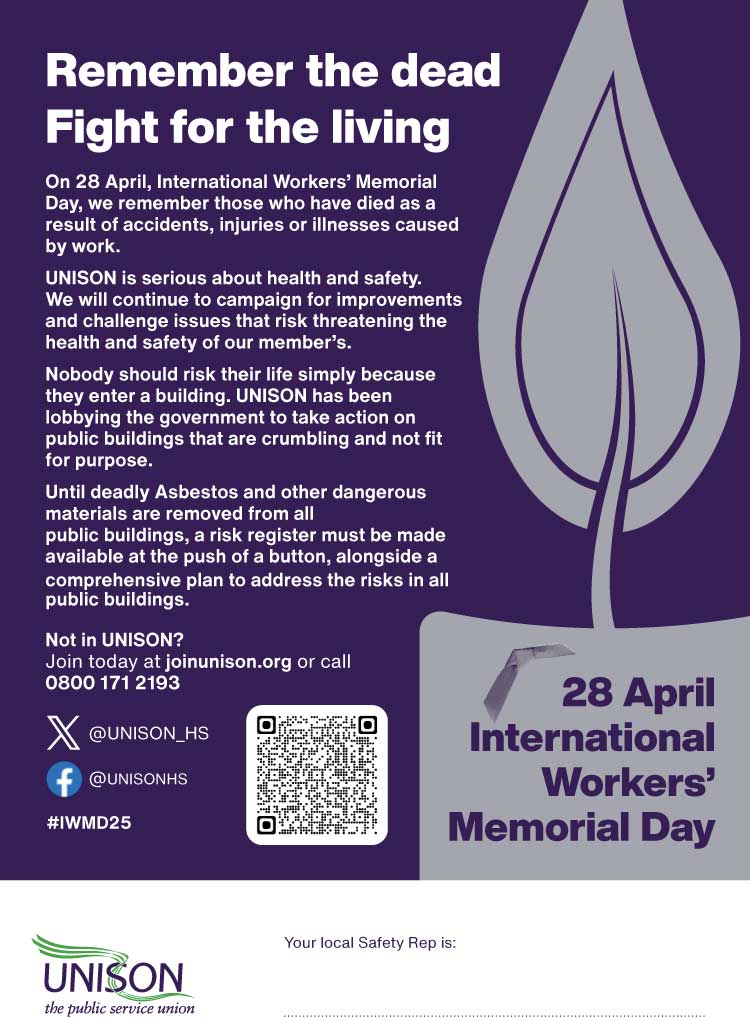
On 28 April each year, International Workers’ Memorial Day (IWMD) is a time to remember those who have died either because of a workplace accident, ill health or diseases as a result of work.

Why we ‘remember the dead and fight for the living’

Health and Safety Executive (HSE) annual statistics show on average that 135 workers are killed in work related accidents each year. They also estimate that there are around 13,000 deaths each year from occupational lung disease and cancer caused by past exposure at work to chemicals and dust (such as asbestos or silica).

However, safety campaigners estimate that the true figure for all work-related deaths is closer to 50,000 each year.

Although it is rare for a UNISON member to die in a workplace incident, unfortunately some do suffer serious injuries and work-related ill health, including musculoskeletal disorders, stress, anxiety and depression. This can significantly affect them, their family, friends and other work colleagues.

UNISON knows that the key to providing safe and healthy workplaces is effective risk management, eliminating or reducing the risk of  harm and having safe systems of work, including training and access to protective equipment.

Additionally, UNISON health safety representatives play a vital role in keeping workplaces safe and healthy by working with employers and raising members’ concerns about working condition, as well as undertaking inspections of workplaces to check all steps are being taking to keep workers safe.

read more

Resources

Britain: Powerful moments at the Unison safety seminar, Belfast

A powerful moment at UNISON Health and Safety Seminar 2024, as delegates mark #IWMD24 by observing a minute of silence to remember all those who have lost their lives at work. #uHS24 pic.twitter.com/eawcg0lsnE

UK: Unison – Workers’ Memorial Day video

Unison – Workers’ Memorial Day video

UK: Workplace safety affects us all – Unison

As we approach International Workers’ Memorial Day, acting national officer for health and safety at UK’s health union Unison,  Robert Baughan, looks back at a year when workplace safety took centre stage.  More

UK: A moment of silence is the very least that we can do – Unison

Blog: A moment of silence is the very least that we can do

by Dave Prentis, Genreal Secretary, Unison

… the nation will fall silent at 11am to honour and remember all of the health, care and other key workers who have lost their lives to coronavirus.

It’s an opportunity for us all to take a moment to pay our respects and give thanks to for the lives of those who saved lives, kept key services running and the rest of the country safe. It’s also a further opportunity to show our love to their families, and to remind everyone of the real danger that key workers are placing themselves in to keep our country going and our communities safe.

Our union has been leading the calls for this commemoration which takes place on International Workers Memorial Day. Every year, this is an important date for our union – but never more so than this year. The risk of death should never be something which any of us have to consider as part of our working lives, but for too many workers that is the ongoing reality of the fight against COVID-19.So while we pay our respects to those who have lost their lives, we continue to fight for better protection at work for everyone who needs it – whether those at risk during the current crisis, or any worker whose life is put at risk by their working conditions.

This virus has had a profound impact on all of our lives, but there are clearly those who are particularly affected. This virus has had a disproportionate impact on older people, Black communities and those with prior health conditions. It has also had a huge impact on those whose vital work means they cannot stay at home, including so many UNISON members – taking care of our loved ones, educating our children, keeping our streets safe or making sure that vital food and supplies are delivered – who are putting themselves at risk to protect us all.

Every minute this pandemic continues, people are making extraordinary sacrifices to keep us safe and run our vital services.

That’s why we’ve issued this call for the whole country to take part and remember the sacrifices key workers have made. So wherever you are – at home or at work – please join us in a moment of silence at 11am tomorrow. To say thank you. To remember. To show our solidarity. To remember the dead, but also on International Workers Memorial Day, to fight for the living.

After all that key workers have already given to us all throughout this crisis, it is the very least that we can do.

Blog: A moment of silence is the very least that we can do | General secretary’s blog, News | News | UNISON National

UK: Remember Covid-19 dead on 28 April – UNISON

IWMD will give us the chance to remember the workers who have died because of COVID-19

Tuesday 28 April is International Workers’ Memorial Day, when we remember all those who have died because of their work – and renew our pledge to fight for the living.

In the year of coronavirus, this day of commemoration has never been more important. And that is why UNISON is asking the country to observe a minute’s silence, to remember all the health, care and other key workers who have already lost their lives to COVID-19.

The campaign for a minute’s silence at 11am next Tuesday was launched earlier this week by UNISON, the Royal College of Nursing and the Royal College of Midwives, which collectively represent more than a million NHS and public service workers, including porters, refuse collectors and care staff.


UNISON general secretary Dave Prentis said it would be “the ultimate tribute to remember workers who’ve lost their lives and put themselves in harm’s way to keep us safe and vital services running.

“Every year, the sacrifice of workers around the world is recognised, but this year has a special significance because of the pandemic.

“Thousands of key staff are on the frontline while the rest of us are in lockdown. That’s why we’ve issued this call for the whole country to take part and remember the sacrifices they’ve made. The best tribute we can all pay them is to stay inside to protect the NHS.”

Thousands of workers across the UK are caring for those suffering from COVID-19 or delivering vital public services that are vital for us all – potentially putting their own safety and even their own lives at risk.

In many cases, these workers know that, by simply doing their jobs, they are putting themselves at risk.

The risks faced by those working in the health and social care sectors has already been acknowledged, but there are also others – those working in childcare, police services and refuse collection, in hostels and rescue centres, in gas, water and electricity, and in transport services among them – whose work and dedication often goes unacknowledged.

Tragically, some of these workers have already died. In some cases, more could have been done to protect them, whether by better enforcement of social distancing, looking after workers with underlying health conditions or provision of adequate personal protective equipment (PPE) to keep them safe.

While improvements have been seen in some areas, more needs to be done – specifically in relation to assessing the risks our members are facing and ensuring that all staff who require it are getting the protective equipment needed to do the job safely.

UNISON has never been afraid to demand the highest standards for workers; we have not been afraid to speak out and hold the government to account on providing the right PPE when staff need it, and to hold employers to account who are not doing enough to keep their workers safe.

All of this adds to the importance of observing a minutes’ silence at 11am next Tuesday.

But other things that you can do include:

  • tweeting us, @unisontheunion, your pictures of public service workers, whether of yourself, your colleagues or even those you may not personally know, continuing to do the jobs that are keeping us all safe – although don’t go out especially to get these;
  • if you are having a problem getting the PPE you need to keep you safe, let us know here;
  • email any other COVID-19 safety related issues to healthandsafety@unison.co.uk.

Coronavirus: what you need to know

https://www.unison.org.uk/news/article/2020/04/remember-covid-19-dead-international-workers-memorial-day/

UK: Coronavirus minute’s silence to honour workers

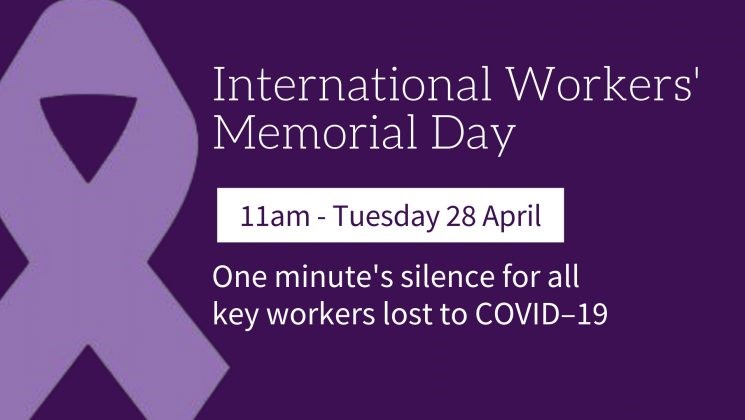
A minute’s silence will be held across the United Kingdom on 28 April to remember all the health, care and other key workers who have lost their lives to coronavirus.

The campaign, launched by the health unions UNISON, the Royal College of Nursing and the Royal College of Midwives – who between them represent more than a million NHS and public service workers, including porters, refuse collectors and care staff – are urging politicians, employers, people at work and those on lockdown at home to join the tribute at 11am.

The minute’s silence – held on International Workers’ Memorial Day #iwmd20 – will allow everyone to pay their respects and give thanks for the lives of those whose work involved caring, saving lives, keeping key services running and the rest of the country safe, say the unions. The tribute is also a show of support for the families of those who have died.

The three unions are hoping the government and other organisations will get on board and join the campaign for there to be a minute’s silence on the day, which every year commemorates workers who have died around the globe.

UNISON general secretary Dave Prentis said: “This is the ultimate tribute to remember workers who’ve lost their lives and put themselves in harm’s way to keep us safe and vital services running. Every year the sacrifice of workers around the world is recognised, but this year has a special significance because of the pandemic.

“Thousands of key staff are on the frontline while the rest of us are in lockdown. That’s why we’ve issued this call for the whole country to take part and remember the sacrifices they’ve made. The best tribute we can all pay them is to stay inside to protect the NHS.

“The minute’s silence is a thank you to all the workers including nurses, midwives, cleaners and care staff who’ve died from this devastating virus.”

Royal College of Nursing general secretary and chief executive Donna Kinnair said: “We’ve become used to hearing a great roar on a Thursday night for key workers, but this respectful silence will be a poignant reminder of the risks they run to keep us safe. I hope the public gets behind this with the same affection they show when applauding our people.

“The silence is a simple show of respect for those who have paid the very highest price, but their loved ones must know the levels of gratitude we feel as a nation and take some comfort from that.”

Royal College of Midwives chief executive and general secretary Gill Walton said: “We had expected 2020 to be a celebration of the International Year of the Nurse and Midwife but, although we actively applaud their service, this is not what we had imagined. Instead, across the country, midwives and maternity support workers are seeing the impact of coronavirus not only on the women in their care, but on their colleagues as well.

“We are proud to join UNISON and the RCN in this campaign and to recognise and remember those who we have lost.”

The minute’s silence will be held at 11am on Tuesday 28 April. The campaign hashtag for the minute’s silence is #neverforgotten.

UNISON news release.

Scotland: International Workers’ Memorial Day 2019 – remember the dead, fight for the living

Staff at UNISON Scotland gathered on Monday 29 April to mark International Workers’ Memorial Day 2019.

Each year on International Workers’ Memorial Day (April 28) we remember the dead and fight for the living. This year’s theme is ‘dangerous substances – get them out of the workplace’.

Around the world one worker dies every 15 seconds. Up to 50,000 people die each year in the UK. Although few UNISON members die in workplace incidents many suffer injuries and work related ill health, from stress or back pain to RSI, bullying, harassment, and workplace violence. These affect them and their families.

Health and safety in our workplaces protects those at work. It also protects those in the wider community. Whether it is a hospital, school or care home, our elderly and vulnerable relatives, our children and our communities are also protected by measures intended to keep everyone safe from harm.

UNISON knows that the key to providing a good and safe service is well-trained employees who have the time and protective equipment to do their job properly.

Today we remember all those killed through work and at the same time continue to work to ensure that such tragedies are not repeated. We will do that by building trade union organisation, and campaigning for stricter enforcement with higher penalties for breaches of health and safety laws. It is a day to remember those who have died or been injured at work.

Unison Scotland