Slovenia: Mednarodni delavski dan spomina na umrle na delovnem mestu – ZSSS

Od leta 1996 sindikati po vsem svetu na 28. april obeležujejo Mednarodni spominski dan na umrle in poškodovane delavce (International Workers’ Memorial Day – International Commemoration Day for Dead and Injured Workers) z geslom: “Spominjaj se umrlih in bori se za žive!”  Namen je s kampanjami ozaveščanja počastiti spomin na žrtve poškodb pri delu in poklicnih bolezni. 28. aprila se po vsem svetu pregleda statistika umrlih zaradi nezgod pri delu in poklicnih bolezni. ZSSS od leta 2006 dalje na ta dan javnosti posreduje svoja sporočila o stanju varnosti in zdravja pri delu v Sloveniji. Glej spodaj sporočila po letih !

Več ITUC na tej povezavi in Organizacija 28. april na tej povezavi

Izhajajoč iz te tradicije Mednarodna organizacija dela (ILO / MOD) od leta 2003 vsako leto 28. aprila obeležuje Svetovni dan varnosti in zdravja pri delu (World Day for Safety and Health at Work) z namenom, da bi po vsem svetu spodbudila preprečevanje nezgod pri delu in poklicnih bolezni. Gre za kampanjo ozaveščanja, katere namen je usmeriti mednarodno pozornost na nove trende na področju varnosti in zdravja pri delu ter na obseg poškodb pri delu, bolezni in smrtnih žrtev po vsem svetu.

Več ILO na tej povezavi

28. april 2026:

Sporočila in pozivi ZSSS ob 28. aprilu 2026

Statistika varnosti in zdravja pri delu IRSD, MDDSZ, KIMPDŠ, ZZZS in ZPIZ za leto 2025

Poročilo o poklicnih boleznih v letu 2025

18/2026 e-novica ZSSS (22. 4. 2026): Globalno poročilo MOD o psihosocialnem delovnem okolju ob 28. aprilu 2026

19/2026 e-novica ZSSS (23. 4. 2026): Znanje je prvi korak k zaščiti – 40 informativnih listov o rakotvornih snoveh

20/2026 e-novica ZSSS (27. 4. 2026): Poziv ETUC za predpis EU o najvišjih delovnih temperaturah, 28. april 2026


USA: Tree of life Workers’ Memorial Monument to be unveiled


A “Tree of Life” Workers Memorial Monument will be unveiled on Workers Memorial Day, April 28, 2026, in Haledon, New Jersey at 2pm.

 The invitation is above.  The address is Tilt Street Park (f/k/a Belmont Park), 407 Belmont Ave., Haledon NJ 07508.

 The monument is just a short walk from the American Labor Museum – Botto House National Landmark (the IWW headquarters during the 1913 Paterson Silk Strike).

Global: Jornada Internacional de Conmemoración de los Trabajadores Fallecidos y Lesionados 2026

Jornada Internacional de Conmemoración de los Trabajadores Fallecidos y Lesionados 2026: abordar los riesgos psicosociales en el trabajo

Con motivo de la Jornada Internacional de Conmemoración de los Trabajadores y Trabajadoras Fallecidos y Lesionados, el 28 de abril, la CSI hace un llamamiento a la acción urgente para abordar la crisis mundial de los riesgos psicosociales en el trabajo, la cual se ha convertido en una de las principales causas de muerte, enfermedad y sufrimiento entre los trabajadores y las trabajadoras de todo el mundo.

Detrás de la realidad cotidiana del trabajo, millones de personas trabajadoras se enfrentan a una presión continua: largas jornadas de trabajo, inseguridad laboral, objetivos imposibles de alcanzar y culturas empresariales tóxicas.

No solamente son malos empleos, son empleos peligrosos. El estrés, la ansiedad y el agotamiento ocupacional causan ahora más daños a escala mundial que los riesgos laborales tradicionales, como los inducidos por productos químicos o el polvo.

El nuevo informe de la CSI muestra la magnitud de la crisis:

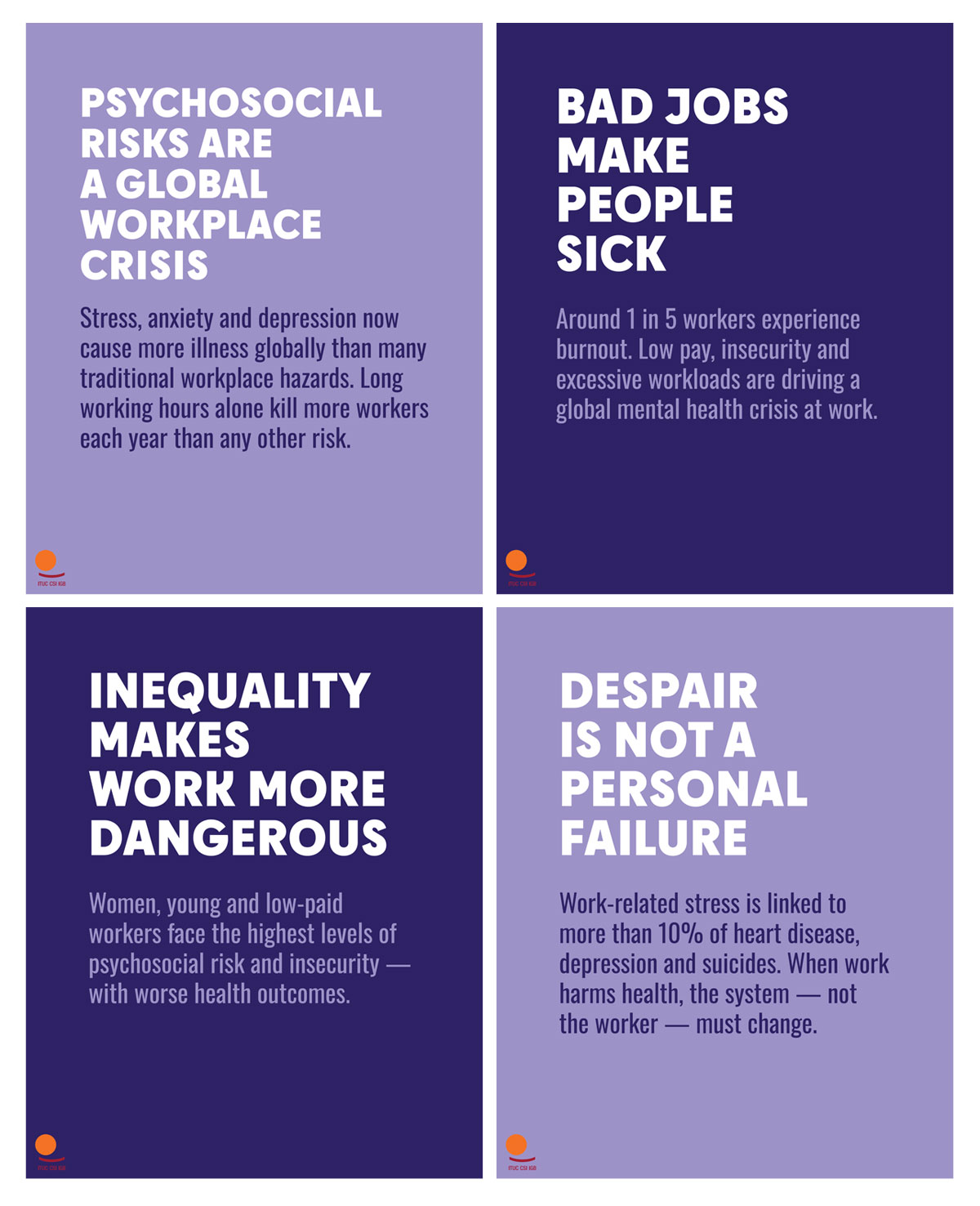
  • Solo las largas jornadas laborales son responsables de aproximadamente 745 000 muertes cada año.
  • Se registran al menos 70 000 suicidios anuales relacionados con el trabajo.
  • Se pierden 12 000 millones de días de trabajo cada año debido a la depresión y la ansiedad.
  • El agotamiento profesional afecta a aproximadamente uno de cada cinco trabajadores en todo el mundo.
  • Los riesgos psicosociales están relacionados con más del 10% de los casos de enfermedades cardíacas, depresión y suicidios.

Luc Triangle, secretario general de la CSI, afirmó en este sentido: “Los malos empleos pueden destrozar a cualquiera. Cuando la inseguridad laboral, las cargas de trabajo excesivas y la falta de control sobre el trabajo llevan a las personas trabajadoras más allá de sus límites, las consecuencias pueden ser fatales. No es algo inevitable: es el resultado de decisiones tomadas en las salas de juntas y por los gobiernos”.

En todo el mundo, los sindicatos demuestran que el cambio es posible. Los datos indican que una presencia sindical fuerte y democrática en el lugar de trabajo constituye la protección más eficaz contra los riesgos psicosociales, mejorando así la salud de las personas trabajadoras y los resultados económicos.

La CSI reclama:

  • Leyes estrictas para prevenir los riesgos psicosociales en el trabajo.
  • La plena implicación de los sindicatos en la salud y la seguridad en el trabajo.
  • Un trabajo decente, que incluya seguridad laboral, una remuneración justa, niveles de dotación de personal adecuados y cargas de trabajo asumibles.
  • El reconocimiento de los trastornos de salud mental como enfermedades profesionales.

Luc Triangle concluyó a este respecto: “Las soluciones a estos problemas comienzan por la democracia en el lugar de trabajo, con una voz para los trabajadores y trabajadoras a través de sus sindicatos. Los empleadores pueden pasar por alto
la salud psicosocial de las personas trabajadoras y agotarlas, perder valiosas competencias y sufrir las consecuencias económicas, o bien pueden colaborar con los sindicatos para garantizar que se valore a las personas trabajadoras. Si los empleadores tienen dificultades para reconocer cuál es la opción correcta, los sindicatos están preparados y dispuestos para recordárselo. La 
lucha por la democracia en el lugar de trabajo es la lucha por el bienestar de todos los trabajadores y trabajadoras”.

Este 28 de abril, conmemoramos a los fallecidos y luchamos por los vivos. El trabajo no debería costar vidas. Debe proteger las vidas, la dignidad y la salud mental.

https://www.ituc-csi.org/Jornada-Internacional-de-Conmemoracion-de-los-Trabajadores-Fallecidos-y-Lesionados-2026

Kenya: Heat stress is a key 28 April campaign theme for Kenyan unions

Three BWI affiliated unions in Kenya will be marking Workers’ Memorial Day with workplace-focused health and safety activities.

ETAWU is holding a workplace meeting and campaign aimed at strengthening workers’ representatives on occupational health and safety, with a focus on raising awareness of heat stress and wider work safety and health risks.

KBCTFIEU is conducting a workplace visit and awareness campaign at Zenith Fabricators in Isinya, meeting 50 workers and training 30 representatives who will relay information to around 580 union members and 600 workers.

UBCCECAWU is carrying out workplace awareness at Zhongmei Engineering Company, addressing compliance with core labour standards and emphasising occupational heath and safety and heat stress among over 300 road construction workers.

Global: Webinar – Ensuring a healthy psychosocial working environment – ILO

Join or watch this event live or replay on ILO Live.


How’s work?

For many workers, the answer lies not only in what they do, but in how their work is designed, organized and managed, and in the broader policies, practices and procedures that govern work. Work can offer meaning, support and a sense of purpose. But when demands are excessive, roles are unclear, support is lacking, or systems fail to protect people, psychosocial risks can harm workers’ safety and health, affect organizational performance and carry wider social and economic costs. As work continues to evolve, the challenge is not only to respond to harm, but to foster healthier psychosocial working environments through preventive action.

In commemorating the World Day for Safety and Health at Work 2026, this event brings together ILO constituents, ministers and international experts to discuss global developments and practical pathways for ensuring a healthy psychosocial working environment.

Join or watch this event live or replay on ILO Live


Argentina: Formación y debate sobre riesgos biológicos en el trabajo en el Día Internacional de la Seguridad y Salud laboral

28 de abril. Día internacional de la salud y seguridad en el trabajo
Actividad conjunta CTA-A y Espacio Intersindical Salud y Trabajo – gratuita
Modalidad híbrida
Horario: 15 a 19 hs en CTA-A


Esta actividad tiene como objetivo la Formación y Debate sobre el Convenio 192 sobre RIESGOS BIOLÓGICOS EN LOS LUGARES DE TRABAJO, y su Recomendación 209, instrumentos adopatos en OIT el año pasado con el consenso de las tres Centrales de Argentina.
La propuesta es dar a conocer este Convenio como un material útil y necesario, a fin de evaluar las diferentes situaciones de trabajo en relación a este riesgo.
Cada región del país y cada actividad laboral tiene realidades diferentes, con condiciones de trabajo comunes, por esto se propone conocer las diferentes realidades, compartir dificultades y construir, en un rico debate, prácticas preventivas colectivas.

Europe: Unions call for EU heat law on workers’ memorial day

Unions call for EU heat law on workers’ memorial day

The growing number of people dying because they are forced to keep working in extreme heat requires the EU to strengthen workers’ rights to meet the rising threat of climate change.

That is the message trade unions will give European Commission representatives on Tuesday at an event held to mark International Workers Memorial Day, the day on which the labour movement commemorates those who have lost their lives at work.

At the conference in Brussels organised by the European Trade Union Confederation (ETUC) and European Trade Union Institute, workers’ representatives will highlight the overwhelming evidence of the need for legislation to ensure employers work with unions to put in place common sense measures, such as the provision of drinking water, access to shade, and breaks in work.

  • There has been a 42% increase in heat-related workplace fatalities in the EU since 2000 – the fastest increase of any part of the world;

  • The number of people exposed to heat waves at work in the EU has increased by 60% over the last 20 years;

  • 47% of people say they have felt too hot at work, but just 15% say action has been taken to keep them safe;

  • When temperatures rise above 30°C, the risk of workplace accidents increases by 5-7% and, when temperatures exceed 38°C, accidents are between 10% to 15% more likely.

In 2023, the European Commission issued guidance on employers’ responsibility to people working in high temperatures. But research shows that employers have demonstrated “reluctance to adopt preventive measures” and a “refusal to accept the inclusion of [heat] specific measures” in collective bargaining agreements.

That contributed to a spate of preventable deaths last summer, including an agriculture worker who died in Spain after harvesting fruit in temperatures exceeding 40°C, two construction workers who died after collapsing with heat stroke, and a 50-year-old who died after his body temperature rose to 42,9 °C while working in a distribution centre in France.

That is why the ETUC is calling for legislation on maximum working temperatures to be included in the forthcoming Quality Jobs Act.

Speaking at the event, ETUC General Secretary Esther Lynch will say:

“Deaths from heat at work are not accidents – they are predictable and preventable, yet too many employers are still failing to take the risk seriously. 

“For many years now, our affiliates have been reporting tragic cases of workers dying as a result of exposure to extreme heat. These deaths are occurring across a wide range of sectors, including street cleaning, forestry, agriculture, construction, and even in indoor environments such as industry. Their loss underlines the urgent need to act.

“While the European Commission has taken steps in recent years, including issuing guidance, the reality on the ground is clear: guidance alone is not enough. As our members systematically report us, every summer, workers continue to fall ill, suffer accidents, and in the worst cases, lose their lives. This situation calls for urgent legislative action.”

ETUC Confederal Secretary Giulio Romani will say:

“Occupational heat is no longer an emerging issue – it is already a daily reality for millions of workers across Europe. As we have heard, this is not only about discomfort; it is about health, safety, and, increasingly, loss of life.

“There is, importantly, a window of opportunity. The ongoing work on the Quality Jobs Act provides a political space to integrate stronger protections for workers facing extreme weather conditions. This could be a key avenue to ensure that climate resilience becomes an integral part of quality employment in Europe.”

Photo: Carlos Costa/ European Union

https://www.etuc.org/en/pressrelease/unions-call-eu-heat-law-workers-memorial-day

Scotland: Multiple events to be held across Scotland – STUC / Scottish Hazards

STUC and Scottish Hazards are listing a comprehensive listing of 28 April events across the country.

See the listing on the STUC’s 28 April webpage

Friday 24 April

Bathgate – 11:00am
Workers Memorial, Bathgate Sports Centre, Torpichen Road, Bathgate


Saturday 25 April

Alexandria – 1:00pm
Memorial Tree, Christie Park

Cumbernauld – 11:00am
Workers’ Memorial, Cloudon Road

Falkirk – 11:00am
Workers’ Memorial, Bellsmeadow / Calendar Road, Falkirk

Kilmarnock – 11:00am
Memorial Tree, Dean Country Park, Dean Road


Tuesday 28 April

Aberdeen – 10:30am
Aberdeen Council Joint Trade Unions, Duthie Park, Polmuir Road

Aberdeen – 12:00pm
Action on Asbestos IWMD, Johnstone Gardens, Viewfield Road

Aberdeen – 1:00pm
Workers’ Memorial, Persley Walled Garden, Bridge of Don

Aberdeen – 3:00pm
NHS Grampian, Foresterhill Health Campus, Foresterhill Road

Angus (Forfar) – 11:00am
Forfar Community Campus, Kirriemuir Road

Bishopbriggs – 11:00am
Cadders Pit Memorial Cairn, Bishopbriggs Library & Community Hub

Bonnyrigg – 12:30pm
George V Park, Bonnyrigg

Coatbridge – 1:00pm
Summerlee Industrial Museum, Heritage Way

Dundee – 12:00pm
Memorial Tree, adjacent to Discovery Quay

Edinburgh – 12:30pm
Memorial and Tree, West Princes Street Gardens

Elgin – 1:00pm
The Moray Council Offices, 10 High Street, Elgin

Forfar – 11:00am
Forfar Community Campus, Kirriemuir Road

Falkirk – 11:00am
Worker’s Memorial, Bellsmeadow / Calendar Road

Glasgow – 12:00pm
Workers’ Memorial, People’s Palace / Winter Gardens, Glasgow Green

Greenock – 12:00pm
Wellpark Park, Greenock

Hamilton – 11:30am
Workers’ Memorial Stone, South Lanarkshire Council, Beckford Street

Inverness – 4:30pm
Workers’ Memorial, Friars Shott, Huntly Street

Kirkcaldy – 11:00am
Memorial Tree, Beveridge Park, Abbotshall Road

Paisley – 12:00pm
Workers’ Memorial, Renfrewshire House, Cotton Street

Renfrewshire – 11:00am
Workers’ Memorial Cairn, Robertson Park, Paisley Road

France: Journée mondiale de la santé et de la sécurité au travail

The French government will mark 28 April 2026  highlighting the need to prevent workplace deaths, injuries and illness. The Ministry of Labour focuses on awareness campaigns, labour inspection activity and national policy on improving working conditions.

Le jeudi 28 avril 2026 marquera la journée mondiale de la santé et de la sécurité au travail. Celle-ci vise à sensibiliser les employeurs et les salariés aux risques professionnels, afin de prévenir les accidents, les maladies et les décès liés au travail. Depuis 1996, cette date est également dédiée à la commémoration des travailleuses et des travailleurs morts ou blessés au travail, rappelant l’importance de la mobilisation de tous les acteurs pour renforcer la sécurité au travail.

En 2024, on a dénombré 824 accidents du travail mortels au sein du régime général et du régime agricole. Dans le régime général, ces accidents mortels sont principalement liés à des malaises, des accidents de la route, l’utilisation d’équipements de travail ou engins dangereux ou encore à des chutes de hauteur. Parmi ces décès, 22 jeunes de moins de 25 ans sont morts suite à un accident du travail en 2024.

Le plan national d’action (PNA) 2026-2029 de l’inspection du travail fait de la santé et de la sécurité au travail un sujet prioritaire d’intervention. Les enjeux de santé et de sécurité au travail constituent ainsi un axe majeur dans la protection des salariés et la sensibilisation des employeurs. Les inspecteurs du travail interviennent donc dans les entreprises ou sur les chantiers pour garantir la santé et la sécurité des salariés pour :

  • Contrôler le respect de la réglementation ;
  • Conseiller employeurs et travailleurs ;
  • Enquêter sur les accidents du travail ;
  • S’assurer de la mise en œuvre par l’entreprise de mesures correctives lorsque cela s’avère nécessaire, y compris par l’utilisation d’outils juridiques coercitifs.

Plus d’informations sur le site du gouvernement français

France: 28 avril – Journée internationale de la santé et la sécurité au travail – CGT

28 avril : Journée internationale de la santé et la sécurité au travail

Perdre la santé, perdre la vie en raison du travail : ça suffit !

Ce 28 avril 2026, journée internationale de la santé et de la sécurité au travail, la CGT appelle comme chaque année à la mobilisation pour qu’enfin de réelles mesures soient prises pour en finir avec la mort ou les blessures graves au travail.

Lire la suite dans le tract UFSE-CGT en téléchargement

Patronat et gouvernement doivent prendre en compte la réalité des situations sur les lieux de travail.
Dans le monde, chaque année, on dénombre près de 380 millions d’accidents du travail, entraînant absences, handicaps… voire la mort : plus de 3 millions de décès sont liés aux accidents du travail ou aux maladies professionnelles.

En 2024, le bilan de la Sécurité sociale dénombre 1 297 morts au travail ou par le travail (auxquels il faut ajouter les travailleur·es dépendant du régime agricole, des régimes spéciaux, de la fonction publique, et les indépendant·es, non comptabilisé·es dans le rapport) :

  • 764 décès à la suite d’un accident de travail ;
  • 318 à la suite d’un accident de trajet ;
  • 215 décès à la suite d’une maladie professionnelle.

C’est un scandale national, plus de 3 morts par jour – invisibilisées ou traitées le plus souvent comme de simples faits divers.

En 2025, 5 victimes étaient des mineurs, apprentis ou lycéens de moins de 18 ans.
C’est un bilan désastreux pour le gouvernement et le patronat qui défendent l’entreprise comme lieu d’apprentissage tout en refusant de prendre en compte la réalité du travail et ses conséquences.

Les morts à la suite d’une maladie professionnelle sont aussi en augmentation. Les cancers professionnels sont encore nettement sous-déclarés, et souvent non considérés comme liés à l’activité professionnelle, faussant ainsi les statistiques et donc à terme la prévention nécessaire des risques et la réparation des préjudices subis par les victimes du travail.

À ces morts s’ajoutent des milliers d’accidents graves occasionnant des lourdes séquelles parfois durables et entraînant trop souvent un licenciement pour inaptitude.

Lire la suite dans le tract CGT en téléchargement

Visitez la page web du 28 avril de la CGT

Rassemblements :
Ile-de-France : 12H30 – Ministère du Travail – 14, rue Duquesne – 75007 PARIS
Pour les territoires : contacter les Unions départementales CGT.

Rappel :

Tract UFSE-CGT « Le travail ne doit plus rendre malade ! »

Appel UFSE-CGT « 28 avril, 1er mai : mobilisons-nous pour nos droits ! »

Appel intersyndical au 28 avril : malades, blessé·es, tué·es au travail ou par le travail : stop !

Remember the dead, fight like hell for the living