Tag Archives: Heat stress

Europe: Heat deaths are not accidents they are failures of policy – EFFAT

International Workers’ Memorial Day 2026: The climate crisis is a workers’ crisis

Apr 28, 2026

Heat deaths are not accidents they are failures of policy.

Brussels, 28 April 2026 :  On International Workers’ Memorial Day, EFFAT joins the global labour movement in remembering workers who have lost their lives at work. This year, as we honour those we have lost, EFFAT demands urgent EU action to protect workers from extreme heat.

Another summer is coming. And we’re sure about one thing: it won’t be cooler.

Every year, extreme heat is killing workers:

  • In 2020, 29% of European workers were exposed to excessive heat.
  • Europe is the region with the most rapidly increasing workforce exposure to excessive heat
  • 47% of workers feel too hot at work, but only 15% report protective action is taken[1]
  • When temperatures exceed 30°C, workplace accidents increase by 5-7%[2]

Last summer, a farm worker died in Spain harvesting fruit at 40°C. A warehouse worker in France died when his body temperature reached 42.9°C.

Their deaths were preventable

For workers in agriculture, food processing, hospitality, and domestic work, extreme heat is not abstract: it is a daily threat that destroys lives and livelihoods. By 2030, working hours in agriculture will go down 60% globally due to heat, with Eastern Europe the hardest-hit region in Europe[3].

Voluntary measures are failing and will not stop heat waves

While the European Commission and EU-OSHA issued guidance in 2023, research shows employers demonstrate “reluctance to adopt preventive measures.” Workers continue to fall ill, suffer accidents, and die. High levels of precarious and undeclared work in agriculture and hospitality discourage workers from reporting heat stress, as they fear job loss or retaliation.

EFFAT’s Demands

EFFAT stands with the ETUC in demanding binding EU legislation on maximum working temperatures as part of the Quality Jobs Act and the Climate Adaptation Plan, including:

 Maximum working temperature limits
 The right to stop work when health is at risk
 Mandatory heat risk assessments using advanced indicators
 Stronger protections: changes in work organization, acclimatization, hydration
 Recognition of climate change and other extreme weather events as an occupational risk with income compensation for working hours lost

Enrico Somaglia, EFFAT General Secretary on Workers Memorial Day said: “Climate change is a reality and a major occupational risk. Every summer, workers pay the price of extreme heat with their health, and too often with their lives. These are not unavoidable tragedies; they are the result of political inaction. The EU must act now to guarantee safe working temperatures for all. Heat protection is a fundamental right, not a privilege”.

[1] Overheated and underprepared: Europeans’ experience of living with climate change | Publications | European Environment Agency (EEA)
[2] Heatwaves as an occupational hazard The impact of heat and heatwaves on workers’ health, safety and wellbeing and on social inequalities-2021.pdf
[3] Working on a warmer planet: The impact of heat stress on labour productivity and decent work

India: Unions highlight heat stress and just transition in Workers’ Memorial Day discussions

In India, BWI affiliated unions KSCWCU and AIKTMS are marking Workers’ Memorial Day through workplace discussions focused on occupational safety and health, just transition and the growing impact of heat stress on workers. These sessions bring together union participants to strengthen awareness and coordination around key challenges facing workers, particularly in the context of climate change and its effects on working conditions.

Kenya: Heat stress is a key 28 April campaign theme for Kenyan unions

Three BWI affiliated unions in Kenya will be marking Workers’ Memorial Day with workplace-focused health and safety activities.

ETAWU is holding a workplace meeting and campaign aimed at strengthening workers’ representatives on occupational health and safety, with a focus on raising awareness of heat stress and wider work safety and health risks.

KBCTFIEU is conducting a workplace visit and awareness campaign at Zenith Fabricators in Isinya, meeting 50 workers and training 30 representatives who will relay information to around 580 union members and 600 workers.

UBCCECAWU is carrying out workplace awareness at Zhongmei Engineering Company, addressing compliance with core labour standards and emphasising occupational heath and safety and heat stress among over 300 road construction workers.

Europe: Unions call for EU heat law on workers’ memorial day

Unions call for EU heat law on workers’ memorial day

The growing number of people dying because they are forced to keep working in extreme heat requires the EU to strengthen workers’ rights to meet the rising threat of climate change.

That is the message trade unions will give European Commission representatives on Tuesday at an event held to mark International Workers Memorial Day, the day on which the labour movement commemorates those who have lost their lives at work.

At the conference in Brussels organised by the European Trade Union Confederation (ETUC) and European Trade Union Institute, workers’ representatives will highlight the overwhelming evidence of the need for legislation to ensure employers work with unions to put in place common sense measures, such as the provision of drinking water, access to shade, and breaks in work.

  • There has been a 42% increase in heat-related workplace fatalities in the EU since 2000 – the fastest increase of any part of the world;

  • The number of people exposed to heat waves at work in the EU has increased by 60% over the last 20 years;

  • 47% of people say they have felt too hot at work, but just 15% say action has been taken to keep them safe;

  • When temperatures rise above 30°C, the risk of workplace accidents increases by 5-7% and, when temperatures exceed 38°C, accidents are between 10% to 15% more likely.

In 2023, the European Commission issued guidance on employers’ responsibility to people working in high temperatures. But research shows that employers have demonstrated “reluctance to adopt preventive measures” and a “refusal to accept the inclusion of [heat] specific measures” in collective bargaining agreements.

That contributed to a spate of preventable deaths last summer, including an agriculture worker who died in Spain after harvesting fruit in temperatures exceeding 40°C, two construction workers who died after collapsing with heat stroke, and a 50-year-old who died after his body temperature rose to 42,9 °C while working in a distribution centre in France.

That is why the ETUC is calling for legislation on maximum working temperatures to be included in the forthcoming Quality Jobs Act.

Speaking at the event, ETUC General Secretary Esther Lynch will say:

“Deaths from heat at work are not accidents – they are predictable and preventable, yet too many employers are still failing to take the risk seriously. 

“For many years now, our affiliates have been reporting tragic cases of workers dying as a result of exposure to extreme heat. These deaths are occurring across a wide range of sectors, including street cleaning, forestry, agriculture, construction, and even in indoor environments such as industry. Their loss underlines the urgent need to act.

“While the European Commission has taken steps in recent years, including issuing guidance, the reality on the ground is clear: guidance alone is not enough. As our members systematically report us, every summer, workers continue to fall ill, suffer accidents, and in the worst cases, lose their lives. This situation calls for urgent legislative action.”

ETUC Confederal Secretary Giulio Romani will say:

“Occupational heat is no longer an emerging issue – it is already a daily reality for millions of workers across Europe. As we have heard, this is not only about discomfort; it is about health, safety, and, increasingly, loss of life.

“There is, importantly, a window of opportunity. The ongoing work on the Quality Jobs Act provides a political space to integrate stronger protections for workers facing extreme weather conditions. This could be a key avenue to ensure that climate resilience becomes an integral part of quality employment in Europe.”

Photo: Carlos Costa/ European Union

https://www.etuc.org/en/pressrelease/unions-call-eu-heat-law-workers-memorial-day

Global: Call to action – International Workers’ Memorial Day 2026 – BWI

International Workers’ Memorial Day 
28 April 2026 
Intensifying the “Too Hot To Work Campaign”  
From Awareness to Agreements 

On 28 April, International Workers’ Memorial Day, BWI fights for the living and remembers those we have lost.

In 2026, we are intensifying our global Too Hot To Work Campaign while confronting the growing impact of extreme weather events on workers.

Heat stress is no longer a seasonal issue. It is a structural occupational hazard driven by climate change, unsafe production targets, and weak enforcement. At the same time, workers face escalating exposure to extreme weather, heatwaves, storms, floods, wildfires, and unpredictable climate conditions, which threaten their safety and lives. In 2023, the World Health Organisation (WHO) estimated that 250,000 additional deaths would occur each year by 2030 due to climate change. In 2024, the International Labour Organisation (ILO) report said that at least 2.41 billion workers – 71 per cent of the working population – are exposed to excessive heat, resulting in 22.85 million injuries and 18,970 deaths annually.

Workers in construction, building materials, forestry, and related sectors are paying the price.

This year, our priority is clear: move from awareness to enforceable protection.

Affiliates are encouraged to push for binding commitments, including:

  • Collective Bargaining Agreements with heat and climate risk clauses
  • Sectoral or national framework agreements
  • Legal and regulatory reforms
  • Company-level heat and climate protection plans
  • Joint declarations with employers

Where agreements already exist, promote them and use them as models.

Where protections are weak or absent, push for new signatures and stronger commitments.

BWI and its affiliates call for protections that guarantee:

  • The right to stop work in extreme heat or dangerous weather without retaliation, through set maximum temperature limits that account for weather conditions and humidity levels.
  • Paid cooling breaks and adjusted working hours
  • Access to water, shade, ventilation, and protective measures appropriate to weather risks
  • Mandatory heat and climate risk assessments
  • Emergency preparedness and evacuation procedures
  • Income protection when work is halted due to unsafe climate conditions
  • Compensation and long-term support for affected workers

Heat stress is predictable. Climate risks are escalating. Deaths are preventable.

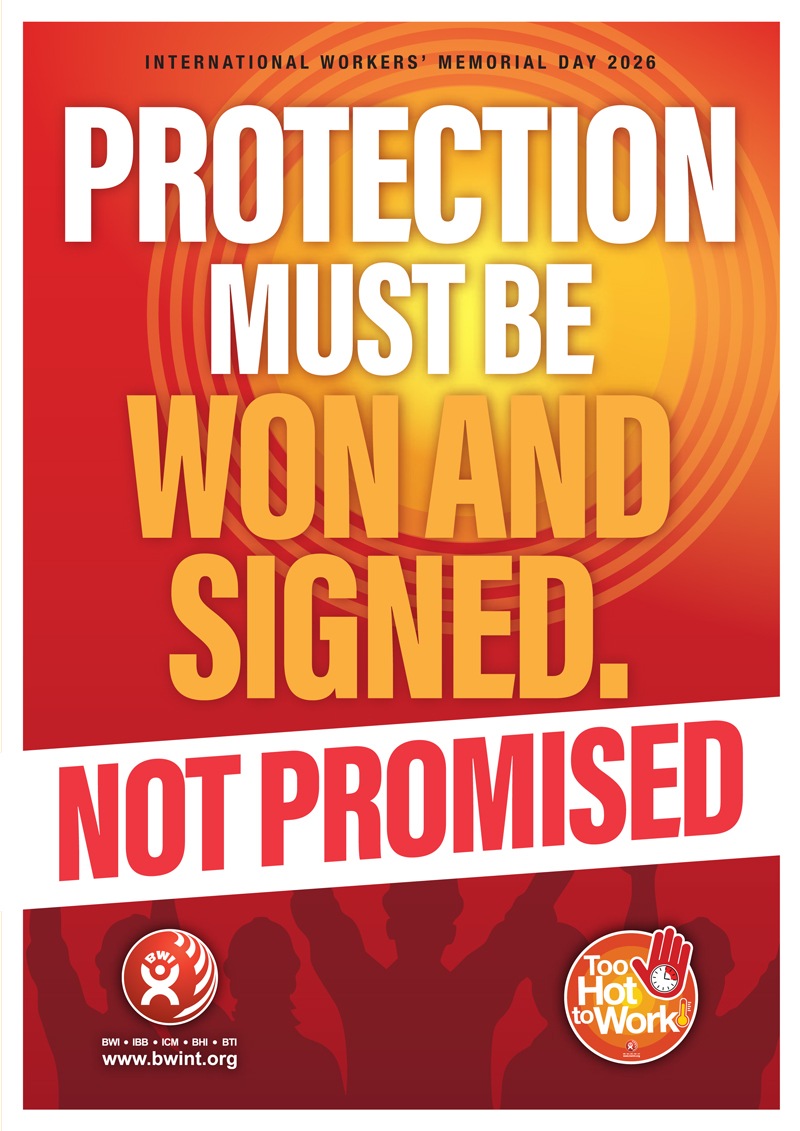
No worker should depend on goodwill. Protection must be written, signed, and enforceable.

Take Action

  • Secure or strengthen agreements
  • Publicise existing CBAs or joint agreements with heat and extreme weather protections
  • Initiate negotiations where no protections exist
  • Mobilise and train workers
  • Conduct toolbox talks and training on heat stress and climate risks
  • Equip safety representatives to identify climate-related hazards
  • Engage governments
  • Push for legally binding national standards and social protection schemes addressing heat and extreme weather risks
  • Call for integrating climate protection into national OSH and adaptation policies.

Share Your Agreements & Action. Showcase union power in action.

Send BWI:

  • Signed agreements
  • Joint declarations
  • CBA clauses
  • National legal commitments
  • Photos and videos from events or mobilisations

Share with your regional coordinator, and your actions will be featured on www.28april.org 

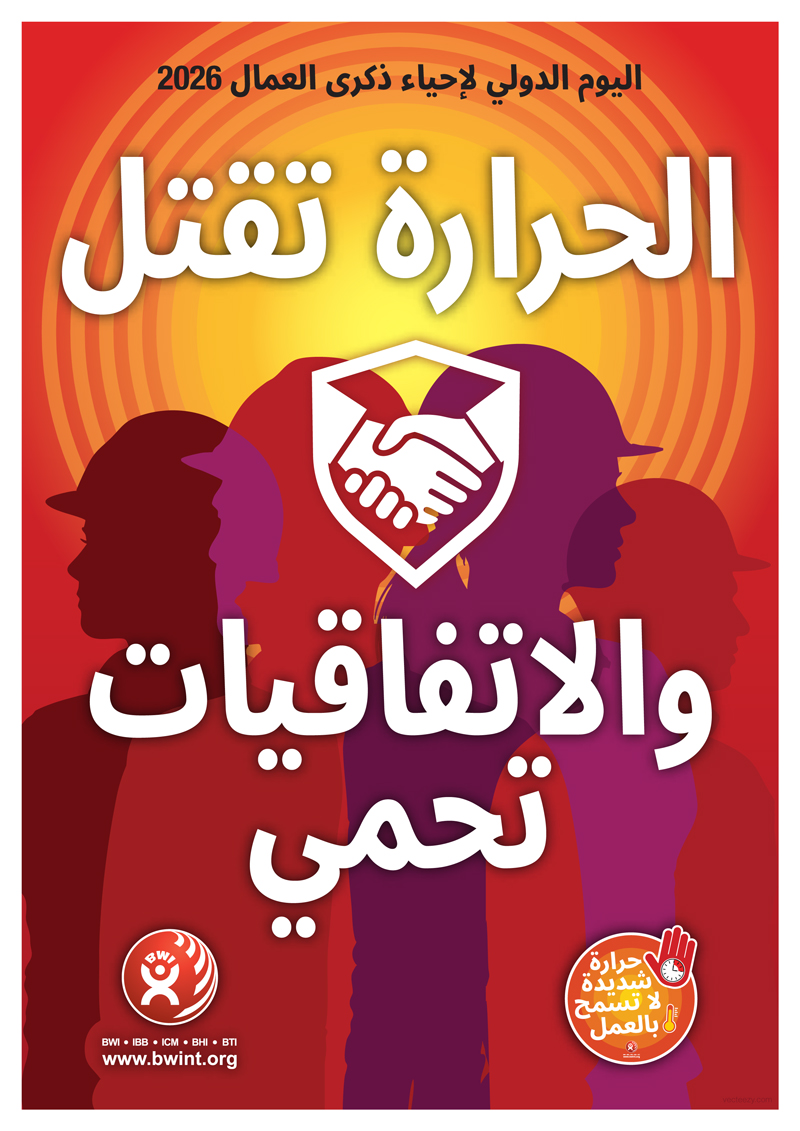
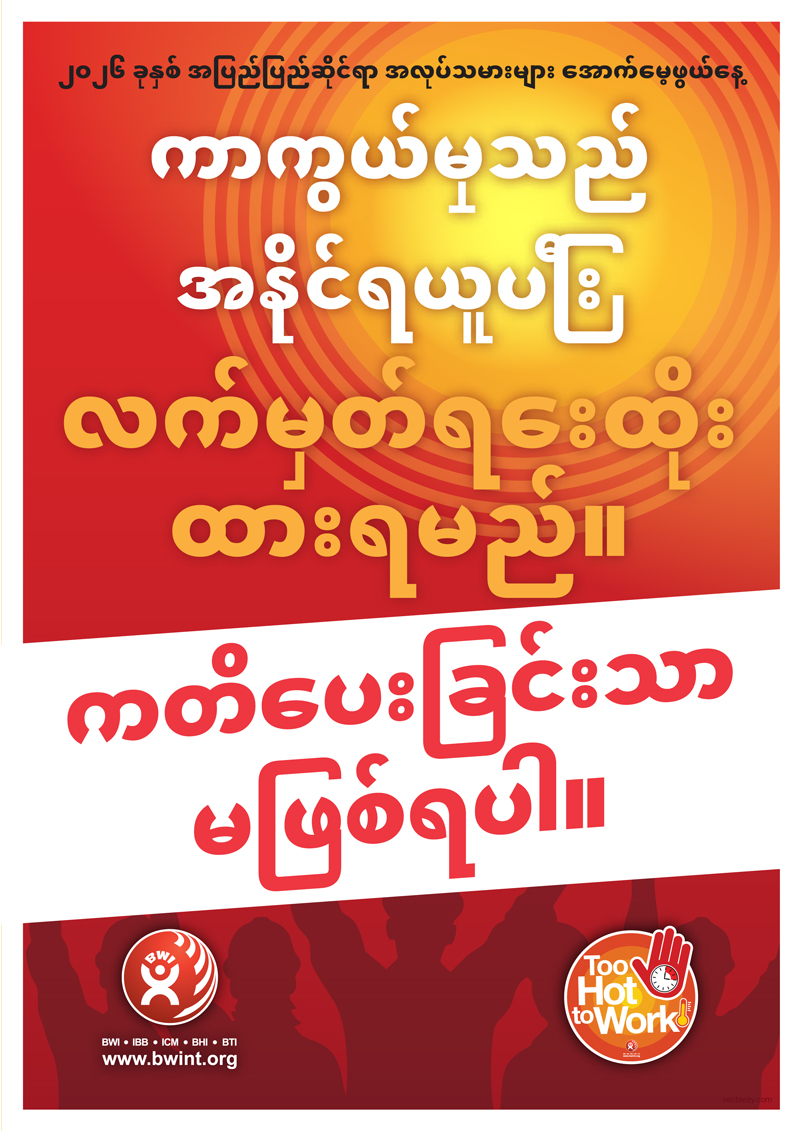
Download IWMD posters.  

#TooHotToWork #IWMD26 #BWI

Malaysia: Join the global campaign to stop heat stress and deadly dust – STIEU, TEUPM and UFES

For #IWMD2025, BWI’s Malaysian affiliates STIEU (Sabah), TEUPM (Kuala Lumpur), and UFES (Sarawak) join the global campaign to #StopDeadlyDust and “heat stress” at work.
Despite facing poor working conditions, low wages, and job insecurity, brave trade union affiliates—especially in the wood industry—stand united for better OSH and stronger protections.


Philippines: NUBCW inspecting workplaces to assess safety for 28 April

NUBCW and BWI  will be holding jointly International Workers Memorial Day Celebrations (IWMD) with Philippine Affiliates in Quezon City. Additionally there will be a joint inspection with BWI of the Asian development bank’s Malalos Clark railway project focusing on worker safety with specific focus on heat stress.