Tag Archives: csi

Global: Jornada Internacional de Conmemoración de los Trabajadores Fallecidos y Heridos: 28 de abril

Estimados compañeros y compañeras:

 El derecho a un entorno laboral seguro y protegido constituye un derecho fundamental en el trabajo, y la CSI va a seguir dando visibilidad a la necesidad de reforzar la salud y la seguridad de los trabajadores y las trabajadoras en vísperas de la Jornada Internacional de Conmemoración de los Trabajadores Fallecidos y Heridos (28 de abril). Este año la CSI dedicará especial atención a los riesgos psicosociales, y tiene previsto elaborar un informe específico sobre el tema.

 Los riesgos psicosociales se están convirtiendo cada vez más en una realidad para los trabajadores de una amplia variedad de sectores en todas las regiones. Este año la CSI pondrá de relieve muchos de los principales factores subyacentes que contribuyen a generar una incidencia cada vez mayor de riesgos como ansiedad, depresión y suicidio, e incluirá la inseguridad del empleo (trabajo temporal, trabajo en plataformas digitales), las largas jornadas laborales no reguladas, el escaso nivel de protección jurídica y de aplicación de la ley, los factores de estrés relacionados con el clima, y la externalización de trabajos especialmente peligrosos, como el etiquetado de datos y la moderación de contenidos, que se realizan mayoritariamente en el Sur global en condiciones pésimas.

 Una preocupante tendencia a la desregulación observada en muchos países está revirtiendo derechos y protecciones que con tanto esfuerzo consiguieron los sindicatos. No obstante, los sindicatos de todo el mundo se están movilizando, y la CSI quiere dar visibilidad para poner de relieve las numerosas acciones que estos están llevando a cabo, así como las reformas que están reclamando, en favor de la salud mental en el trabajo.

 Aunque muchas organizaciones tendrán sus propios temas prioritarios para el 28 de abril, lo fundamental es que los sindicatos se movilicen para garantizar que esta fecha siga representando la mayor y más eficaz acción mundial enfocada a dar visibilidad a la seguridad y la salud de los trabajadores y las trabajadoras.

 Para preparar el próximo informe de la CSI, agradecemos todas las contribuciones relativas a las experiencias de los sindicatos a la hora de abordar los riesgos psicosociales en el trabajo, como, por ejemplo, normas jurídicas de protección que los sindicatos hayan conseguido o en favor de las cuales hayan hecho campaña, convenios colectivos sobre el estrés y la salud mental en el trabajo, y campañas dirigidas por los sindicatos.

 De cara al 28 de abril, la CSI también desearía recibir información sobre los actos y actividades previstos, así como materiales relacionados. Se irán publicando actualizaciones y recursos en el sitio web www.28april.org. Les rogamos envíen a rory.oneill@ituc-csi.org información detallada sobre el trabajo que su sindicato realiza en este sentido.

 Sin otro particular, les saluda atentamente,

 Luc Triangle

Secretario general

Global: Journée internationale de commémoration des travailleuses et des travailleurs, le 28 avril

Chers/Chères collègues,

Le droit à un milieu de travail sûr et salubre est un droit fondamental au travail, et la CSI continuera à mettre en lumière la nécessité de renforcer la santé et la sécurité des travailleurs et des travailleuses en prévision de la Journée internationale de commémoration des travailleuses et des travailleurs (28 avril). Cette année, la CSI mettra l’accent sur les risques psychosociaux et élaborera un rapport en la matière.

Les risques psychosociaux sont une réalité de plus en plus tangible pour les travailleurs et les travailleuses dans un grand nombre de secteurs et dans toutes les régions. Cette année, la CSI mettra en évidence un grand nombre des principaux facteurs sous-jacents qui contribuent à accroître l’incidence des risques, tels que l’anxiété, la dépression et le suicide – notamment la précarisation de l’emploi (travail temporaire/via des plateformes numériques), les longues heures de travail non réglementées, les faibles niveaux de protection juridique et d’application de la législation, les facteurs de stress liés au climat et l’externalisation d’emplois particulièrement dangereux tels que l’étiquetage des données et la modération des contenus, effectués principalement dans les pays du Sud dans de mauvaises conditions.

Une tendance inquiétante à la déréglementation dans de nombreux pays réduit à néant les droits et protections durement acquis par les syndicats. Toutefois, les syndicats se mobilisent aux quatre coins du monde. La CSI a ainsi l’intention d’apporter de la visibilité en mettant en évidence les nombreuses actions lancées par les syndicats ainsi que les réformes qu’ils réclament pour apporter un soutien en matière de santé mentale au travail.

Alors que de nombreuses organisations établiront leur propre thème prioritaire à l’occasion du 28 avril, il est important que les syndicats se mobilisent afin de garantir que cette date continue de représenter l’action mondiale la plus importante et la plus efficace pour assurer une visibilité à la sécurité et à la santé des travailleurs et des travailleuses.

Dans le cadre des préparatifs du prochain rapport de la CSI, nous vous invitons à nous transmettre vos contributions concernant les expériences des syndicats en matière de lutte contre les risques psychosociaux au travail. Il peut s’agir de normes juridiques de protection obtenues ou défendues par les syndicats, de conventions collectives sur le stress et la santé mentale au travail ou de campagnes menées par les syndicats.

À l’approche du 28 avril, la CSI aimerait également recevoir des informations sur les activités et les événements prévus, ainsi que toute documentation s’y rapportant. Des mises à jour et des supports seront publiés sur le site web www.28april.org. Nous vous prions de bien vouloir envoyer des informations détaillées sur les actions menées par votre syndicat à rory.oneill@ituc-csi.org.

Salutations fraternelles,

Luc Triangle

Secrétaire général

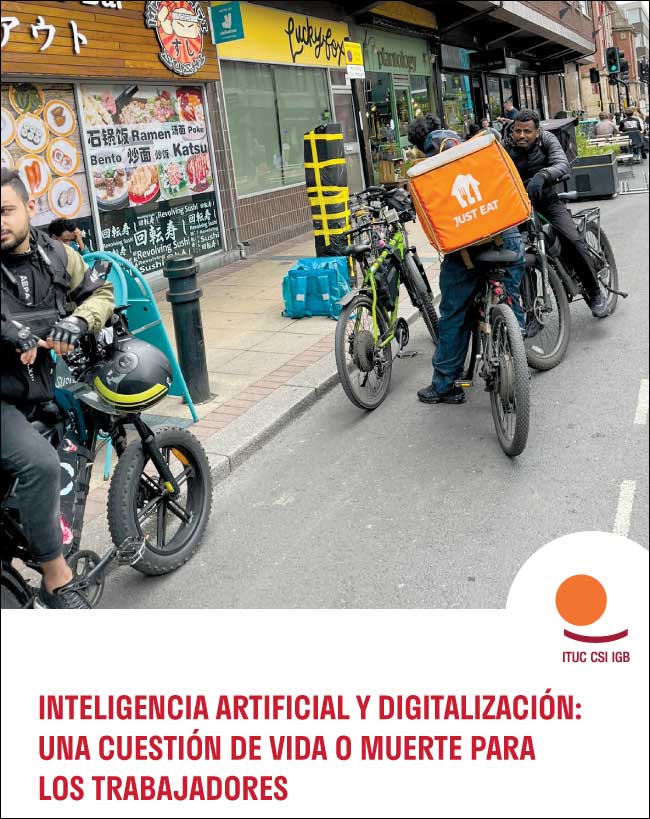
Global: CSI – Inteligencia artificial y digitalización: una cuestión de vida o muerte para los trabajadores

Inteligencia artificial y digitalización: una cuestión de vida o muerte para los trabajadores En este informe de la CSI se identifican daños físicos y psicosociales generalizados en el trabajo asociados al uso de estas tecnologías, desde la sobrecarga cognitiva que supone para los humanos tener que trabajar en tándem con robots – cobots o robots colaborativos – hasta lesiones por movimientos repetitivos, estrés y depresión como consecuencia de objetivos inalcanzables determinados y controlados por algoritmos. Descargar aquí


Global: CSI – Intelligence artificielle et numérisation : une question de vie ou de mort pour les travailleureuses

Le présent rapport – Intelligence artificielle et numérisation : une question de vie ou de mort pour les travailleureuses –  identifie les dommages physiques et psychosociaux couramment associés à l’utilisation de ces technologies sur le lieu de travail, lesquels vont de la surcharge cognitive touchant les personnes obligées de travailler en tandem avec des robots – les « cobots » – aux blessures dues à la fatigue, au stress et à la dépression en raison de quotas irréalisables fixés et suivis par des algorithmes.
Télécharger ici

Mondial: Matériel de campagne de la Journée internationale de commémoration des travailleurs de la CSI

Journée internationale de commémoration des travailleuses et des travailleurs morts ou blessés au travail 2025 : protéger les droits des travailleurs à l’ère de la numérisation et de l’intelligence artificielle

À l’occasion de la Journée internationale de commémoration des travailleuses et des travailleurs morts ou blessés au travail, du 28 avril 2025, la CSI réclame des actions urgentes pour préserver la vie et les droits des travailleuses et des travailleurs à l’ère de la numérisation et de l’intelligence artificielle (IA).

Voir les matériels de campagne ici

Global: Materiales de campaña del Día Internacional en Memoria de los Trabajadores de la CSI

Jornada Internacional de Conmemoración de los Trabajadores Fallecidos y Lesionados 2025: Proteger los derechos de los trabajadores en la era de la digitalización y la inteligencia artificial.

Con ocasión de la Jornada Internacional de Conmemoración de los Trabajadores Fallecidos y Lesionados, que se celebra el 28 de abril, la CSI ha hecho un llamamiento para que se adopten medidas urgentes destinadas a salvaguardar la vida y los derechos de los trabajadores en la era de la digitalización y la inteligencia artificial (IA).

Para descargar los gráficos y obtener mayor información, visiten aquí

POLAND: Światowy Dzień Bezpieczeństwa i Ochrony Zdrowia w Pracy 2024: BEZPIECZEŃSTWO PRACY A ZMIANY KLIMATYCZNE

Światowy Dzień Bezpieczeństwa i Ochrony Zdrowia w Pracy 2024:

BEZPIECZEŃSTWO PRACY A ZMIANY KLIMATYCZNE

 Szanowni Państwo,

 Uprzejmie informuję, że na stronie https://bit.ly/ciop-safeday-2024 zamieściliśmy informacje dotyczące tematyki i obchodów Światowego Dnia Bezpieczeństwa i Ochrony Zdrowia w Pracy. Są tam: plakat Dnia (do druku), baner internetowy, infografiki, linki do nagrań seminariów oraz szereg materiałów źródłowych – m.in.:

 Obciążenia cieplne pracowników w środowisku cieplnym i zimnym (pdf)

 Zachęcamy do wykorzystania zgromadzonych materiałów.

 Z pozdrawieniami

Dorota Pięta
Ośrodek Promocji i Wdrażania
tel. 22 623 37 22

Centralny Instytut Ochrony Pracy – Państwowy Instytut Badawczy
ul. Czerniakowska 16, 00-701 Warszawa
www.ciop.pl

Australia: New worker protections against silica will save lives

Australian national union federation ACTU has welcomed a 22 March 2024 decision by the country’s Labor government and work health and safety (WHS) ministers to move closer to a full ban on engineered stone and implement new regulations to protect all workers from exposure to silica dust.

ACTU assistant secretary Liam O’Brien: “Next month we mark International Workers’ Memorial Day, a day where we remember those who have lost their lives at work and fight to ensure others don’t have the same fate. The passing of these protections is a fitting tribute and testament to the hard work of unions in keeping us all safe at work.

“Unions will always fight to keep workers safe from harm. Unions thank WHS Ministers for listening to workers and health experts in banning engineered stone. None of this would’ve been possible without the campaign of unions, like the CFMEU, and organisations that demanded strong action to keep workers safe.

“The war on silicosis is not over until these new rules are in place, properly enforced, and employers and workers are aware of them. The best way to protect yourself and your workmates is to join your union.”

www.actu.org.au

28 April resources: Climate risks for workers

28 April resources: Climate risks for workers

ITUC

ITUC climate change webpages.

ITUC global shifts – just transition webpages.

Biological hazards and the work environment: Trade union position and priorities ahead of the International Labour Conference 2024 first discussion on occupational safety and health protection against biological hazards, ITUC, December 2023.

Peligros biológicos y entorno laboral: Postura y prioridades de los sindicatos de cara al primer debate de la Conferencia Internacional del Trabajo 2024 sobre protección de la salud y la seguridad en el trabajo contra los peligros biológicos, CSI, Diciembre 2023.

Risques biologiques et environnements professionnels: Position et priorités des syndicats en prévision de la première discussion de la Conférence internationale du Travail 2024 sur la protection de la sécurité et de la santé contre les risques biologiques sur les lieux de travail, CSI, Decembre 2023.

Hazards

Climate and workers’ health webpages.

ILO

ILO social protection, climate change and just transition webpages.

ILO ACTRAV (workers’ bureau) environment and climate change webpages.Working on a warmer planet: The impact of heat stress on labour productivity and decent work, ILO, July 2019.

ETUC

Adaptation to Climate Change and the world of work webpages.

Adaptation to Climate Change and the world of work: A guide for trade unions, ETUC, 2020.

Related toolkits in other languages.

EN • DE • FR • ES • IT • PT • NL • HR • PL • GR • FI_videoCZ_Guide

Other

HesaMag special edition, Workers and the climate challenge | etui Winter 2023

The Right to Refuse Unsafe Work in an Era of Climate Change, NELP, 27 March 2023.

Environmental heat stress on maternal physiology and fetal blood flow in pregnant subsistence farmers in The Gambia, west Africa: an observational cohort study, The Lancet Planetary Health, volume 6, issue 12, e968-e976, 1 December 2022.

Muhammad Hidayat Greenfield. An urgent need to reassess climate change and child labour in agriculture, The Lancet Planetary Health, first published online 18 May 2022.

MCN Position Statement: Climate-Integrated Disaster Preparedness Needed to Protect Most Vulnerable Workers, Migrant Clinicians Network, December 2021.

Xiuwen Sue Dong and others. Heat‐related deaths among construction workers in the United States, American Journal of Industrial Medicine, First published online 22 July 2019. https://doi.org/10.1002/ajim.23024

ETUC Resolution on the Need for EU Action to Protect Workers from High Temperatures, adopted December 2018.

Climate crisis a major workplace risk, warns ITUC

#iwmd24   |   Climate risks for workers   |    ITUC International Workers’ Memorial Day/Day of Mourning theme announced

The climate crisis is creating new and heightened occupational risks to workers, the International Trade Union Confederation (ITUC) is warning.

Extreme weather and changing weather patterns are affected job security and health for workers, the global union body says. In response to the crisis, it says, the theme for International Workers’ Memorial Day on 28 April 2024 will be ‘Climate risks for workers’.

 Heat-related deaths and diseases in workers in agriculture, construction and other outdoor jobs have soared, ITUC notes. It adds work in extreme weather can cause fatigue and increases in workplace injuries and stress-related disease. Elevated levels of airborne pollution associated with heatwaves can lead to increased hospitalisations and deaths, it warns. And it adds higher UV exposures place workers at risk of chronic health problems, including skin cancer and eye damage (macular degeneration).

The ITUC alert comes in the wake of climate-related health warnings from UN agencies. A World Health Organisation (WHO) December 2023 statement noted the year had witnessed “an alarming surge in climate-related disasters, including wildfires, heatwaves and droughts, leading to the displacement of populations, agricultural losses and heightened air pollution. The ongoing climate crisis has significantly increased the risk of life-threatening diseases such as cholera, malaria and dengue.”

A September 2023 International Labour Organisation (ILO) just transition policy brief, Occupational safety and health in a just transition, noted the climate crisis “without proper controls in place, may increase the risk for injury, disease and death for workers due to heat stress, extreme weather events, exposure to hazardous chemicals, air pollution and infectious disease, among others.”

ILO added: “Numerous health effects on workers have been linked to climate change, including injuries, cancer cardiovascular disease, respiratory conditions, and effects on their psychosocial health. There has been an increase in the estimated number of deaths among the global working-age population due to exposure to hot temperatures.”

ITUC notes that climate change is also putting workers at increased risk from infections. “The climate crisis, urbanisation and changing land use are impacting on occupational health and safety and have led to biological hazards posing new risk or risks in new places,” a December 2024 ITUC briefing on biological hazards notes.

It is a point reinforced in the ILO just transition policy brief, which warns “risks from vector-borne diseases, such as malaria or dengue fever, will increase with warming temperatures, including potential shifts in geographic range of these vectors as a result of climate change.

“This development affects all workers, especially outdoor workers who are at higher risk of contracting vector-borne diseases, from vectors such as mosquitoes, fleas and ticks. Moreover, infectious diseases may also affect workers via waterborne and foodborne pathogens, such as Salmonella spp. when they have direct contact with contaminated water or food.”

ILO has said it will commemorate World Day for Safety and Health at Work on 28 April, and will follow the theme adopted by ITUC and unions worldwide, focusing on “the impacts of climate change on occupational safety and health”. ILO added it will produce supporting promotional materials including a poster and report and will organise a global event with experts and guest speakers from governments, employers and workers “to discuss how to protect workers and respond to this global challenge.”

ITUC will produce its own guides and social media resources which will be available on its dedicated International Workers’ Memorial Day website, www.28april.org

Resources

ITUC climate change webpages.

ITUC global shifts – just transition webpages.

Hazards climate and workers’ health webpages.