Category Archives: Resources

Global: Tema del Día Internacional de la Memoria de los Trabajadores/Día de Duelo, 28 de abril de 2025

Estimados/estimadas colegas,

En 2025, la CSI propone continuar con el tema del 28 de abril: “Salud y seguridad en el trabajo: Un derecho fundamental en el trabajo”.

Este año, habrá un enfoque adicional explícito sobre el impacto de la inteligencia artificial (IA) y la digitalización en la salud y la seguridad en el trabajo.

Aunque la inteligencia artificial puede utilizarse para mitigar el trabajo monótono, en el contexto laboral, la IA está aumentando la intensificación del trabajo, la supervisión y la vigilancia, generando impactos negativos en el bienestar mental y físico sobre los trabajadores al sentir la presión extrema de la microgestión constante en tiempo real y la evaluación automatizada.

En los próximos meses, la CSI proporcionará recursos relacionados y materiales para las redes sociales. Mientras tanto, adjuntamos un breve artículo elaborado por nuestro experto Rory O’Neill, el cual podrá darles unas ideas generales iniciales.

La Organización Internacional del Trabajo (OIT) también destacará los riesgos para la salud y la seguridad en el lugar de trabajo asociados a la IA (véase el anuncio de la OIT en varios idiomas (inglés, español, francés): Crecimiento de la Inteligencia Artificial y la Digitalización: ¿un salto en la dirección correcta para la seguridad y la salud en el trabajo? | International Labour Organization)

Por supuesto, muchas organizaciones tendrán sus propios temas prioritarios. La cuestión fundamental es que los sindicatos se movilicen para garantizar que el 28 de abril siga siendo la mayor y más eficaz actividad en materia de salud y seguridad en el trabajo.

Por favor, asegúrense de informar a la CSI de las actividades que tengan previstas y de cualquier recurso relacionado, y envíen detalles de sus eventos a medida que se produzcan. Publicaremos recursos y actualizaciones en nuestra página web dedicada al 28 de abril, www.28april.org.
Pueden enviar detalles de sus actividades a rory.oneill@ituc-csi.org.

Nuestros mejores deseos,

Luc Triangle
General Secretary

New Zealand: 28 April resources – NZCTU Te Kauae Kaimahi

New Zealand Council of Trade Unions Te Kauae Kaimahi has published a host of  Workers’ Memorial Day resources on their on 28 April webpage.

In additional to listing events NZCTU has called for any additional events to be submitted.

Resources include 

Artificial Intelligence in the Workplace: A Resource for New Zealand Trade Unions

Unions make work safe poster

NZCTU Health and Safety starter pack 2025


More details here


New Zealand: Artificial intelligence in the workplace: A resource for New Zealand trade unions

NZCTU has developed Artificial Intelligence in the Workplace: A Resource for New Zealand Trade Unions – a resource guide on the topic of this year’s 28 April theme.

The introduction of AI in workplaces can create significant health and safety risks for workers (such as intensification of work, and extreme surveillance) which can significantly impact workers’ mental and physical wellbeing.

It is critical that unions and workers are involved in any decision to introduce AI so that these risks can be eliminated, and that the benefits and productivity gains are shared with the workforce.

The NZCTU Te Kauae Kaimahi has developed Artificial Intelligence in the Workplace: A Resource for New Zealand Trade Unions to support workers and their unions to ensure that workers benefit from the introduction of AI and are not harmed by it.

UK: Technology shouldn’t be the boss of you. #iwmd25

Hazards magazine warns that the UK’s rush to exploit AI, algorithmic management and automation could be dangerous for workers, with work intensification, psychosocial problems and management by algorithm making work more unsafe and more unfair. A special report for International Workers’ Memorial Day, 28 April 2025.

Code red: AI and digitalisation – technology shouldn’t be the boss of youHazards magazine report, April 2025.

Canada: Workers’ Day of Mourning | April 28, 2025 | CUPE Saskatchewan

On April 28, we gather to mourn workers who have been killed, injured, or made ill because of workplace hazards or incidents – and recognize the lasting impact on their families and communities. Attend vigils on April 28 in Regina (City Hall at 5:30 p.m.), Moose Jaw (Union Centre at 6:00 p.m.), Saskatoon (Civic Square at 6:00 p.m.), and Weyburn (T.C. Douglas Calvary Centre at 5:30 p.m.).

In 2024, 27 workers in Saskatchewan lost their lives due to work-related causes, not including farm-related fatalities or other workplaces that are not covered or reported by workers’ compensation. 10 fatalities were due to occupational disease and 17 fatalities were from traumatic incidents (four motor vehicle collisions, equipment contact and drowning).

The Workers’ Day of Mourning is a call to “Mourn for the Dead, Fight for the Living ”, created by CUPE members more than 40 years ago to remember those who lost their lives on the job and to inspire other workers to fight to prevent further tragedies. Visit the CUPE Saskatchewan health and safety hub for more resources.


As trade unionists, we also know the importance of holding employers accountable to recognize and address the impacts of systemic understaffing – including the resulting stress and over work on the health of public service workers, the need to address and prevent exposure to violence on the job, and the importance of a psychologically safe working conditions and the prevention of mental health injuries. The health and safety of workers includes the prevention of mental health injuries from work, the prevention of suicide, and recognizing psychosocial hazards.


Attend a vigil in your community:

Regina & District Labour Council

  • Where: Regina City Hall (2476 Victoria Avenue) * In the event of inclement weather, the ceremony may move indoors to the Regina Union Centre (2709 – 12th Avenue)
  • When: Monday, April 28th at 5:30 pm
  • Contact: Dee Wagner, President, wagnerdee5@gmail.com

Moose Jaw & District Labour Council

  • Where: Moose Jaw Union Centre (1402 Caribou Street West) * The event will be held outdoors, however, in the event of inclement weather, the ceremony will be held inside the main hall. Annual vigil, wreath laying
  • When: Monday, April 28th at 6:00 pm
  • Contact: Deidre Wilson, President, mjdlcpresident@gmail.com

Saskatoon & District Labour Council

  • Where: Civic Square (222 3rd Avenue North, Saskatoon)
  • When: Monday, April 28th at 6:00 pm
  • Annual vigil, wreath laying. *If you would like to present a commemorative to your fellow workers, please register prior to the ceremony starting at 6:00pm.
  • Contact: Don MacDonald, President, sdlc@sasktel.net

Weyburn & District Labour Council

  • Where: T.C. Douglas Calvary Centre (#400-10th Avenue, Weyburn)
  • When: Monday, April 28th at 5:30 pm
  • Annual vigil, wreath laying
  • Contact: Wanda Bartlett, President, wbartlett@sasktel.net

https://sk.cupe.ca/2025/04/15/workers-day-of-mourning-april-28-2025/

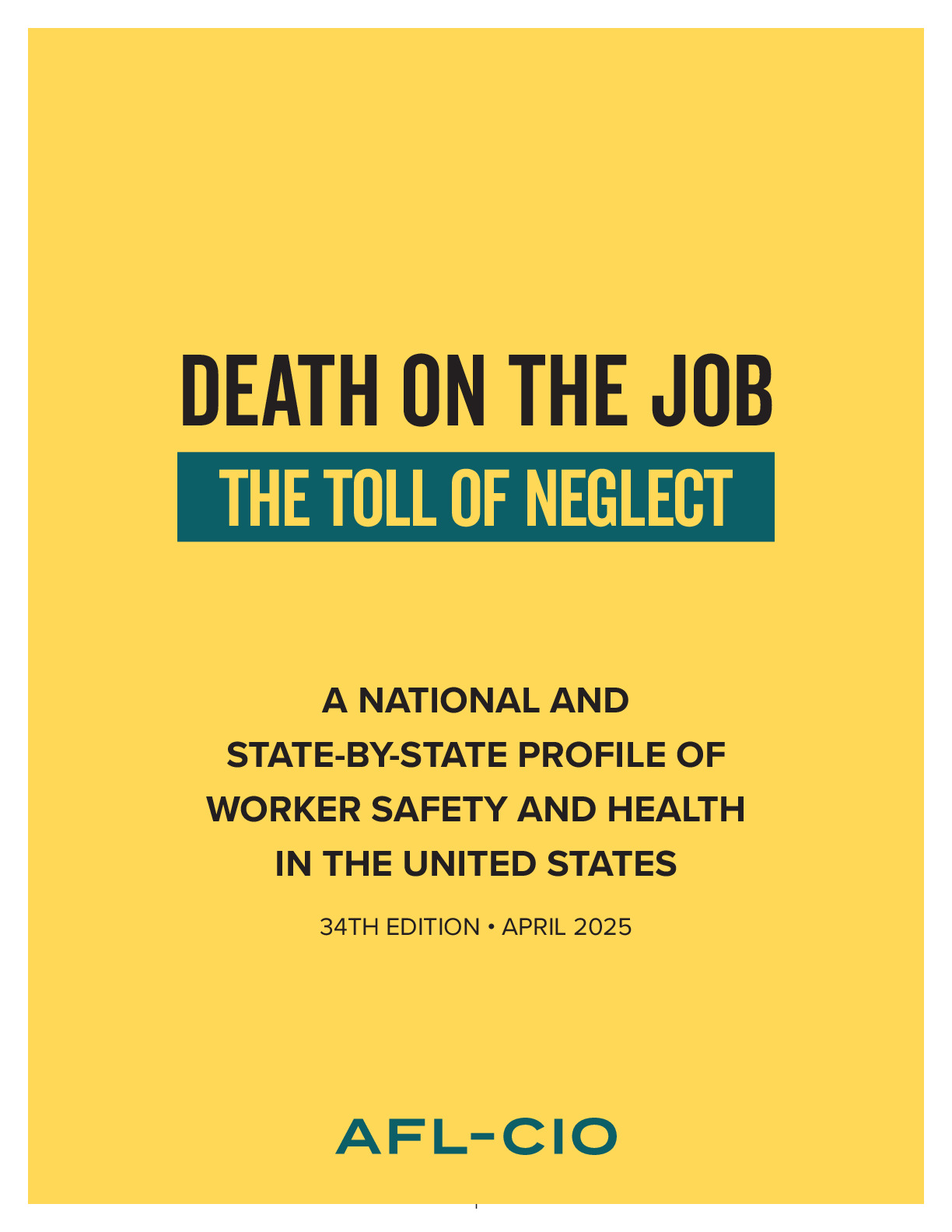
USA: AFL-CIO Workers’ Memorial Day 2025 toolkit online!

AFL-CIO has published its Workers, Memorial Day toolkit

This year’s theme is in the USA is “Fight for Our Lives: Safe Jobs Now!”  On our website, you can: 

Poland: Digitalisation and artificial intelligence – a new era of work [CIOP]

On 28 April, Poland observes the World Day for Safety and Health at Work. This year’s theme is: Digitalisation and artificial intelligence – a new era of work

Modern technologies are transforming our workplaces — influencing work organisation, productivity, and also the safety and health of workers. This year, at the initiative of the International Labour Organization, we are looking into the role of artificial intelligence, machine learning, exoskeletons, the Internet of Things, virtual and augmented reality, as well as the challenges associated with remote work and digital platforms.

How can we leverage innovation to improve safety while minimising risks? What changes lie ahead in the coming years? We will seek answers to these questions during the observance, with more details available at:

www.ciop.pl/28kwietnia

Poland: Cyfryzacja i sztuczna inteligencja – nowa era pracy

28 kwietnia obchodzimy w Polsce Światowy Dzień Bezpieczeństwa i Ochrony Zdrowia w PracyTegoroczne hasło brzmi:

Cyfryzacja i sztuczna inteligencja – nowa era pracy

Nowoczesne technologie zmieniają nasze miejsca pracy – wpływają na organizację pracy, wydajność, ale także na bezpieczeństwo i zdrowie pracowników. W tym roku, z inicjatywy Międzynarodowej Organizacji Pracy, przyglądamy się roli sztucznej inteligencji, uczenia maszynowego, egzoszkieletów, Internetu rzeczy, wirtualnej i rozszerzonej rzeczywistości, a także wyzwaniom związanym z pracą zdalną i platformami cyfrowymi.

Jak wykorzystać innowacje, by poprawić bezpieczeństwo i jednocześnie minimalizować ryzyko? Jakie zmiany czekają nas w najbliższych latach? Odpowiedzi na te pytania poszukamy podczas obchodów, których szczegóły można znaleźć na stronie:

www.ciop.pl/28kwietnia


Global: Time to deliver rights for ALL platform workers – ITUC

Millions of people worldwide now depend on digital platforms for their income. From food delivery couriers to ride hailing drivers and content moderators, technological innovation has opened new opportunities for workers and consumers. However, it has also created a system where workers are often denied their basic rights and protections.

Many platform companies argue that they merely provide useful technology that connects independent contractors with customers. In reality, they exert control over wages, working hours, and conditions – without being held accountable for existing standards that govern fair pay or social protections.
The result? Unstable earnings, no sick leave or pensions, and workers left vulnerable to sudden “deactivation” by machine-driven decision-making. The ITUC is calling for global rules to ensure platform workers are protected. We are campaigning for a binding International Labour Organization (ILO) Convention, backed by a Recommendation, to establish fair standards worldwide.

Why this campaign, now?

Under international law, every worker is entitled to decent working conditions and fundamental rights. Yet platform workers often face:

  • Labour standards that are sidestepped or poorly enforced.
  • Low, unpredictable wages.
  • A lack of social protections like insurance, sick leave, and pensions.

Job security is minimal, with workers at risk of being “logged out” or “deactivated.” Over the past two decades, platform companies have reshaped industries while using business models that circumvent labour laws:

  • Operating in a regulatory grey zone to avoid employer responsibilities.
  • Misclassifying workers as “partners” or “contractors” to deny basic protections.
  • Lobbying against regulations that would ensure fair pay and safe conditions.

Big platform companies are making massive profits while shifting all the risks onto workers. They operate in a legal grey zone, avoiding employer responsibilities and lobbying against regulations that would ensure fair conditions. This “race to the bottom” threatens not only platform workers but the entire workforce as technology expands further into new sectors.

Download the campaign toolkit and social media material

ITUC Time to deliver rights for ALL platform workers

Global: Trade union rights are key to technological transformation

At a major global summit on artificial intelligence (AI), the ITUC has called for stronger worker involvement in how AI is introduced and used in the workplace.

The AI Action Summit, which commenced on 10 February 2025 and was hosted by the French government, brought together heads of state, international organisations, multinational companies, trade unions, and academics to address the societal implications of AI.

Speaking at the event, which precedes the digitisation and AI themed International Workers’ Memorial Day on 28 April, ITUC deputy general secretary Eric Manzi (above) stressed the need to protect and involve workers.

“The future of work, shaped by digitalisation and AI, is inevitable, but the outcomes are not predetermined. The question is not if this change comes, but how it is managed. And for this, workers’ trade unions are crucial,” he said.

“By ensuring that trade unions are actively involved in this transformation, we can create a future of work that is both inclusive and equitable.”

“This means respecting the fundamental, democratic trade union rights of collective bargaining and social dialogue. This is about democracy in the workplace that delivers technological changes that work for everyone.

“At the same time, we need strong safeguards against the unchecked use of algorithms in employment decisions and worker surveillance. We need strengthened regulation at national and international level to protect workers in the age of AI.”

Christy Hoffman, general secretary of UNI Global Union, outlined an urgent decision facing our societies: either let AI widen the gap between rich and poor or give workers a seat at the table to shape its future.

Representing more than 20 million workers across 150 countries, Hoffman joined a high-profile panel on “Harnessing AI for the Future of Work” where she called on governments, employers and tech giants to put people at the centre of AI innovations.

Hoffman stressed: “Workers everywhere have fear about their futures, and for good reason. Our societies are not ready for an AI transformation.

“Workers don’t have confidence that employers will include them in decisions about how and where AI will be used, that their jobs are safe or that they will have a chance to learn the skills that will be required to move forward.

“People fear losing not only their livelihoods but also their way of life. But we know it does not have to be this way. A voice on the job goes a long way towards addressing fear and minimizing risks. Unions have successfully negotiated new technology at work for a very long time.”

She added: “We know from history that an inclusive AI transition is possible but far from guaranteed. According to even modest projections, many millions are likely to be displaced by AI over the next five years. And we can’t sweep those people under the rug or watch them fall through the cracks.

“We have important choices to make about the kind of future we want, and time is running out. With the right ground rules, set by people-centred policies and hammered out through social dialogue and bargaining, we can rise together.”

The ITUC is demanding:

  • Workers and their unions must be involved in deciding how AI is introduced and used in the workplace.
  • AI must not be used to undermine fundamental rights, including freedom of association and the right to organise.
  • Algorithmic decision-making cannot replace human oversight, especially in areas that affect employment, wages and working conditions.

Additionally, the ITUC has stressed that stronger international regulation is needed, including a binding ILO Convention on Decent Work for the Platform Economy – a key demand of the global trade union movement in the leadup to the upcoming ILO International Labour Conference in June 2025.

https://www.ituc-csi.org/ai-action-summit-trade-union-rights

https://uniglobalunion.org/news/paris_ai_action_summit/