BWI global union federation affiliate ACEEU will hold a rally in Lahore to mark International Workers’ Memorial Day- 28 April. Union officials will participate in the rally using materials produced by BWI including theme posters.
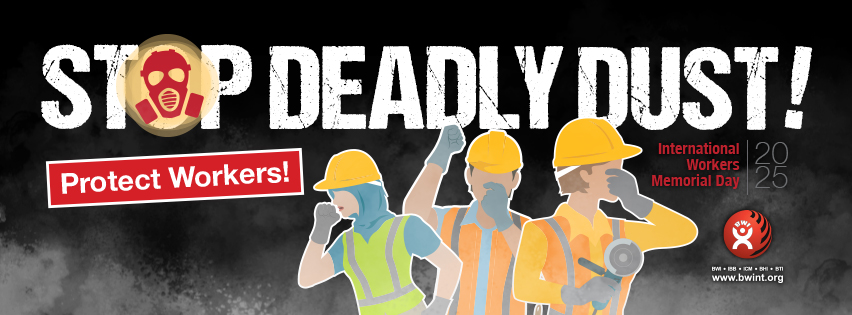
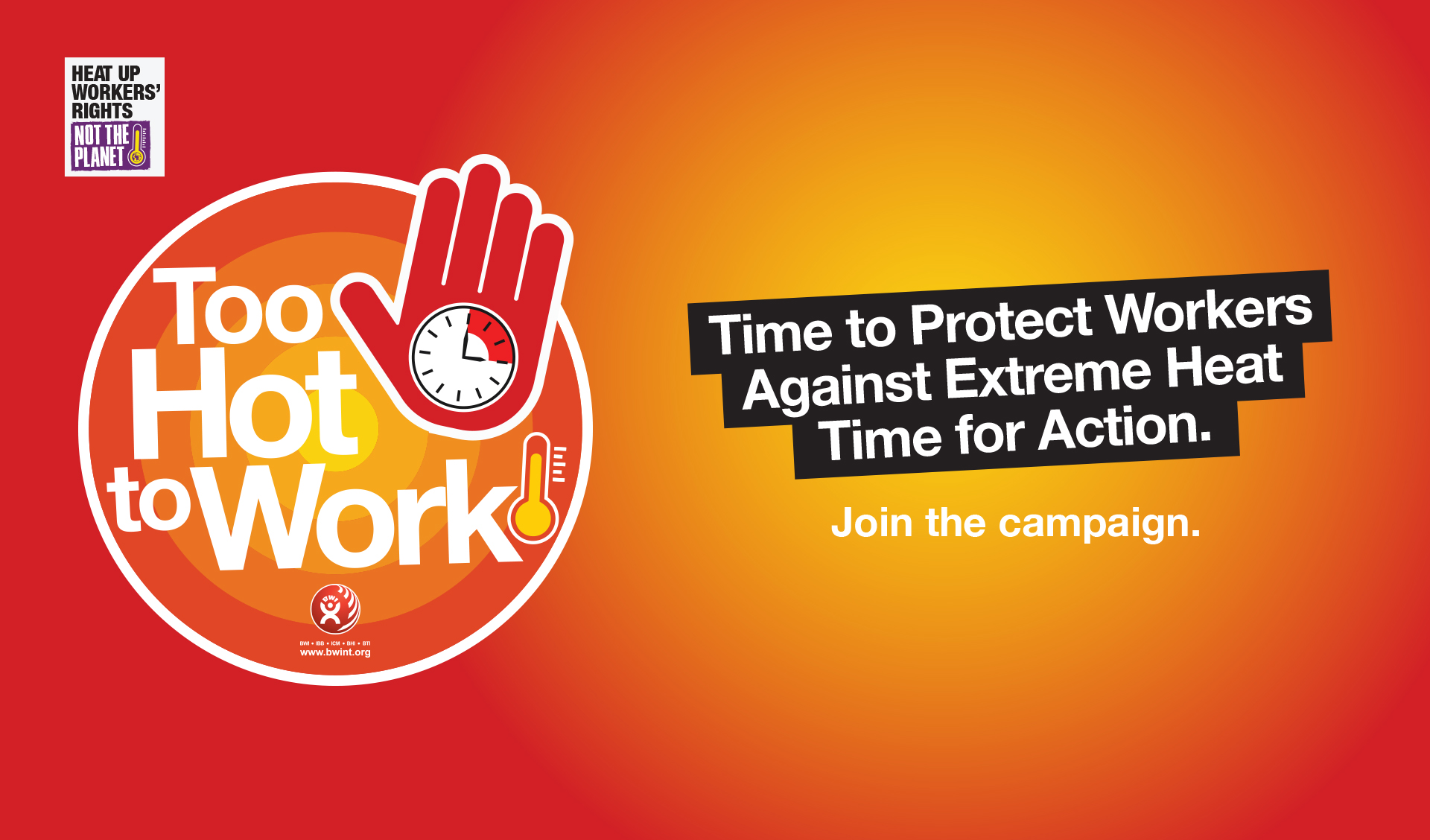
BWI global union federation affiliate ACEEU will hold a rally in Lahore to mark International Workers’ Memorial Day- 28 April. Union officials will participate in the rally using materials produced by BWI including theme posters.

On April 28 of each year, CUPE members across the country organize events to honour all workers who were killed or injured at work. This year, we mourn the loss of four members of our CUPE family:
We are pleased to provide materials for this important day, including the annual poster, workers’ statement, and checklist. Day of Mourning flags, pins, and t-shirts can be ordered online at cupe.ca/store. Please order your materials early to ensure we can fulfill your order.
Putting up the posters, lowering flags to half-mast, and reading the workers’ statement at Workers’ Day of Mourning ceremonies are ways to promote awareness of CUPE’s role in fighting for health and safety improvements in the workplace.We hope that on April 28, you will join us and other workers around the world in reaffirming our commitment to demanding healthier and safer workplaces. For additional information or copies of materials, please contact your national representative or the Health and Safety Branch at National Office.
The ITUC is using this year’s International Workers’ Memorial Day, 28 April, to call for urgent action to safeguard workers’ lives and rights in the age of digitalisation and artificial intelligence (AI).
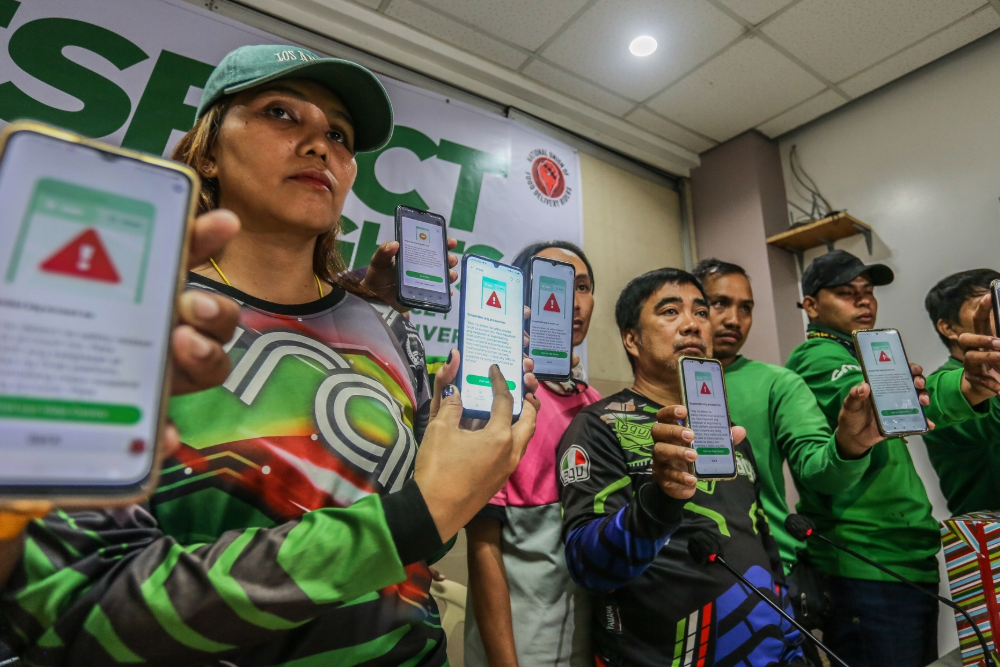
AI is transforming the world of work at unprecedented speed. But behind the promise of innovation lies a darker reality: algorithmic management, constant surveillance, impossible productivity targets, and dangerous working conditions. Technology is being used not to improve working conditions and safety, but to exploit them — putting lives and health at risk.
“Too often artificial intelligence is being deployed not as a tool for progress but as a weapon against workers.” ITUC General Secretary Luc Triangle
“From warehouses to hospitals, delivery bikes to data labs, workers are under pressure like never before. The deployment of new technologies must respect the norms of any other changes in the workplace: workers have a right be consulted and included. This basic, democratic, workplace right will ensure the use of AI is designed with safety, fairness and dignity at is core. Workers and their unions must have a seat at the table for the benefit of all.”
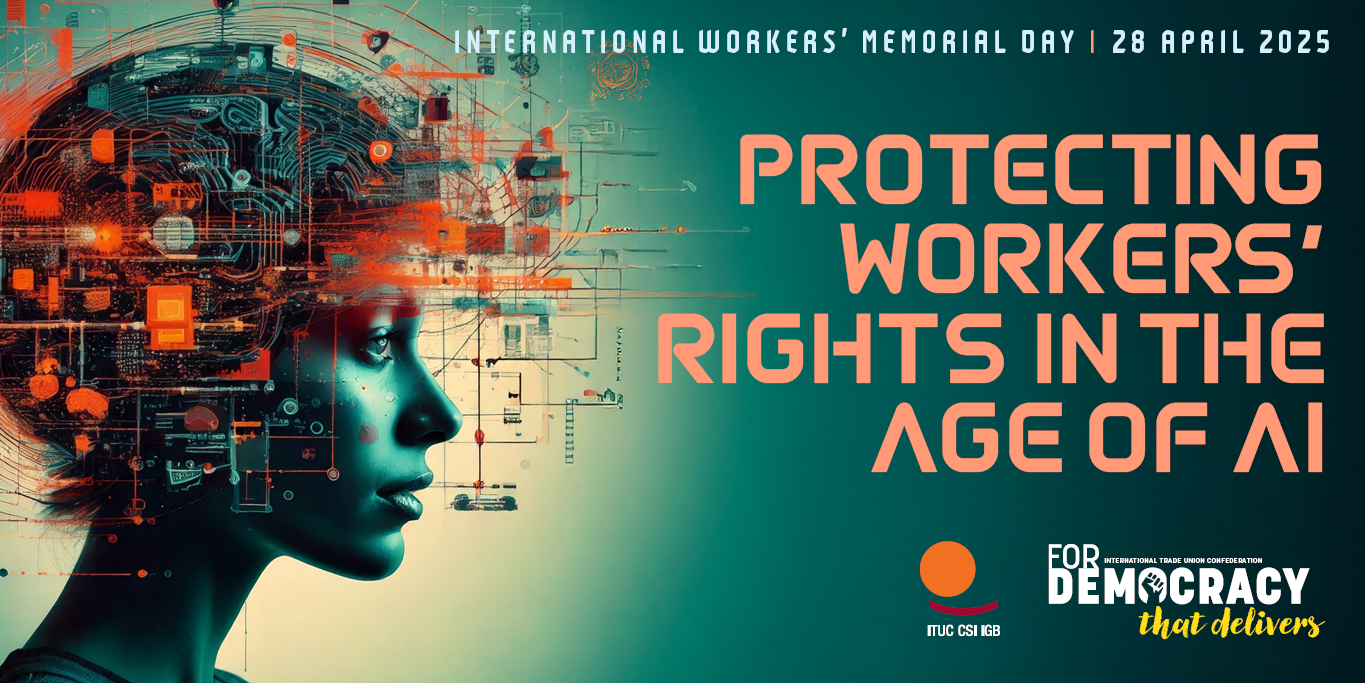
Deployment of new technologies, such as AI, without proper consultation with workers and their unions is already causing serious problems around the world:
The ITUC is calling for:
This 28 April, we remember the dead – and fight for the living. Technology should work for us, not against us.
The new ITUC report, ‘Artificial intelligence and digitalisation: A matter of life and death for workers’, identifies the physical and psychosocial harms at work when these technologies are introduced without consulting workers. Check out the campaign materials.
 IWMD 2025 – English graphicsIWMD 2025
IWMD 2025 – Gráficos en españolIWMD 2025
IWMD 2025 – Graphiques en françaisIWMD 2025
IWMD 2025 – Gráficos em portuguêsIWMD 2025
https://www.ituc-csi.org/International-Workers-Memorial-Day-2025


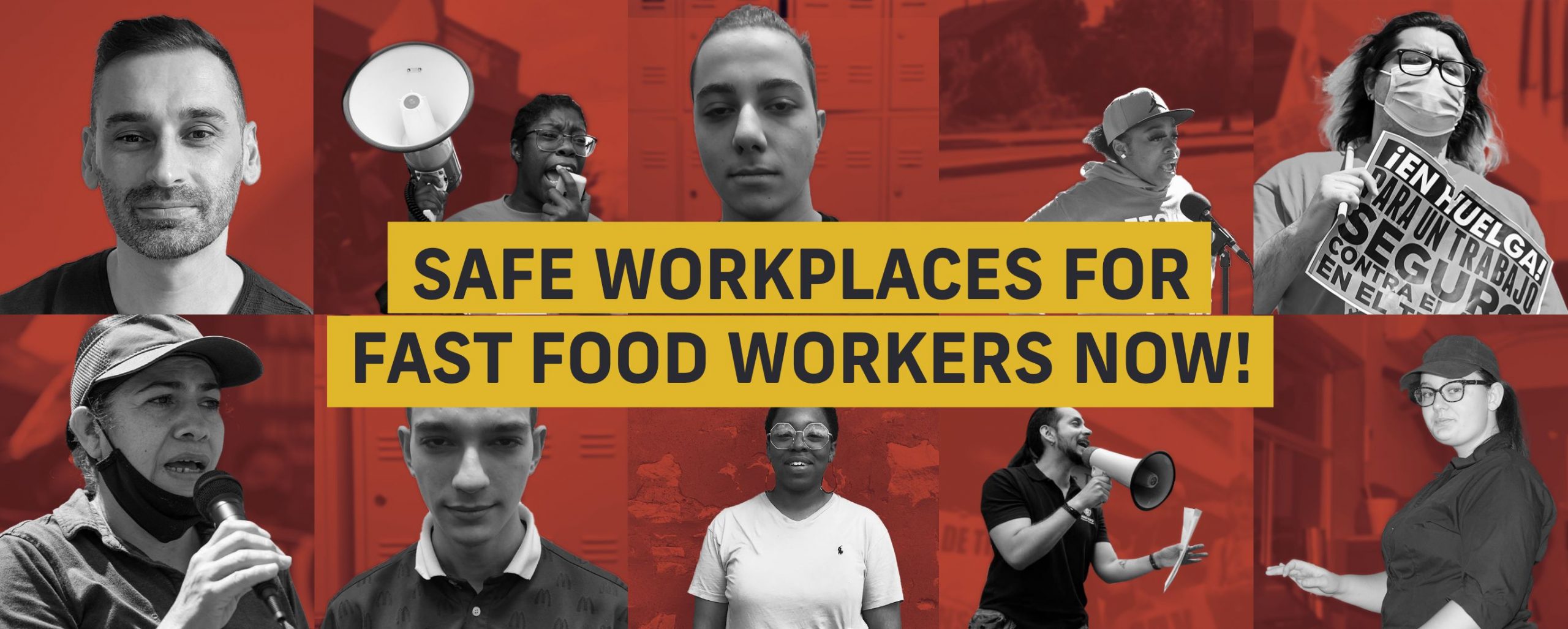
Millions of workers are employed by the Fast Food industry globally, on hundreds of thousands of locations. Despite huge growth in numbers of workers and profitability, the sector has chosen to prioritize profits over people with dangerous and abusive working conditions. For many young workers, it’s our first job and one that leaves us scarred for life.
Fast Food workers deserve a safe workplace. And we deserve it now.
A l’occasion de la journée mondiale de la sécurité et de la santé au travail, retrouvez-nous en live le 28 avril à 14h (vidéo ci-dessous) pour une rencontre avec les militantes et militants de la maroquinerie, du paysage et de l’hospitalisation privée.
Le 28 avril est un moment important pour des millions de travailleurs et travailleuses à travers le monde. C’est l’occasion de mettre en lumière la nécessité d’agir continuellement pour faire respecter le droit en matière de santé et sécurité au travail.
Cette journée sera l’occasion de valoriser le travail de terrain mené par les équipes CFDT, à travers plusieurs témoignages qui démontrent qu’il est possible, par l’action, de faire évoluer les organisations du travail et d’améliorer les conditions de travail pour agir sur le maintien en emploi en bonne santé.
Every year, thousands of transport workers are killed while doing their jobs. Millions more suffer preventable injuries and illnesses due to dangerous working conditions.
On International Workers’ Memorial Day, we honour their memory — and reaffirm our commitment to fighting for the living.
From aviation to fishing, railways to the streets, docks to the seas – workers are still paying the price for a transport industry too often driven by profit, not safety. And in every corner of the industry, ITF unions are demanding change.
A union movement built on safety
Protecting lives and demanding safe, healthy workplaces has always been at the heart of the trade union movement — and always will be. At the ITF, we believe that no job is worth a life.
At the 2024 ITF Congress, affiliates unanimously passed a motion that makes clear: every transport worker has a fundamental right to a safe and healthy working environment. That means protection from the hazards that cause stress, fatigue, injury, illness or death.
Safety is not optional — it’s a right
Every transport worker has the right to come home safe. But across our industries, employers and governments are still failing to take that right seriously. We’re raising our voice to say: enough is enough.
We’re calling on governments to ratify and enforce international safety standards, including:
ILO C152 (Dock Work)
ILO C155 (Occupational Safety and Health)
ILO C161 (Occupational Health Services)
ILO C187 (Promotional Framework)
ILO C188 (Work in Fishing)
ILO C190 (Violence and Harassment)
These aren’t just conventions. They’re lifesaving protections that every worker deserves.
What we’re demanding from employers
Employers must take responsibility for workers’ safety — across every transport sector, every border, and every shift.
We are demanding action now:
Guarantee a safe and healthy working environment for all transport workers – whether directly employed, subcontracted, or working informally across global supply chains.
Work with unions: Safety policies must be developed through negotiation with workers and their representatives.
Make safety inclusive: That means a gender-responsive approach that protects not just physical safety, but also workers’ mental health, wellbeing, and freedom from violence and harassment.
Invest in safety: Employers must provide adequate resources to implement safety measures and ensure all workers – including apprentices, cadets and trainees – have equal access to high-quality OSH training.
Address the full spectrum of risk — including those linked to climate change, cross-border transport, and the introduction of new technologies.
Recognise the commute as part of the job: Safe transport to and from work is a workplace issue, and employers must extend their duty of care beyond the worksite.
No more negligence. No more exploitation. No more silence.
Occupational safety and health is a fundamental right, and we will keep fighting until every worker, in every corner of transport, is safe.
https://www.itfglobal.org/en/news/international-workers-memorial-day-2025-remember-dead-fight-living

¿Cómo se puede reconocer a quien trabaja en el sector de comida rápida en cualquier parte del mundo? Por las cicatrices en los brazos.
La industria de la comida rápida emplea a millones de personas en todo el mundo, en cientos de miles de locales. A pesar del enorme crecimiento del número de trabajadores y trabajadoras y de la rentabilidad, el sector ha optado por priorizar las ganancias sobre las personas, con condiciones de trabajo peligrosas y abusivas. Para muchos trabajadores y trabajadoras jóvenes, es nuestro primer trabajo y nos deja cicatrices de por vida.
Los trabajadores y trabajadoras de comida rápida merecemos un lugar de trabajo seguro. Y nos lo merecemos ahora.
Comment reconnaître un-e employé-e de de la restauration rapide n’importe où dans le monde ? Par les cicatrices sur nos bras.
Des millions de travailleurs-euses sont employé-e-s par l’industrie de la restauration rapide dans le monde, sur des centaines de milliers de sites. Malgré l’augmentation considérable du nombre de travailleurs-euses et de la rentabilité, le secteur a choisi de privilégier les profits au détriment des personnes, avec des conditions de travail dangereuses et abusives. Pour de nombreux-euses jeunes travailleurs-euses, il s’agit de leur premier emploi, qui les marque à vie.
Les travailleurs-euses de la restauration rapide méritent un lieu de travail sûr. Et nous le méritons maintenant.

Révolution dans le secteur de la santé et de la sécurité : le rôle de l’IA et de la numérisation au travail
L’IA et les outils numériques révolutionnent la sécurité et la santé au travail. Aujourd’hui, les robots opèrent dans des environnements dangereux, se chargent des tâches lourdes, gèrent des matériaux toxiques et travaillent à des températures extrêmes. Ils effectuent des tâches répétitives et monotones, tandis que les dispositifs numériques et les capteurs peuvent détecter les risques à un stade précoce. Dans le même temps, en l’absence de mesures de sécurité et de santé au travail adéquates, les technologies numériques peuvent entraîner des accidents, des risques ergonomiques, une intensification du travail, une réduction du contrôle du travail et des frontières floues.
La campagne 2025 met en lumière la manière dont les nouvelles technologies transforment la santé et la sécurité au travail (SST), notamment par l’automatisation des tâches, l’utilisation d’outils de SST intelligents et de systèmes de contrôle, la réalité étendue et la réalité virtuelle, ainsi que la gestion algorithmique du travail.
La transformation numérique du travail a entraîné une évolution des modalités de travail, telles que le télétravail et les plateformes numériques de travail, qui seront examinées plus en détail.
L’Organisation international du Travail (OIT) publiera un nouveau rapport et du matériel promotionnel analysant ces questions cruciales, évaluant comment la transformation numérique peut améliorer la sécurité et la santé au travail, et soulignant les réponses des gouvernements, des employeurs, des travailleurs et d’autres parties prenantes pour atténuer les risques potentiels en matière de sécurité et de santé.
Cliquez ici pour en savoir plus