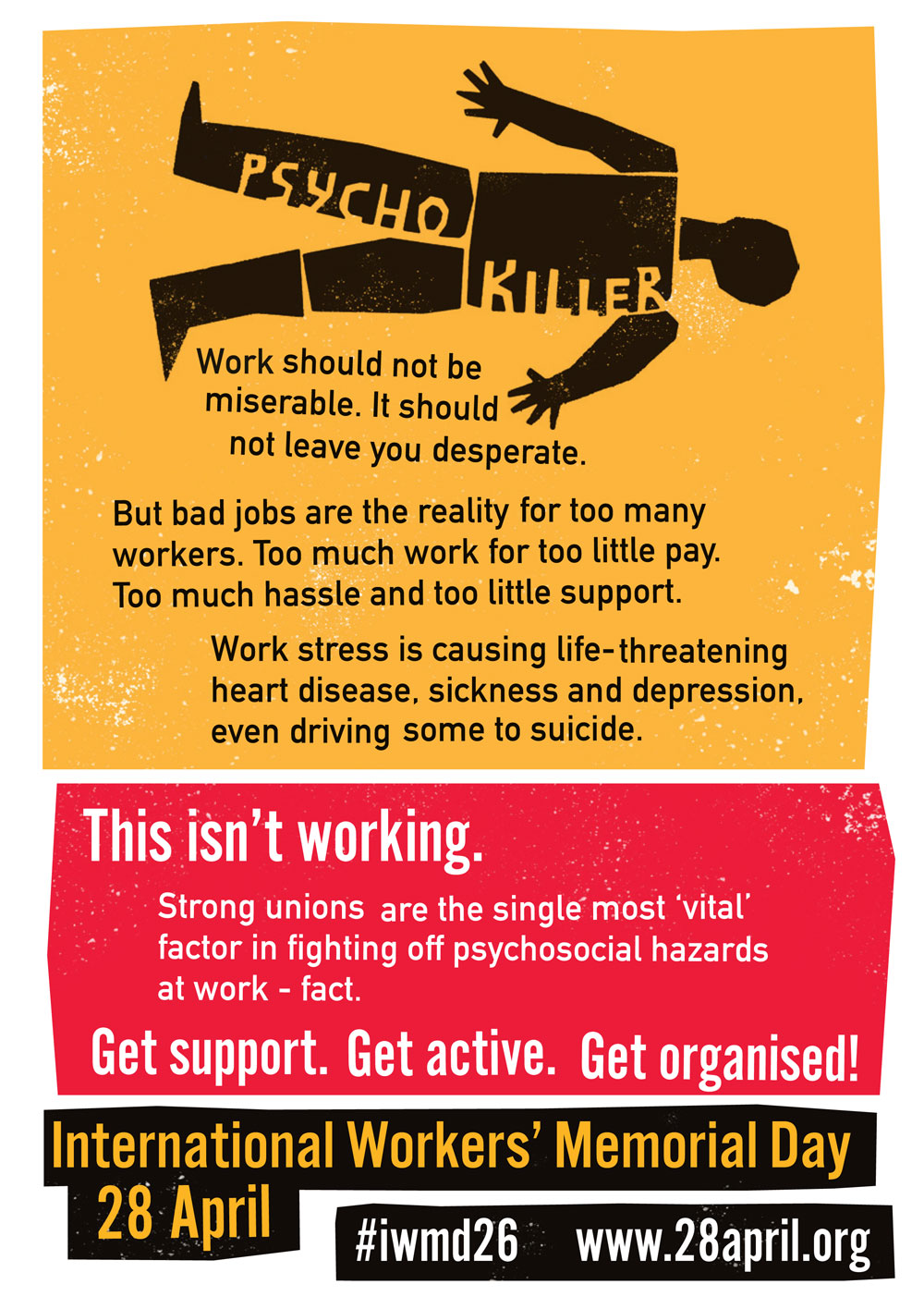
On April 28, World Day of Work Environment or as it is also called Workers’ Memorial Day. The day when we pay special attention to those who unfortunately have had to put to life because of their work.
Ahead of this year’s 28 April, ILO releases a new global report on psychosocial work environment, or as we call it in Sweden: organizational and social work environment. It’s heavy reading, but nothing that surprises, unfortunately. We have long discussed the impact of the increased workload; when structural risks are taken to achieve the greatest possible economic gain, without regard to the health of workers. When workers are stressed by the high workload, it is not individuals’ “stress management” that is the problem. It’s a systemfelsystem failure.
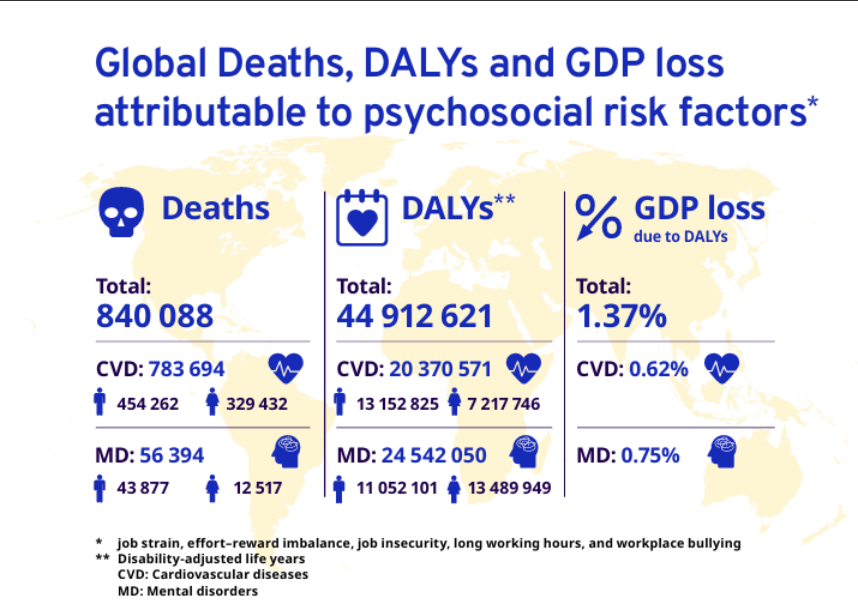
In its report, the ILO estimates that over 840 000 people die every year – mainly through cardiovascular diseases and mental illness – due to stress, unhealthy workload and major shortcomings in how work is organized. Nearly 45 million healthy years of life are lost each year, and costs represent 1.37 percent of global GDP. Long working days are a central risk factor – globally, 35 percent of all workers work more than 48 hours a week. Work-related violence and harassment is another area where the scale is high: almost one in four workers globally state that they have been subjected to violence and harassment at some point during their working life.
Also ITUC releases a very useful report, with global examples: Tackling psyhosocial risks at work. Among other things, work-related suicides are lifted, with terrible figures of at least 70 000 per year. Again, these are deaths that have all been avoided. This is not the case of workers’ “sensitivity”, lack of coping strategies or individual shortcomings. It is about how the work is organized, how requirements and resources are distributed and about power, i.e. influence over working conditions. The ability for the individual employee to influence their work situation varies greatly between countries, as deficiencies in democratic rights are increasing and compliance with fundamental human rights is reduced, such as the right to freely organise and negotiate their working conditions.
From a trade union perspective, the conclusion is self-evident: psychosocial work environment is a collective issue that requires collective solutions – through legislation, supervision, influence from employee representatives such as safety representatives and through improved working conditions through collective agreements. In Sweden we have our OSA (AFS 2023:2), but globally there is a lack of protection and influence for workers.
Swedish work environment statistics confirm the picture presented by the ILO in its report. According to the Swedish Work Environment Authority’s latest work environment survey, many employees state that the work is characterized by high workload, lack of opportunity for recovery and requirements that are not proportional to the resources.
Particularly vulnerable are female-dominated professions in health care, school and care – where stress-related mental illness is the most common cause of long-term sick leave. The Swedish Social Insurance Agency’s data shows that women are more than double the risk compared to men to be on sick leave due to stress-related mental illness. It should be clarified that it is not a women-related problem, but the problem lies in the fact that female-dominated professions often suffer cuts by staff, which in turn lead to excessive workload. An example of trying to counteract this is what Kommunal is now fighting for, removing minute control in elderly care. This leads to both a better working environment for employees and safer and more secure care for the elderly.
From individual focus to organizing work
A central point in ILO’s report is the need to shift focus: from treating mental illness as an individual problem to preventing psychosocial risks where they arise – in the organization of work.
ILO divides the psychosocial work environment into three levels:
- Requirements and content of the work
- How the work is led and organized
- the overall systems: working time, governance, digitisation and influence
These three levels are clearly recognised from the fundamental rights of a safe working environment globally (Convention 155) and in our OSA regulations. Both the ILO report and the evaluation of OSA conducted in 2022 show that implementation often shortages, both globally and nationally. Risk assessments are made – but are not always followed by actual changes in how the work is organized. The fact that measures taken actually make a difference are also lacking.
Social dialogue – still a blind spot
Although mental illness, due to work is one of the greatest work environment risks, the issue is still surprisingly stepmotherly treated in many contexts. The ILO review of 338 cross-border collective agreements shows that only 18 percent explicitly address psychosocial factors or mental health in work environment management.
It shows how much the lack of knowledge about these issues is. There is a need for a substantial knowledge boost on how to prevent mental illness caused by work, both globally and nationally. The focus needs to be shifted to the organization of the work from what the employer so often focuses on: the individual’s private possible problems. Our now 10-year OSA regulation is precisely raising the requirement for knowledge in section 4 (AFS 2023:2):
The employer shall ensure that managers and supervisors have knowledge of how to prevent and handle unhealthy workload, and victimisation.
The employer must ensure that there are conditions to put these knowledge into practice.
From a trade union perspective, the way forward is clear:
- Strengthen supervision and compliance with OSA Regulations nationally.
- Move the focus from individual to organization – employers are and should be held responsible for how work is organized.
- Strengthen the mandates and resources of safety representatives on issues of organisational and social work environment.
- Integrate psychosocial risks more clearly into collective agreements and in systematic work environment management.
- At a global level, collaboration between workers and employers needs to be strengthened.
The ILO’s message is clear: psychosocial risks are not an inevitable feature of a modern working life. They are the result of political choices, corporate strategies and power relations – and can therefore be changed. Together we can change the terms – the conclusion will therefore be as usual: don’t mourn – organize!
Cyrene Martinsson Waern – När arbetet dödar – LO Bloggen (When work kills…)
Regeringen måste göra mer för att stoppa hot och våld i arbetslivet – Altinget
https://www.facebook.com/reel/1968326160439577