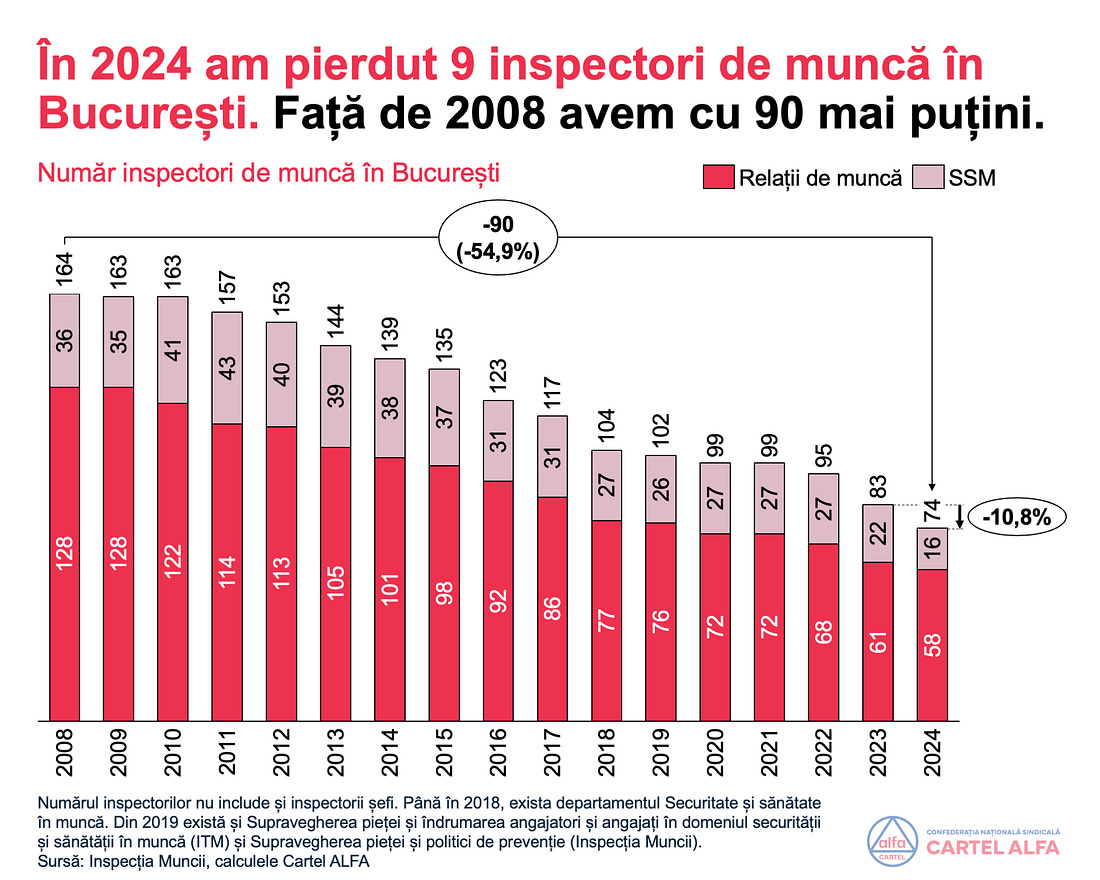
ITM Bucharest has lost 54.9 per cent of its total labour inspectors between 2008 and 2024
28 April is World Day for Safety and Health at Work.
The International Labour Organization states that a safe and healthy working environment is built on a national culture of occupational safety and health, focused on preventing workplace accidents and occupational diseases.
The context in which we mark this day in 2026 is more serious than it first appears. An analysis developed under the Cartel ALFA +CAP project, based on the Annual Reports of the Labour Inspection, shows with precise figures how Romania has systematically weakened the very state mechanism that should guarantee workers’ rights at work: the labour inspectorate.
Figures that should alarm us
At national level, Romania lost 43 labour inspectors in a single year. Of these, 38 were from territorial labour inspectorates and 5 from the central level of the Labour Inspection.
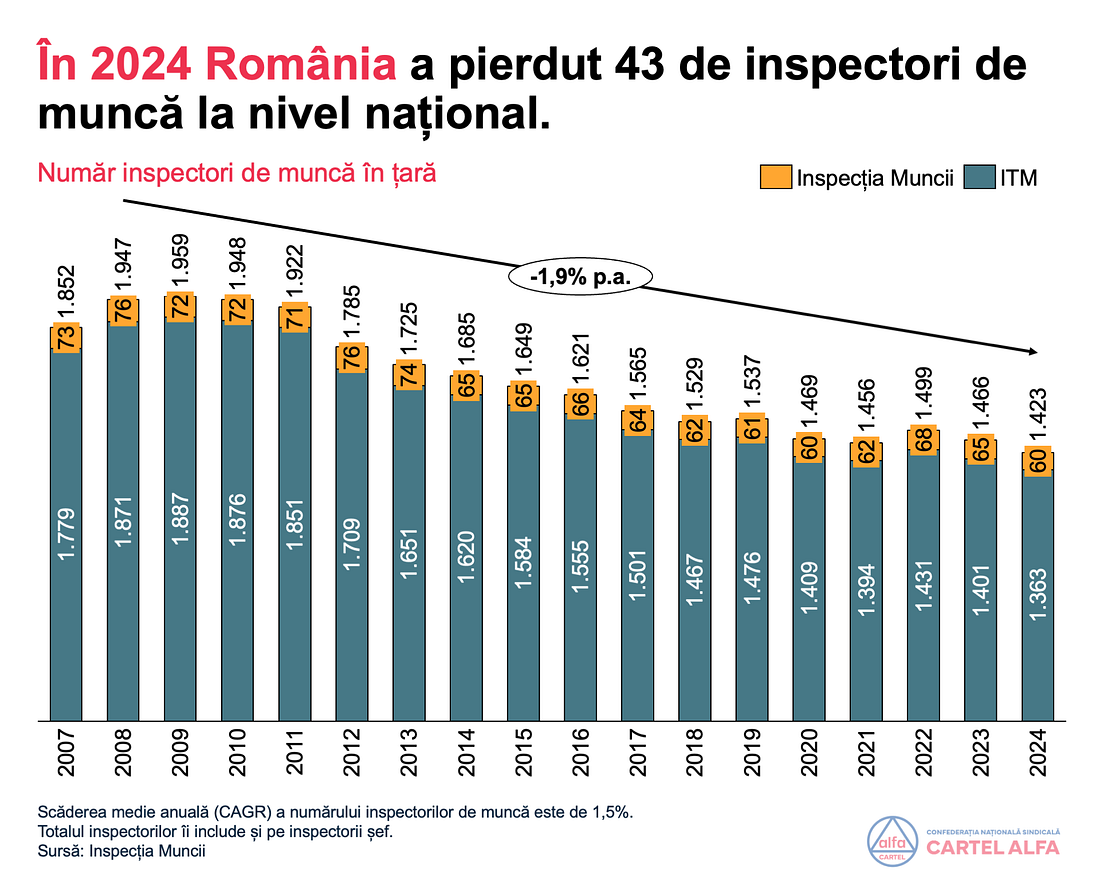
The average annual decrease in their number is 1.5 per cent, year after year. If the national picture is worrying, the situation in Bucharest is far more severe.
Compared to 2008, Bucharest has lost 90 labour inspectors — a decrease of 54.9 per cent, equivalent to 4.9 per cent per year, consistently over 16 years. This trend does not reflect a deliberate reform or a rational reorganisation of inspection capacity.
In 2024, Bucharest lost 9 labour inspectors, representing a 10.8 per cent drop compared to the previous year.
Of the 43 labour inspectors lost nationwide, 9 were from Bucharest, accounting for 21 per cent.
Această scădere reflectă, în primul rând, efectul cumulat al blocărilor de posturi din sectorul public, al ieșirilor la pensie necompensate prin angajări și al unui sistem de salarizare care nu a reușit să facă din profesia de inspector de muncă o opțiune atractivă pentru absolvenți calificați.
Datele Rapoartelor Anuale ale Inspecției Muncii, corelate cu statisticile Institutului Național de Statistică privind efectivul salariaților, scot la iveală un paradox structural care ar trebui să fie în centrul oricărei dezbateri serioase despre SSM în România.
În timp ce numărul de inspectori de muncă din București a scăzut cu 54,9% față de 2008, numărul de salariați din capitală a crescut cu 16% în același interval de timp.
De la 17,8 inspectori la 100.000 de salariați în 2008, astăzi mai sunt doar 6,8 la 100.000 de lucrători. Aproape de trei ori mai puțini inspectori, în mai puțin de 20 de ani.
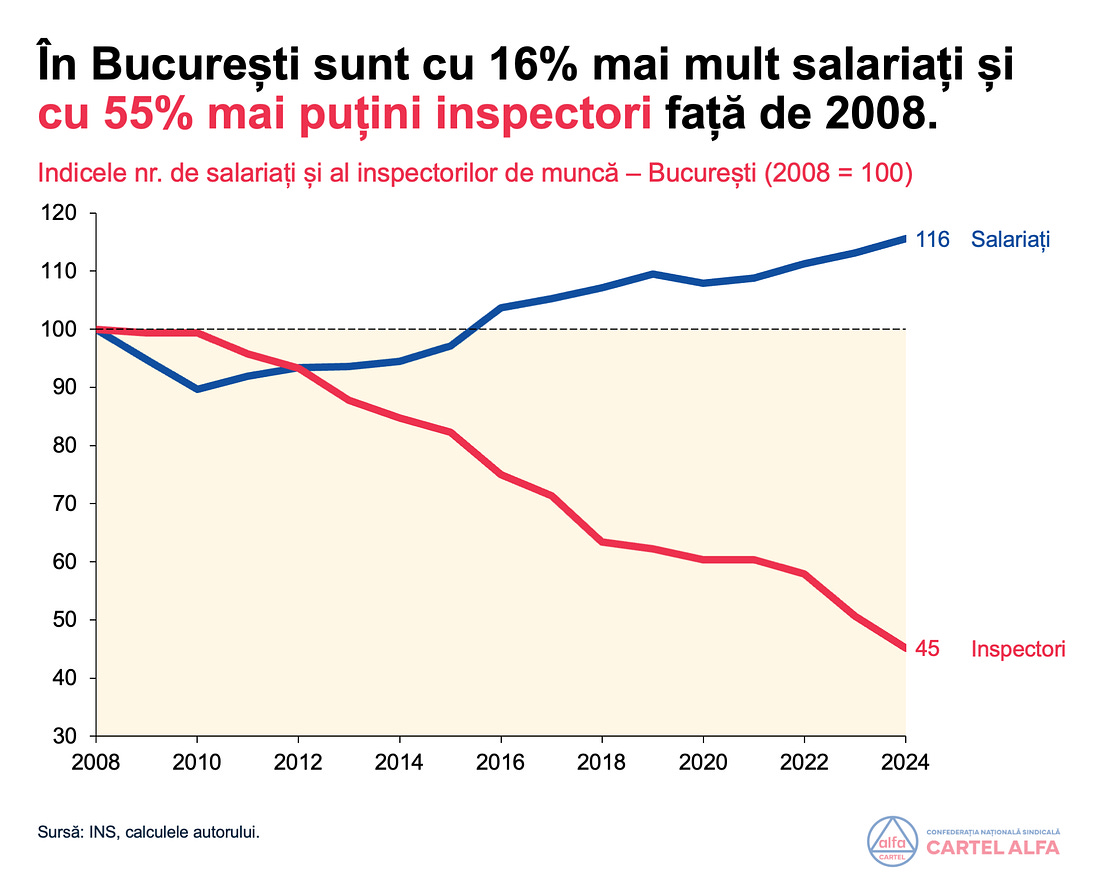
A labour inspector today must cover a territory three times larger than that of a colleague 16 years ago — with more responsibilities, more procedures and far more complex working conditions.
If in 2008 a Bucharest inspector oversaw around 5,600 workers on average, by 2024 that figure has risen to approximately 14,700. This is not a metaphor, but reflects figures published directly by the Labour Inspection.
A national issue, not just a capital city problem
Annual Reports of the Labour Inspection, analysed by county, show that the reduction in inspector numbers has affected almost the entire country between 2010 and 2024.
The largest relative decreases are recorded in counties with growing economies — where the number of workers has increased significantly, but the number of inspectors overseeing them has moved in the opposite direction. This means that where occupational safety and health risks are more numerous and diverse, institutional inspection capacity is under the greatest pressure.
A few counties have seen increases in inspector numbers compared to 2010, but these are isolated exceptions that do not change the national picture. Overall, Romania now has a significantly smaller body of labour inspectors than it did 15 years ago.
The long-term situation does not appear to be improving, as public sector hiring remains restricted due to austerity, and public trust in inspection mechanisms is low. Highly publicised cases of inspectors involved in illegal or unethical behaviour have further reduced confidence in the institution.
Those who carry out their duties and strive to uphold occupational safety and health principles are overshadowed by these scandals, as well as by staff shortages and a lack of state vision in labour policy.
What does this mean in practice?
The shortage of labour inspectors is not an abstract organisational issue — it has direct, concrete consequences for every worker in Romania:
· Inspections are carried out less frequently.
o An inspector responsible for a far larger portfolio than a decade ago cannot check each employer as often as needed.
o Employers who break the law are therefore less likely to be caught and sanctioned — not due to lack of will, but lack of capacity.
· Accident investigations take longer.
o When a workplace incident occurs, the official investigation falls to inspectors.
o With fewer staff available, timelines are extended.
o In the period between an accident and the conclusion of the investigation, the conditions that caused it may remain unchanged, exposing other workers to the same risks.
Underreporting remains a structural problem. There are persistent concerns that many accidents go unreported or are misclassified to avoid sanctions. The informal economy, undeclared work and excessive subcontracting all contribute to this.
For example, in recent weeks tramline modernisation works have been carried out by workers without adequate protective equipment. Welding has been done without protective masks, exposing workers to toxic substances that can lead over time to serious health complications and shorter lives. Such cases often remain invisible.
A larger and better-distributed inspectorate is the only real lever to address this issue. Without it, official statistics risk consistently appearing better than the reality they reflect.
What can we do on 28 April?
28 April is not just a date in the calendar. It is a moment to recognise that improving working conditions is a collective goal, shaped by long struggles, and to reflect on how much more must be done to protect workers’ lives and health.
The Annual Reports of the Labour Inspection provide Romanian authorities with all the data needed to understand the scale of the problem. There is no excuse for ignorance.
The decline in inspector numbers has been publicly and consistently documented for over a decade. What is missing is not information, but political will to treat labour inspection as a governing priority rather than an easy budget cut.
Current demands to address the issue are clear:
· unblocking vacant posts;
· creating salary conditions that attract and retain qualified inspectors;
· establishing genuine social dialogue on OSH policies — not formal consultation, but real negotiation with trade unions playing a decision-making role.
Moreover, simply hiring more inspectors will not solve the problem if their professional training remains inadequate. Alongside increasing staff numbers, rebuilding public trust in the authority is essential.
An eroded labour inspectorate cannot fulfil this role, and the data from the Annual Reports confirm it. What we do with this information depends on us.
Analiza Cartel ALFA 👇
Analiză Cartel ALFA – Inspecția Muncii +…