Tag Archives: Eurocadres

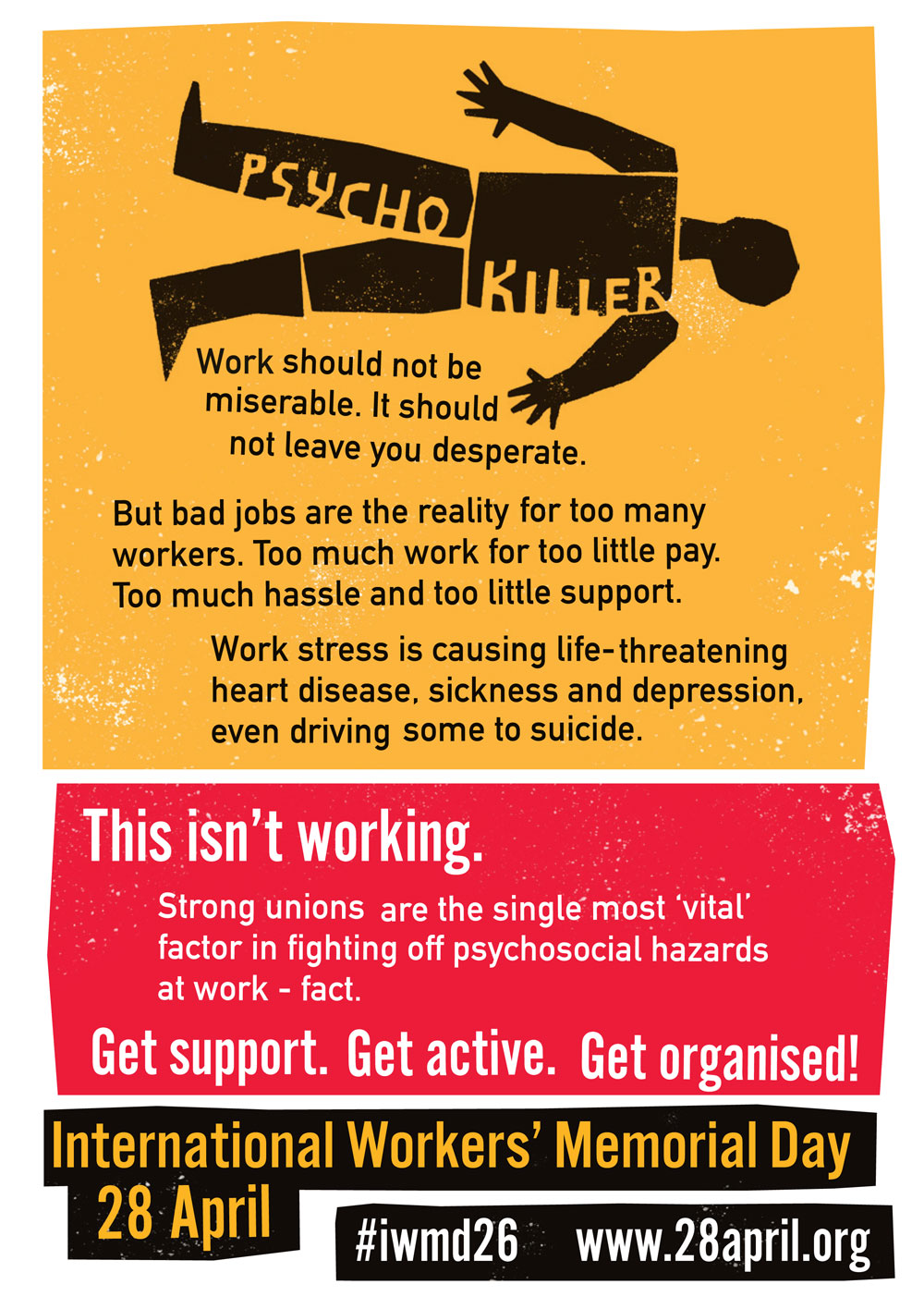
Europe: Psycho killer in focus on IWMD

April 28th is known as both International Workers Memorial Day and World Day for Safety and Health at Work, an opportunity to reflect on what must change for our working world to deliver safe and dignified jobs.

This year’s thematic approach focuses on psychosocial risks (PSR), with trade unions across the globe united in calling for not just recognition, but action, in an area where Europe continually fails to deliver.

Last week, the International Trade Union Confederation (ITUC) hosted a webinar exploring the differing approaches to tackling PSR, including an in-depth analysis of the European landscape from Eurocadres President Nayla Glaise. A full recording of the webinar can be found here.

Despite the public opinion of the “Brussels effect”, what was made clear throughout the event was how far behind Europe lags in comparison to other nations and regions. One such example comes from the other side of the world, with the Australian Council of Trade Union’s Liam O’Brien highlighted the excellent provisions within their national legislation, won through years of campaigning and advocacy with progressive political parties.

Adding to the presentation by PSC Observatory’s Maureen Dollard, Union Density and its Role in Shaping a Psychosocial Safety Climate, and efforts at the ILO level, what becomes clear is that Europe is dragging its feet in the protection of workers against psychosocial risks.

However, efforts are underway to change this.

“We are delighted to see International Workers’ Memorial Day focus on such a pivotal topic for professionals and managers. Eurocadres will continue to lead the push for European action, with the support of unions, as seen today, from right around the world”.

This month the European Parliament’s employment and social affairs (EMPL) committee were presented with MEP Estelle Ceulemans’ (S&D, BE) report on psychosocial risks, including a prominent call for a directive. The result of many months of discussions and drafting, the Belgian lawmaker has not only called on the Commission to act, but has outlined what a directive would look like in the annexe of the text.

While still a long way to go in the process, this report is an excellent starting point for yet another parliamentary call for action.

On the significance of IWMD, Eurocades President Nayla Glaise stated: “We are delighted to see International Workers’ Memorial Day focus on such a pivotal topic for professionals and managers. Eurocadres will continue to lead the push for European action, with the support of unions, as seen today, from right around the world.

“An integral part of this is the work of the European Parliament, and we commend Estelle for her terrific work in the proposal of this report. The coming months will be crucial to ensure support for the text, and we are looking forward to playing our part to help deliver a strong mandate to the Commission”.
Psycho killer in focus on IWMD

Europe: Continuing the call for change for worker’s health – Eurocadres

Where do we stand on this workers memorial day?
IWMD 23 EU graphicrev

April 28th is widely known as both International Workers Memorial Day and World Day for Safety and Health at Work, but recent findings show that commemoration and awareness raising are failing to alleviate the plight of workers.

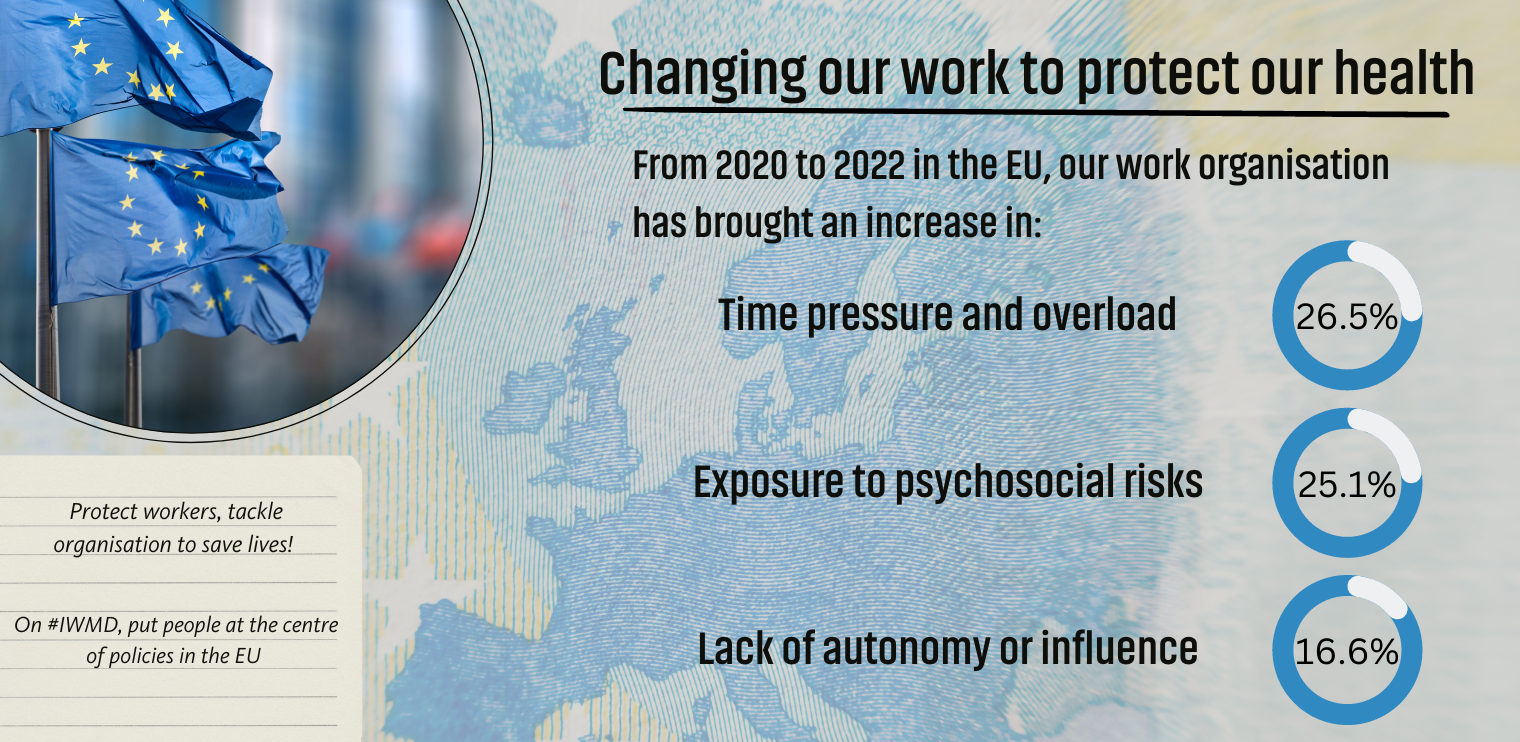
The European Agency for Safety and Health at Work (EU-OSHA), in their report Occupational safety and health in post-pandemic workplaces, highlight how European workers are exposed to more risks now than before the pandemic. In speaking with over 27,000 workers throughout all 27 Member States, the report found that, on average in Europe, certain risks became more prominent. Exposure to time pressure/overload increased to 26.5%, psychosocial risks to 25%, while 66% of workers have experienced health problems caused or made worse by their work.

While there has been a general consensus post-COVID that workplace mental health must be spoken about more openly, participants across the EU are divided in their view whether disclosing a mental health condition would have a negative impact on their career: 16% ‘strongly agree’ and 34% ‘agree’ vs 13% who ‘strongly disagree’ and ‘32%’ who ‘disagree’. Awareness raising has clearly failed to change the culture within many European workplaces, with 27% of respondents reporting that stress, depression or anxiety has been caused by, or made worse due to their work.

Yet again we see non-binding initiatives resulting in workers suffering.

Trade unions have continually called on legislators to act in a more meaningful manner to eradicate exposure to risks in the workplace, with Europe’s mental health epidemic the latest in a line of preventable tragedies affecting workers and their families. While we move towards a vision of zero deaths at work in Europe, we match this ambition with an ominous reduction in workplace autonomy, increased surveillance of workers, the use of automation to determine workload and speed, and the introduction of digital tools without the necessary human oversight or training. These contradictory approaches are seen most clearly in our use of awareness raising campaigns to reduce the burden on workers, only for employers to escape any accountability when issues arise.

The pandemic afforded us an opportunity to re-imagine working life in Europe, and to re-orientate how we sought to balance professional and private life. It is now abundantly clear that we have failed to seize the opportunities presented to us in increased digitalisation, while the prospect of high-quality sustainable jobs for our green transition remains ambiguous at best. As the latest statistics show us, if we seek to make a real change, the window to do so is closing.

There is no denying that European workplaces have improved health and safety measures compared to the issues facing previous generations, but the rise in precarious working environments and arrangements, mental health problems caused/exacerbated by exposure to psychosocial risks, digitalisation without due diligence and automation of workloads has created a new series of problems for future generations. On both International Workers Memorial Day/the World Day for Safety and Health at Work, should we not seek to consolidate our victories, not work against them?