Category Archives: Resources

Global: International Workers’ Memorial Day 2026: Tackling psychosocial risks at work – ITUC

International Workers’ Memorial Day 2026: Tackling psychosocial risks at work

This International Workers’ Memorial Day, 28 April, the ITUC calls for urgent action to tackle the global crisis of psychosocial risks at work – now one of the leading causes of death, disease and distress for workers worldwide.


Behind the daily reality of work, millions of working people are facing relentless pressure: long hours, job insecurity, impossible targets and toxic workplace cultures.

These are not just bad jobs – they are dangerous jobs. Stress, anxiety and burnout are now causing more harm globally than traditional workplace hazards such as chemicals or dust.

The ITUC’s new report shows the scale of the crisis:

  • Long working hours alone are responsible for around 745,000 deaths each year.
  • There are at least 70,000 work-related suicides annually.
  • 12 billion working days are lost every year due to depression and anxiety.
  • Burnout affects around one in five workers globally.
  • Psychosocial risks are linked to over 10 per cent of cases of heart disease, depression and suicides.

“Bad jobs can break anyone. When workers are pushed beyond their limits by job insecurity, excessive workloads and lack of control, the consequences can be fatal. This is not inevitable – it is a result of choices made in boardrooms and by governments.”ITUC General Secretary Luc Triangle

Across the world, unions are proving that change is possible. Evidence shows that a strong, democratic trade union presence in the workplace is the most effective protection against psychosocial risks, improving workers’ health and economic outcomes.

The ITUC is calling for:

  • Strong laws to prevent psychosocial risks at work.
  • Full involvement of trade unions in workplace health and safety.
  • Decent work, including secure jobs, fair pay, safe staffing levels and manageable workloads.
  • Recognition of mental health conditions as occupational diseases.

Luc Triangle concluded: “The solutions to these problems start with democracy in the workplace, with a voice for workers through their trade unions. Employers can ignore the psychosocial health of workers and break them, lose valuable skills and face the financial cost, or they can work with unions to ensure that workers are valued. If employers are struggling to recognise which is the correct choice, unions are ready and available to remind them. The fight for democracy in the workplace is the fight for the wellbeing of all working people.”

This 28 April, we remember the dead – and fight for the living. Work should not cost lives. It must protect lives, dignity and mental health.

https://www.ituc-csi.org/International-Workers-Memorial-Day-2026

Global: Jornada Internacional de Conmemoración de los Trabajadores Fallecidos y Lesionados 2026

Jornada Internacional de Conmemoración de los Trabajadores Fallecidos y Lesionados 2026: abordar los riesgos psicosociales en el trabajo

Con motivo de la Jornada Internacional de Conmemoración de los Trabajadores y Trabajadoras Fallecidos y Lesionados, el 28 de abril, la CSI hace un llamamiento a la acción urgente para abordar la crisis mundial de los riesgos psicosociales en el trabajo, la cual se ha convertido en una de las principales causas de muerte, enfermedad y sufrimiento entre los trabajadores y las trabajadoras de todo el mundo.

Detrás de la realidad cotidiana del trabajo, millones de personas trabajadoras se enfrentan a una presión continua: largas jornadas de trabajo, inseguridad laboral, objetivos imposibles de alcanzar y culturas empresariales tóxicas.

No solamente son malos empleos, son empleos peligrosos. El estrés, la ansiedad y el agotamiento ocupacional causan ahora más daños a escala mundial que los riesgos laborales tradicionales, como los inducidos por productos químicos o el polvo.

El nuevo informe de la CSI muestra la magnitud de la crisis:

  • Solo las largas jornadas laborales son responsables de aproximadamente 745 000 muertes cada año.
  • Se registran al menos 70 000 suicidios anuales relacionados con el trabajo.
  • Se pierden 12 000 millones de días de trabajo cada año debido a la depresión y la ansiedad.
  • El agotamiento profesional afecta a aproximadamente uno de cada cinco trabajadores en todo el mundo.
  • Los riesgos psicosociales están relacionados con más del 10% de los casos de enfermedades cardíacas, depresión y suicidios.

Luc Triangle, secretario general de la CSI, afirmó en este sentido: “Los malos empleos pueden destrozar a cualquiera. Cuando la inseguridad laboral, las cargas de trabajo excesivas y la falta de control sobre el trabajo llevan a las personas trabajadoras más allá de sus límites, las consecuencias pueden ser fatales. No es algo inevitable: es el resultado de decisiones tomadas en las salas de juntas y por los gobiernos”.

En todo el mundo, los sindicatos demuestran que el cambio es posible. Los datos indican que una presencia sindical fuerte y democrática en el lugar de trabajo constituye la protección más eficaz contra los riesgos psicosociales, mejorando así la salud de las personas trabajadoras y los resultados económicos.

La CSI reclama:

  • Leyes estrictas para prevenir los riesgos psicosociales en el trabajo.
  • La plena implicación de los sindicatos en la salud y la seguridad en el trabajo.
  • Un trabajo decente, que incluya seguridad laboral, una remuneración justa, niveles de dotación de personal adecuados y cargas de trabajo asumibles.
  • El reconocimiento de los trastornos de salud mental como enfermedades profesionales.

Luc Triangle concluyó a este respecto: “Las soluciones a estos problemas comienzan por la democracia en el lugar de trabajo, con una voz para los trabajadores y trabajadoras a través de sus sindicatos. Los empleadores pueden pasar por alto
la salud psicosocial de las personas trabajadoras y agotarlas, perder valiosas competencias y sufrir las consecuencias económicas, o bien pueden colaborar con los sindicatos para garantizar que se valore a las personas trabajadoras. Si los empleadores tienen dificultades para reconocer cuál es la opción correcta, los sindicatos están preparados y dispuestos para recordárselo. La 
lucha por la democracia en el lugar de trabajo es la lucha por el bienestar de todos los trabajadores y trabajadoras”.

Este 28 de abril, conmemoramos a los fallecidos y luchamos por los vivos. El trabajo no debería costar vidas. Debe proteger las vidas, la dignidad y la salud mental.

https://www.ituc-csi.org/Jornada-Internacional-de-Conmemoracion-de-los-Trabajadores-Fallecidos-y-Lesionados-2026

France: 28 avril – Journée internationale de la santé et la sécurité au travail – CGT

28 avril : Journée internationale de la santé et la sécurité au travail

Perdre la santé, perdre la vie en raison du travail : ça suffit !

Ce 28 avril 2026, journée internationale de la santé et de la sécurité au travail, la CGT appelle comme chaque année à la mobilisation pour qu’enfin de réelles mesures soient prises pour en finir avec la mort ou les blessures graves au travail.

Lire la suite dans le tract UFSE-CGT en téléchargement

Patronat et gouvernement doivent prendre en compte la réalité des situations sur les lieux de travail.
Dans le monde, chaque année, on dénombre près de 380 millions d’accidents du travail, entraînant absences, handicaps… voire la mort : plus de 3 millions de décès sont liés aux accidents du travail ou aux maladies professionnelles.

En 2024, le bilan de la Sécurité sociale dénombre 1 297 morts au travail ou par le travail (auxquels il faut ajouter les travailleur·es dépendant du régime agricole, des régimes spéciaux, de la fonction publique, et les indépendant·es, non comptabilisé·es dans le rapport) :

  • 764 décès à la suite d’un accident de travail ;
  • 318 à la suite d’un accident de trajet ;
  • 215 décès à la suite d’une maladie professionnelle.

C’est un scandale national, plus de 3 morts par jour – invisibilisées ou traitées le plus souvent comme de simples faits divers.

En 2025, 5 victimes étaient des mineurs, apprentis ou lycéens de moins de 18 ans.
C’est un bilan désastreux pour le gouvernement et le patronat qui défendent l’entreprise comme lieu d’apprentissage tout en refusant de prendre en compte la réalité du travail et ses conséquences.

Les morts à la suite d’une maladie professionnelle sont aussi en augmentation. Les cancers professionnels sont encore nettement sous-déclarés, et souvent non considérés comme liés à l’activité professionnelle, faussant ainsi les statistiques et donc à terme la prévention nécessaire des risques et la réparation des préjudices subis par les victimes du travail.

À ces morts s’ajoutent des milliers d’accidents graves occasionnant des lourdes séquelles parfois durables et entraînant trop souvent un licenciement pour inaptitude.

Lire la suite dans le tract CGT en téléchargement

Visitez la page web du 28 avril de la CGT

Rassemblements :
Ile-de-France : 12H30 – Ministère du Travail – 14, rue Duquesne – 75007 PARIS
Pour les territoires : contacter les Unions départementales CGT.

Rappel :

Tract UFSE-CGT « Le travail ne doit plus rendre malade ! »

Appel UFSE-CGT « 28 avril, 1er mai : mobilisons-nous pour nos droits ! »

Appel intersyndical au 28 avril : malades, blessé·es, tué·es au travail ou par le travail : stop !

Global: 840,000 deaths a year linked to psychosocial risks at work – ILO

More than 840,000 people die each year from health conditions linked to psychosocial risks, such as long working hours, job insecurity, and workplace harassment, according to a new global report by the International Labour Organization (ILO). These work-related psychosocial risks are mainly associated with cardiovascular diseases and mental disorders, including suicide.

The report also finds that these risks account for nearly 45 million disability-adjusted life years (DALYs) lost annually, reflecting years of healthy life lost due to illness, disability, or premature death, and are estimated to result in economic losses equivalent to 1.37 per cent of global GDP each year.

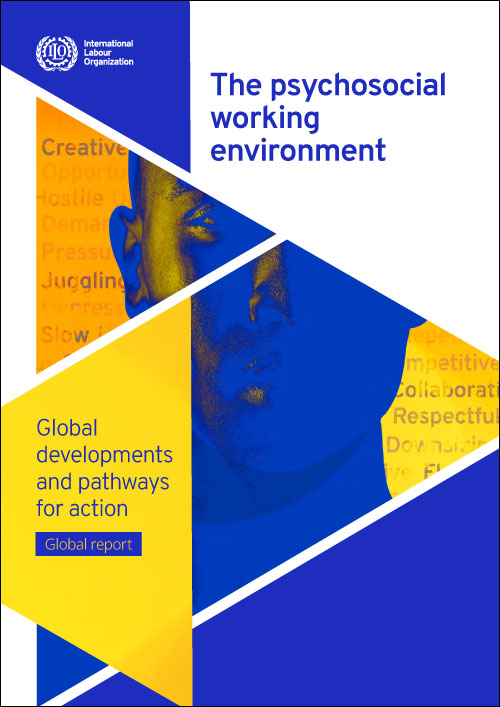
The report, The psychosocial working environment: Global developments and pathways for action, highlights the growing impact of how work is designed, organized, and managed on workers’ safety and health. It warns that psychosocial risk factors—including long working hours, job insecurity, high demands with low control, and workplace bullying and harassment—can create harmful working environments if not properly addressed.

Read more on the ILO webpages

Global: Psychosocial hazards at work – Hazards magazine poster for International Workers’ Memorial Day

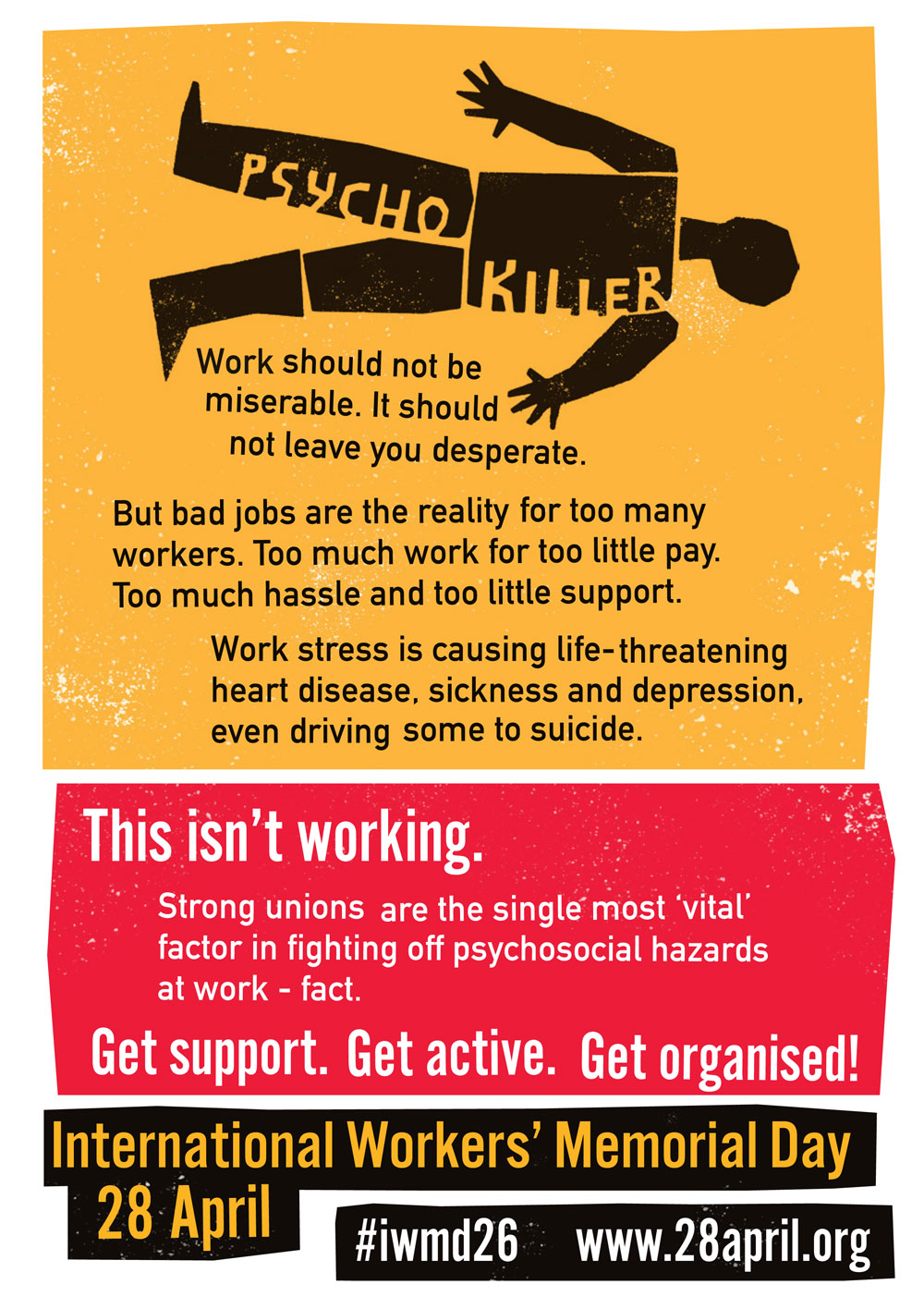
Psycho killer
Work should not be miserable. It should not leave you desperate…

Get support. Get active.
Get organised!

Download the poster from Hazards Magazine here

Hazards webpages

USA: NCOSH one worker dies every 104 minutes – ‘Dirty Dozen 2026’ exposes companies putting workers at risk

One Worker Dies Every 104 Minutes: National COSH Dirty Dozen 2026 Exposes Dangerous Companies Putting Workers at Risk 

  • New report released during Workers’ Memorial Week highlighting preventable workplace hazards and calls for urgent accountability.
  • Latino, immigrant, and Black workers disproportionately face dangerous conditions, exploitation, and barriers to workplace protections.
  • Released amid a sharp drop in workplace health and safety enforcement, as federal penalties decline 47 percent in 2025.

Los Angeles, CA – On April 22, marking the beginning of Workers’ Memorial Week—observed this year from April 22 to April 29—the National Council for Occupational Safety and Health (National COSH) has released its 2026 Dirty Dozen report, identifying twelve companies that have put workers’ lives at risk through unsafe practices, inadequate protections, and systemic neglect. The report comes as federal workplace health and safety penalties drop nearly 45 percent during the current administration, according to Good Jobs First, raising alarm about declining enforcement just as preventable deaths, injuries, and illnesses continue across the country. The Dirty Dozen underscores the urgent need for stronger enforcement and corporate accountability.

“Every year, we honor workers who have lost their lives on the job, and every year, we see the same pattern: companies prioritizing profit over people,” said Jessica E. Martinez, MPH, Executive Director of National COSH. “The Dirty Dozen 2026 makes clear that these tragedies are not accidents, they are the result of choices. Employers must be held accountable, and workers must be empowered to speak out without fear.”

Across industries, the report documents recurring corporate failures that placed workers at risk,  including extreme heat, hazardous machinery, toxic chemicals, wage theft, retaliation, and exploitative labor practices. Weak enforcement, reflected in a 47 percent drop in workplace health and safety penalties in 2025, and complex subcontracting systems allow companies to evade responsibility while workers bear the consequences.

The Dirty Dozen 2026 includes the following companies, listed in alphabetical order:

  • Alliance Ground International: Repeated safety violations, unsafe equipment, and worker mistreatment allegations.
  • Cambria Company, LLC: Engineered stone products linked to deadly silica disease.
  • CommonSpirit Health: Unsafe staffing, workplace violence, and labor concerns impacting care.
  • Consolidated Catfish Producers, LLC: Amputations, machine hazards, and dangerous indoor heat.
  • D.R. Horton, Inc.: Repeated safety violations and hazardous construction jobsite conditions amid ICE enforcement actions.
  • Hyundai-Kia U.S. Supply Chain: Worker deaths, child labor findings, and subcontracted exploitation.
  • Jeny Sod and Nursery: Wage theft claims, heat risks, pesticide exposure, and housing concerns.
  • LSG Sky Chefs: Extreme heat and lack of cooling protections for workers.
  • Maker’s Pride LLC (formerly Hearthside, LLC): Amputations, child labor violations, and anti-union concerns.
  • Revoli Construction Co., Inc: Decades of trenching violations ending in fatal   collapse.
  • Subway IP LLC: Wage theft, retaliation, and labor issues across franchises.
  • Wellmade Industries MFR. N.A LLC: safety violations, labor exploitation, and trafficking investigation.

Workers directly impacted by these conditions shared powerful testimonies that underscore the human cost of unsafe workplaces.

Gustavo Reyes Gonzalez, former engineered stonecutter who worked with Cambria products and is now living with silicosis, said: “For more than a decade, I cut and polished engineered stone without knowing the dust I was breathing could kill me. By the time I was diagnosed with silicosis, my lungs were already severely damaged. No one warned me about the risks or the silica in the product. If I had known, I would have chosen a different path to protect my life.”

A catfish processing worker at Consolidated Catfish Producers, LLC, who requested anonymity due to fear of retaliation, said: “The heat inside the plant is overwhelming. By the time we reach a break, we are dizzy and dehydrated, and we don’t always have safe access to water. People get seriously injured on the machines, and others are put in their place without proper training. It feels like safety is not a priority.”

Kissy Cox, an auto manufacturing worker at Hyundai Motor Manufacturing Company, part of the Hyundai-Kia U.S. supply chain, said: “I reported my injuries, but I was still required to work in pain for months before getting proper medical attention. Many of my coworkers are going through the same thing. The company says it’s a safe place to work, but the reality does not match what we experience.”

An auto manufacturing supply chain worker employed through a subcontractor connected to the Hyundai-Kia U.S. Supply Chain, who requested anonymity, said: “We see safety violations every day, from inadequate training to dangerous conditions that put lives at risk. Workers have been injured and even killed, yet there is little accountability. We want safe jobs, not just promises.”

A food processing worker at Maker’s Pride LLC (formerly Hearthside, LLC), who requested anonymity due to risk of retaliation, said: “We are pushed to work faster and faster, often skipping water or bathroom breaks because of the pressure. People get sick, dizzy, and injured, but many do not report it because they are afraid of losing their jobs. We are treated like machines instead of human beings.”

Martinez added: “No one should have to risk their life to earn a paycheck. These workers are showing tremendous courage by speaking out.   Their voices must  shape stronger protections, real accountability, and every worker’s right to return home safe.” National COSH calls on policymakers for stronger workplace protections, increased enforcement resources, accountability across supply chains, federal health protections, and safeguards against retaliation when workers speak out.

Dirty Dozen 2026 report
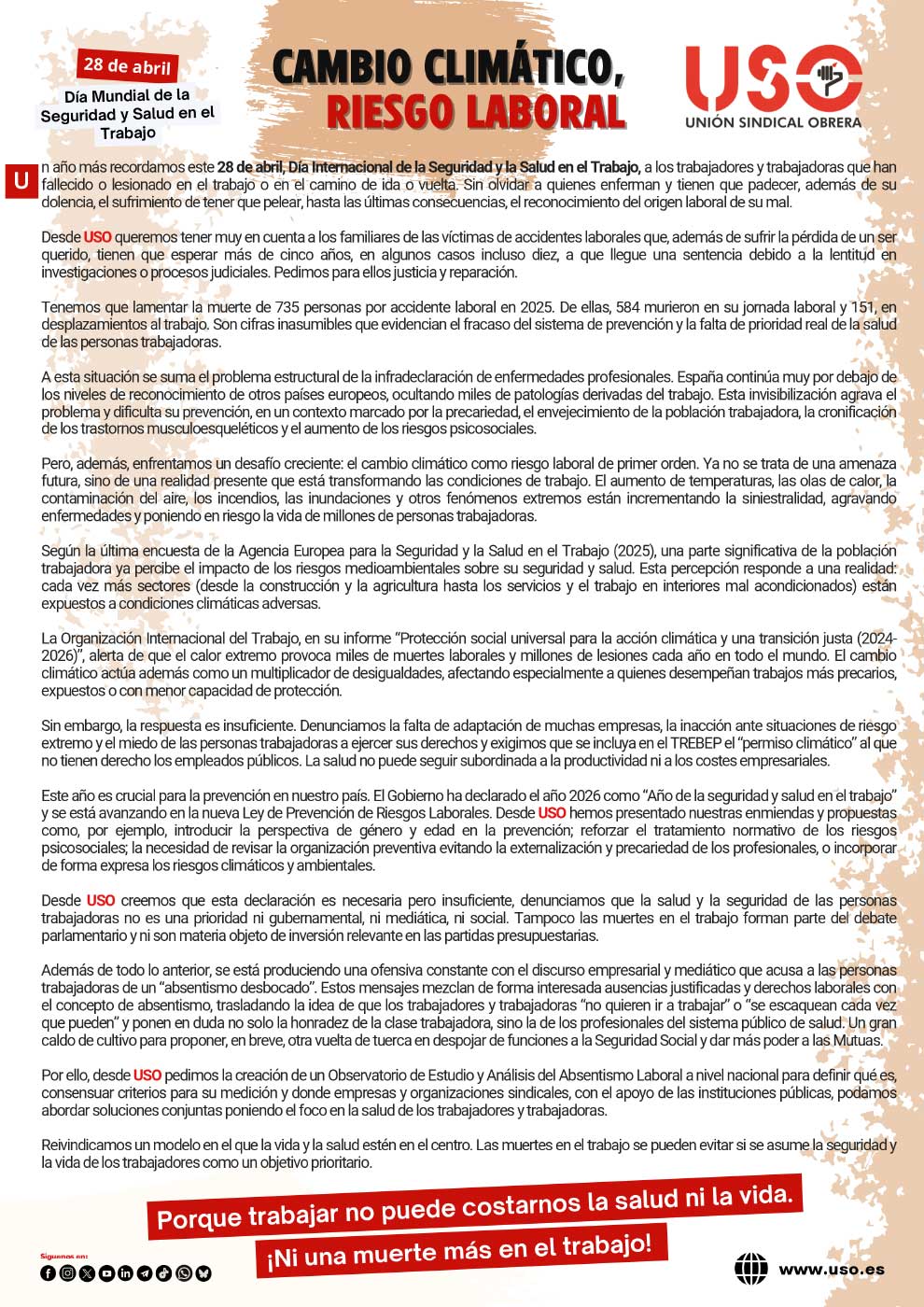
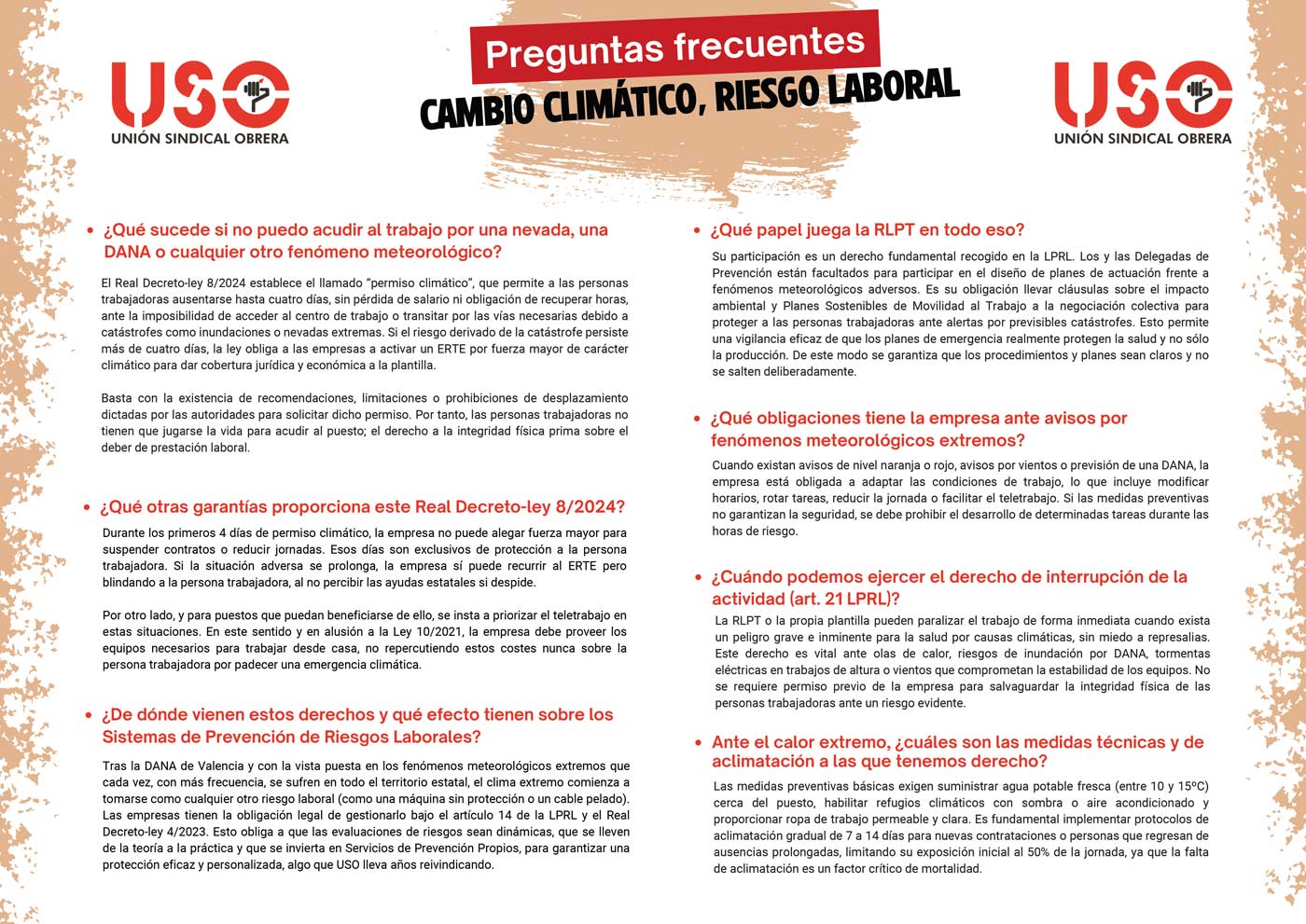
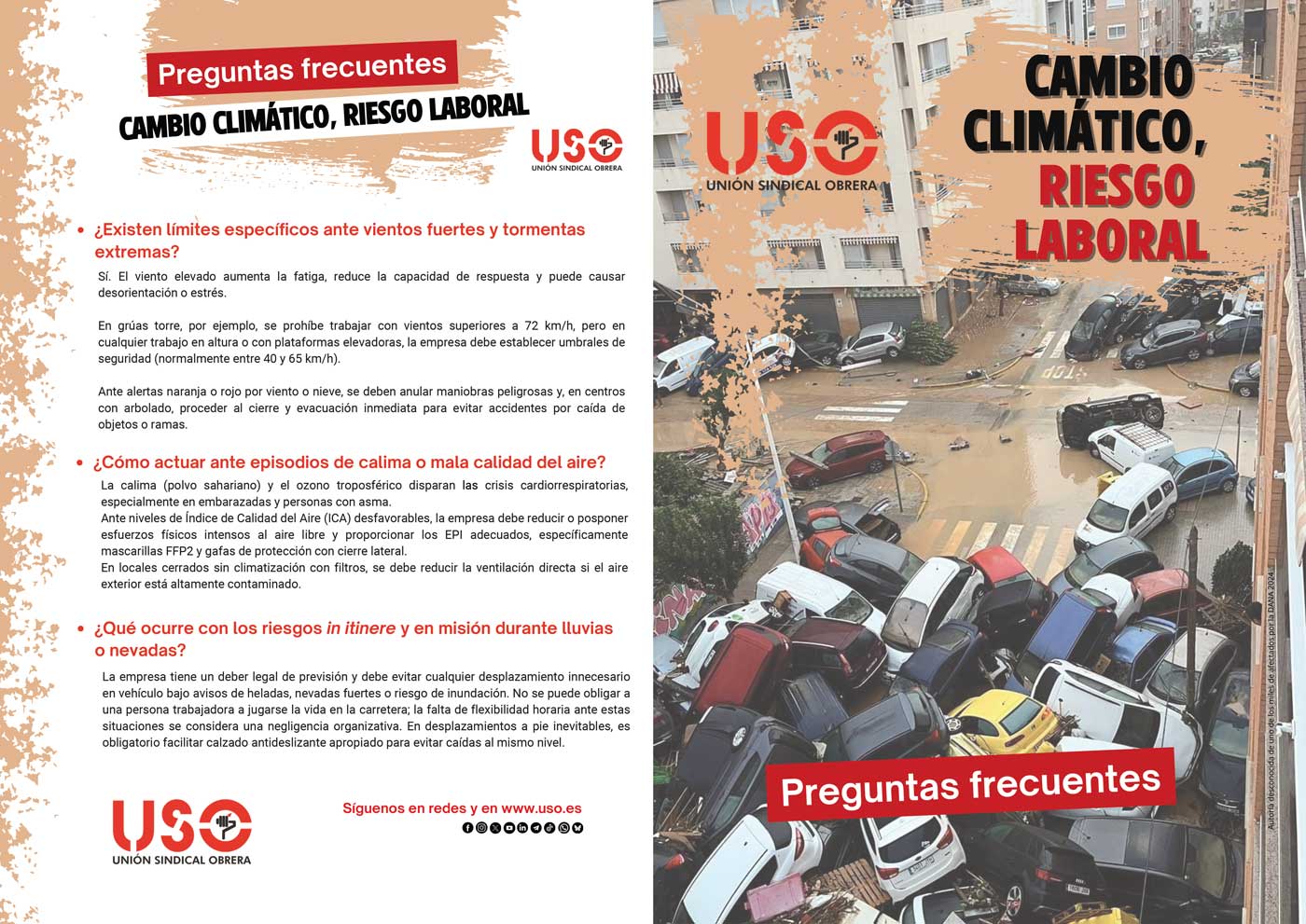
Spain: USO 28 april resources show climate change is a workplace risk

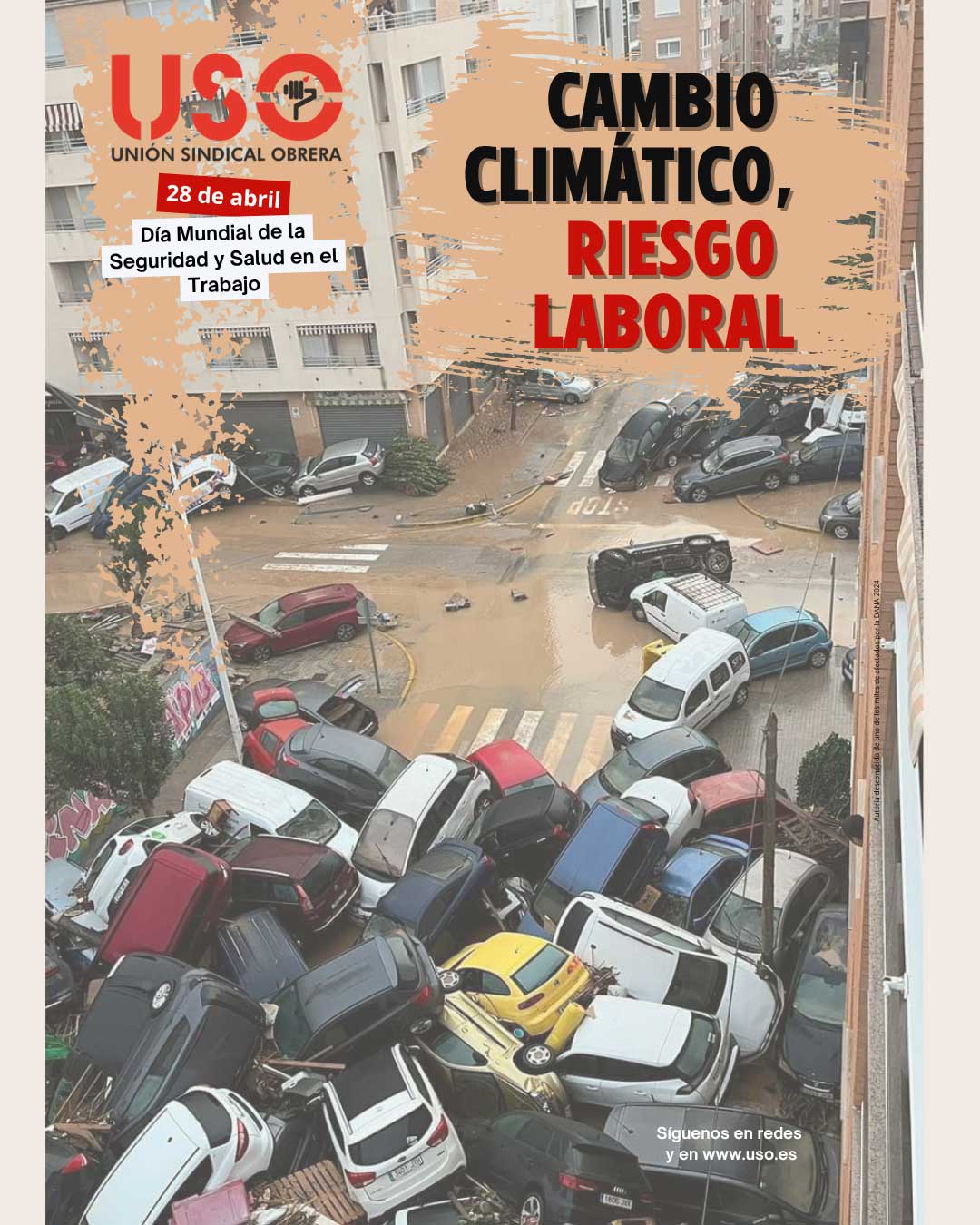
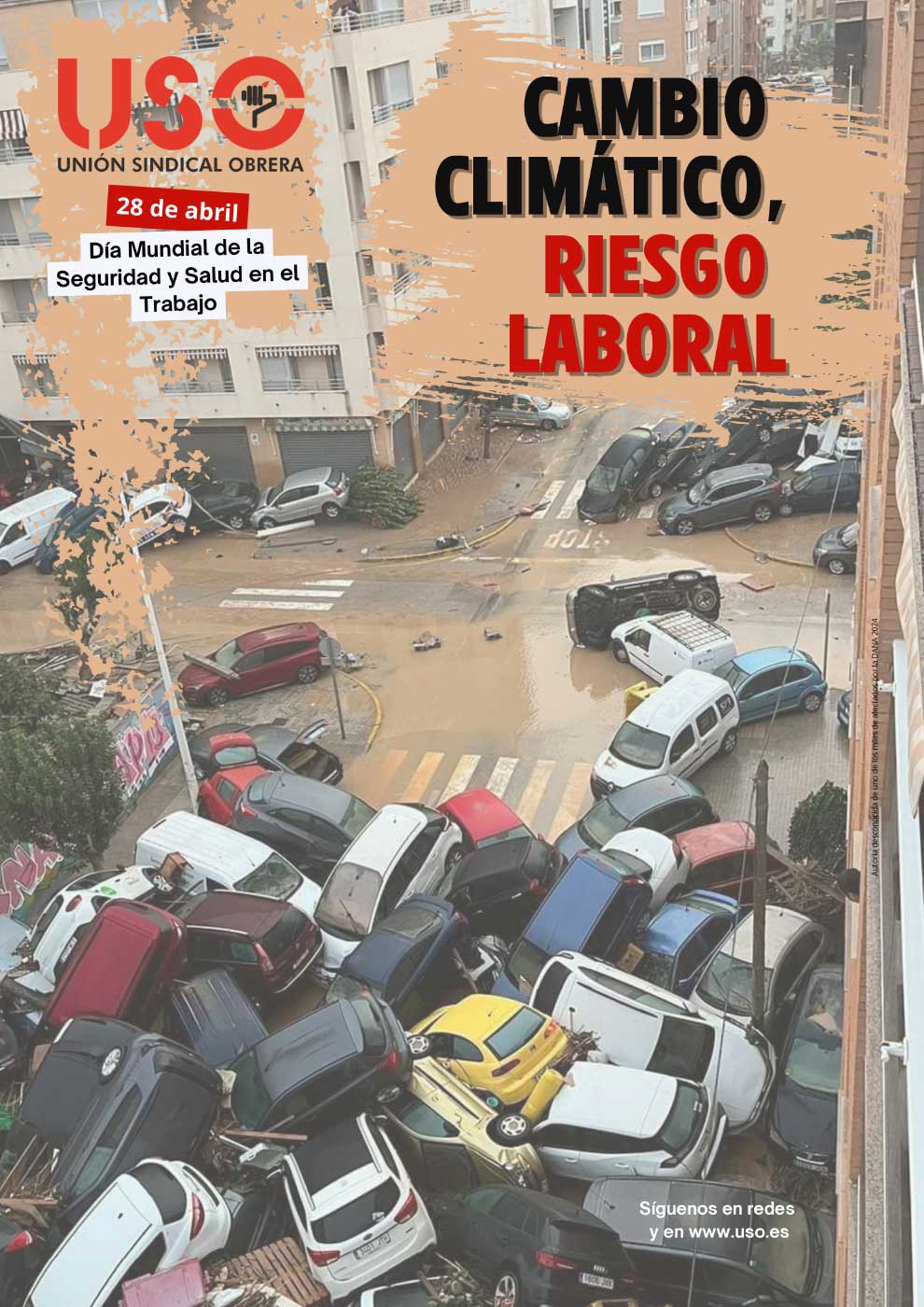
Te envío nuestra campaña de este año, centrada en que el cambio climático es ya un riesgo laboral. En este sentido, reivindicamos espacios de trabajo seguros ante los fenómenos meteorológicos adversos cada vez más frecuentes y el cambio climático.

En los últimos años estamos asistiendo a un cambio en los patrones climatológicos que, más allá de veranos más largos o inviernos más cálidos, afecta directamente sobre el entorno y las condiciones de trabajo. La DANA de Valencia, los incendios del 2025 o la borrasca Filomena nos han demostrado que las condiciones ambientales también afectan directamente a la seguridad y la salud en el trabajo.

Por ello, desde USO consideramos imprescindible poner en el foco datos, estadísticas, estudios y análisis que, ante el próximo Día Mundial de la Seguridad y la Salud en el Trabajo, evidencian esta nueva realidad laboral. Mientras las empresas mantienen una actitud reactiva y las instituciones avanzan con marcos normativos en fase de desarrollo, la siniestralidad vinculada al clima exige una intervención inmediata.

Los materiales de esta campaña son:

·  Manifiesto y cartel
·  Díptico en formato Preguntas Frecuentes dirigido a trabajadores y trabajadoras.

Un abrazo


USA: New York memorial to mark 28 April

A memorial to mark Workers’ Memorial Day will be held in New York City on Tuesday 28 April 2026 at 12 pm at 345 Park Avenue. It is presented by New York Committee for Occupational Safety and Health (NYCOSH) together with AFL-CIO affiliate New York City Central Labor Council. 

Workers’ Memorial Day commemorates workers who have died, been injured, or made ill because of their jobs and is observed internationally by labour organisations and workplace safety groups.

Global: Call to action – International Workers’ Memorial Day 2026 – BWI

International Workers’ Memorial Day 
28 April 2026 
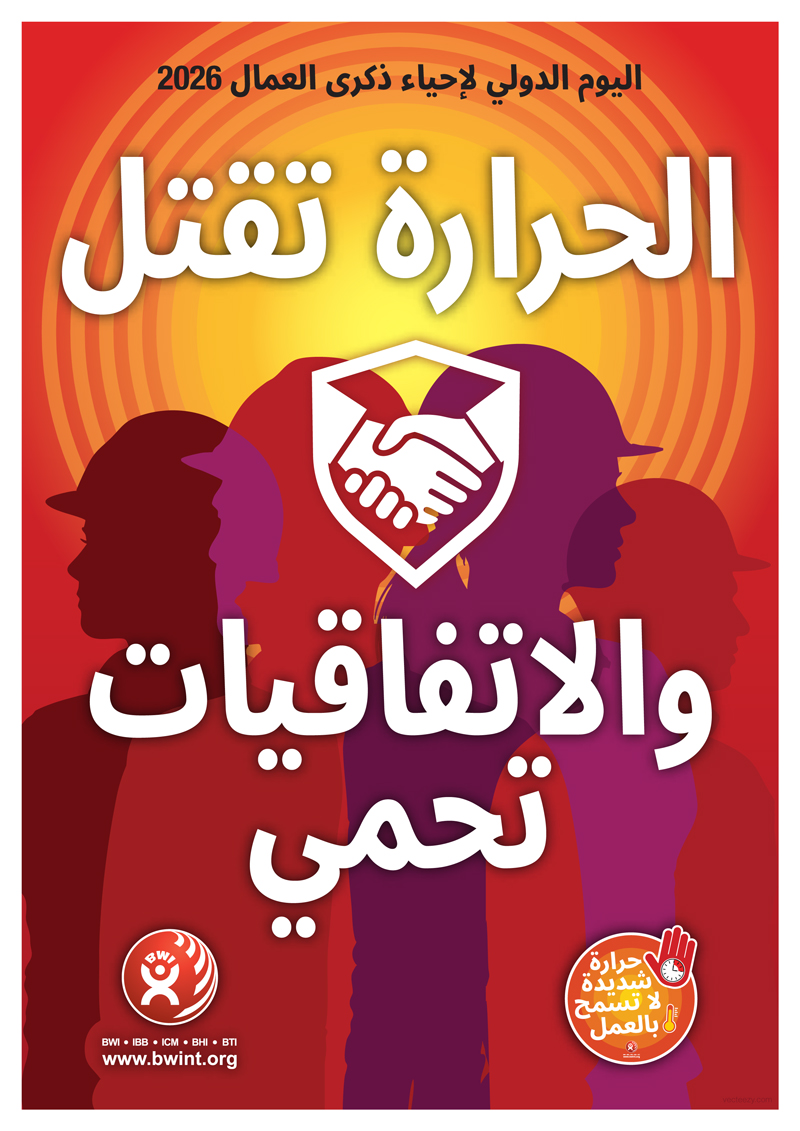
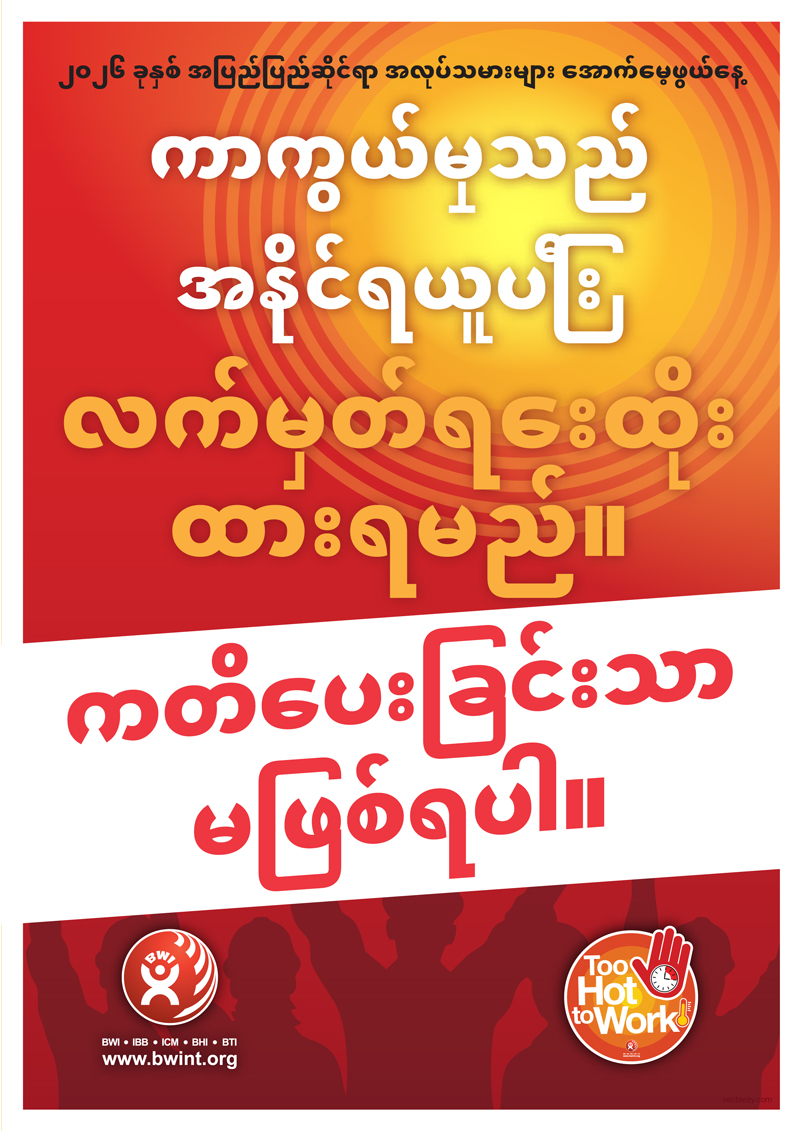
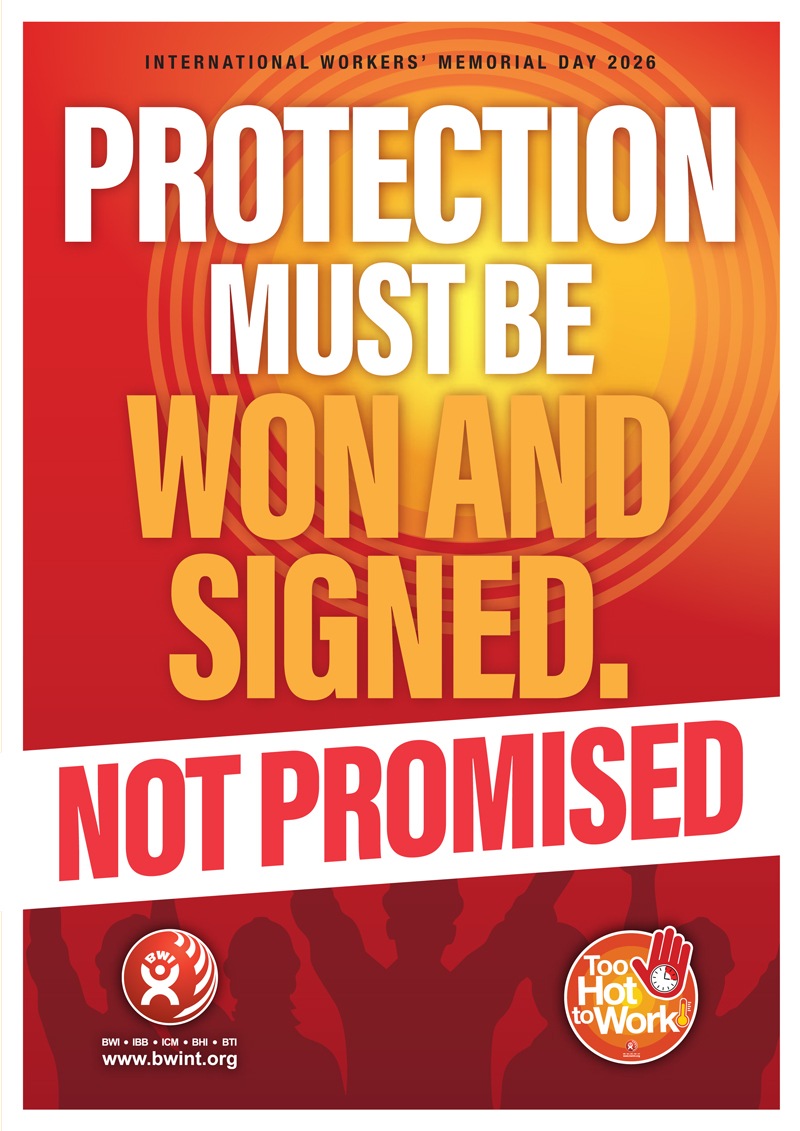
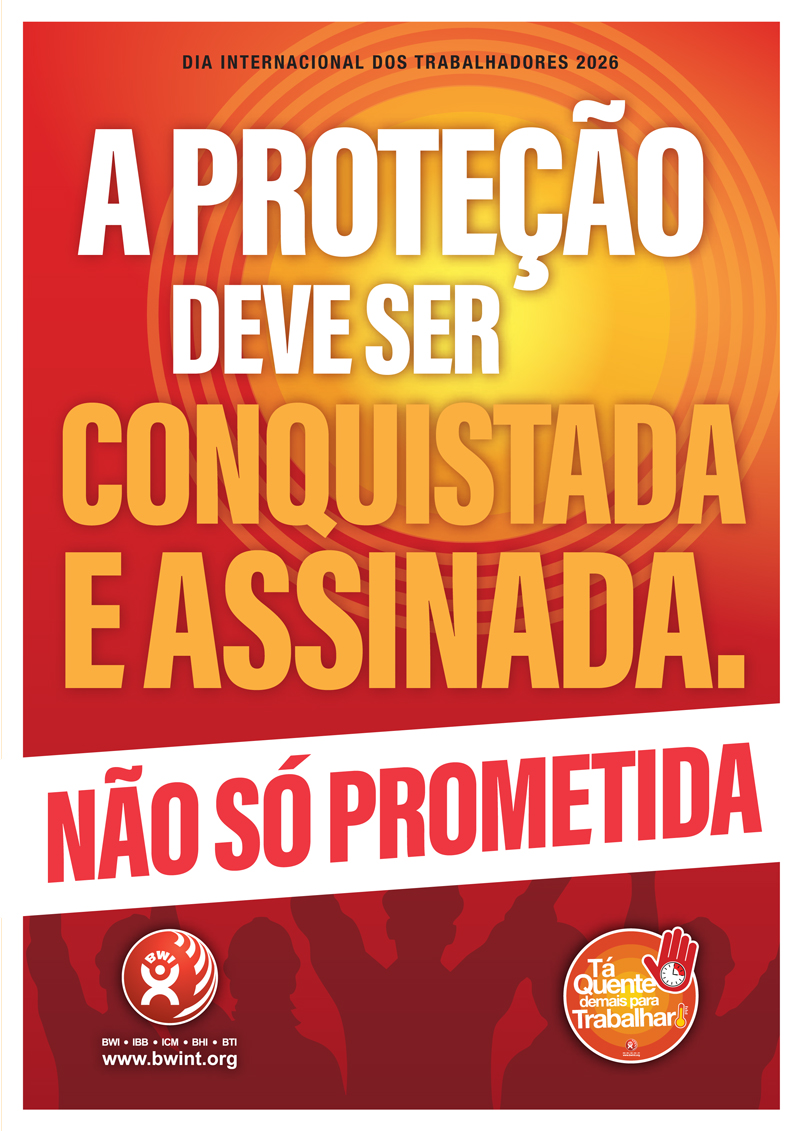
Intensifying the “Too Hot To Work Campaign”  
From Awareness to Agreements 

On 28 April, International Workers’ Memorial Day, BWI fights for the living and remembers those we have lost.

In 2026, we are intensifying our global Too Hot To Work Campaign while confronting the growing impact of extreme weather events on workers.

Heat stress is no longer a seasonal issue. It is a structural occupational hazard driven by climate change, unsafe production targets, and weak enforcement. At the same time, workers face escalating exposure to extreme weather, heatwaves, storms, floods, wildfires, and unpredictable climate conditions, which threaten their safety and lives. In 2023, the World Health Organisation (WHO) estimated that 250,000 additional deaths would occur each year by 2030 due to climate change. In 2024, the International Labour Organisation (ILO) report said that at least 2.41 billion workers – 71 per cent of the working population – are exposed to excessive heat, resulting in 22.85 million injuries and 18,970 deaths annually.

Workers in construction, building materials, forestry, and related sectors are paying the price.

This year, our priority is clear: move from awareness to enforceable protection.

Affiliates are encouraged to push for binding commitments, including:

  • Collective Bargaining Agreements with heat and climate risk clauses
  • Sectoral or national framework agreements
  • Legal and regulatory reforms
  • Company-level heat and climate protection plans
  • Joint declarations with employers

Where agreements already exist, promote them and use them as models.

Where protections are weak or absent, push for new signatures and stronger commitments.

BWI and its affiliates call for protections that guarantee:

  • The right to stop work in extreme heat or dangerous weather without retaliation, through set maximum temperature limits that account for weather conditions and humidity levels.
  • Paid cooling breaks and adjusted working hours
  • Access to water, shade, ventilation, and protective measures appropriate to weather risks
  • Mandatory heat and climate risk assessments
  • Emergency preparedness and evacuation procedures
  • Income protection when work is halted due to unsafe climate conditions
  • Compensation and long-term support for affected workers

Heat stress is predictable. Climate risks are escalating. Deaths are preventable.

No worker should depend on goodwill. Protection must be written, signed, and enforceable.

Take Action

  • Secure or strengthen agreements
  • Publicise existing CBAs or joint agreements with heat and extreme weather protections
  • Initiate negotiations where no protections exist
  • Mobilise and train workers
  • Conduct toolbox talks and training on heat stress and climate risks
  • Equip safety representatives to identify climate-related hazards
  • Engage governments
  • Push for legally binding national standards and social protection schemes addressing heat and extreme weather risks
  • Call for integrating climate protection into national OSH and adaptation policies.

Share Your Agreements & Action. Showcase union power in action.

Send BWI:

  • Signed agreements
  • Joint declarations
  • CBA clauses
  • National legal commitments
  • Photos and videos from events or mobilisations

Share with your regional coordinator, and your actions will be featured on www.28april.org 

Download IWMD posters.  

#TooHotToWork #IWMD26 #BWI

USA: AFL-CIO 28 April resources available now!

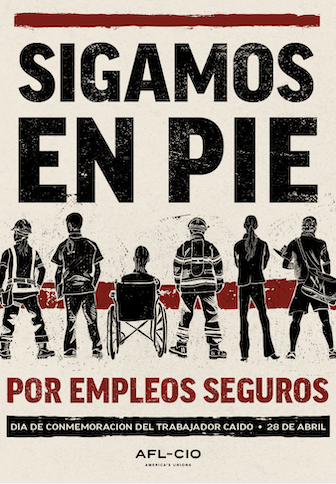
The AFL-CIO’s Workers Memorial Day’s web page in now live, which means you can download stickers, posters and fliers in English and Spanish.

You can also download a toolkit, which includes some important fact sheets and information on deregulation and worker safety and health, the Trump record, etc. There are some English and some Spanish sections to the toolkit. Descargue el Kit de Herramientas (Ingles / Espanol)

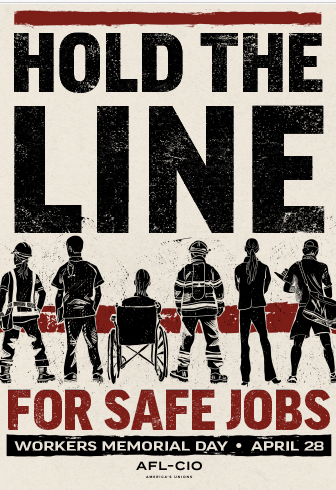
This year we will HOLD THE LINE FOR SAFE JOBS/SIGAMOS EN PIE POR EMPLEOS SEGUROS. “Mourn for the Dead, Fight for the Living” stickers are also available.

We are pretty excited about the theme and the artwork this year. State feds/CLCs, faith groups, other community groups and others have already placed orders.

Rebecca Reindel

OHS Director, AFL-CIO